Died
11th & 12th May 1930
Aged 27 & 2½ years
Born
1903 & 1927
Sources
Barrow News
Place
Walks
Themes
John & Joan Fletcher
NB They actually died on the 11th & 12th respectively, contrary to what it says on the gravestone. A memorial to a tragic motorcycle accident which resulted in the deaths of a young father and his toddler daughter.
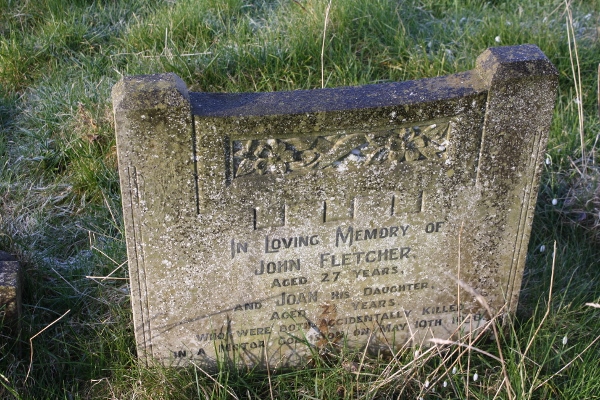
IN LOVING MEMORY OF
JOHN FLETCHER
AGED 27 YEARS
AND JOAN HIS DAUGHTER
AGED 2½ YEARS
WHO WERE BOTH ACCIDENTALLY KILLED
IN A MOTOR COLLISION ON MAY 19TH 1930
Barrow News 17 May 1930MOTOR-CYCLE FATALITY VICTIMS
DOUBLE FUNERAL AT BARROWHundreds of people gathered in Frederick-street, Roose-road, on Thursday to witness the funeral of the late John and Miss Joan Fletcher, both of whom were killed in a motor-cycle collision on Creep Hill, Haverthwaite1, on Sunday evening. The funeral started from the home of the father of the deceased man, Mr. J. Fletcher, 24, Frederick-street. Then the coffins were carried from the house to Roose-road United Methodist Church, the seating capacity of which as sorely taxed. The Rev. A. S. Nash conducted a brief service in the church, after which the coffins were placed side by side in the motor hearse and the cortege moved off for Rampside Cemetery. There the Rev. R. J. Fletcher preformed the last rites at the graveside. The father’s coffin was of pitch pine, with brass mountings, and the child’s pitch pine, with xxxx mountings. The bearers of the father’s coffin were all fellow workmen. A large number of floral tributes covered both coffins and the motor hearse.
The chief mourners were:- Mrs. Fletcher, widow; Mr. and Mrs. J. Fletcher, father and mother; Mr. J. Fletcher, jun., and Doris Fletcher , brother and sister; Mr. and Mrs. G. Hornebrook2 (Morecambe), uncle and aunt; Mr. and Mrs. J. Murray, uncle and aunt; Mr. and Mrs. G. Fletcher, uncle and aunt.
Mourners present included: Coun. and Mrs. Waddington; Mr. and Miss Harper, representing the Pulp Works; and Ald. J. xxx (district secretary), ex-Ald. J. xxsell (chairman), and Mr. A. Pratt (secretary), representing the Amalgamated Engineering Union, of which the deceased was a member. The funeral arrangements were carried out by Mr. W. J. Fox.
NB The article is on the extreme edge of a page, an unreadable in parts – represented by xxx.
Elsewhere in the same edition (17 May 1930) was a lengthy report, covering four columns, of the inquest:
TRIPLE MOTOR FATALITY INQUEST
Eye Witness’s Graphic Account of Collision
TERRIFIC IMPACT: DRIVERS’ SHOCKING INJURIES
Coroner’s Searching Analysis of Evidence
A graphic account of the circumstances in which three Barrow lives were lost in a motor-cycle collision at Creep Hill, (As far as I can make out, this is to the left (leaving Barrow) of the cutting on the Haverthwaite by-pass, where the railway crossed the old road on a bridge.) on the road from Ulverston to Haverthwaite, on Sunday evening, was given at the inquest on Tuesday afternoon, which the Coroner for Furness, Mr. F. W. Poole, conducted at Ulverston Police Court, when he had the assistance of a jury.
The witnesses included a motorist who had the motor-cycle combination driver, John Fletcher, aged 27, under observation for some time before the collision, both travelling in the same direction; and a motor-cyclist who had been in company with Harold Price coming in the direction of Ulverston some little while before the fatal crash.
It will be fresh in the memory of readers that John Fletcher took his wife and child Joan, aged two years, for a spin on Sunday afternoon, and at Creep Hill a collision occurred with a motor-cycle driven by Harold Price (aged 23), of 33, Ramsden-street, Barrow.
Fletcher, whose home was at 27, Provincial-street, Barrow, received such terrific injuries that death was almost immediate, but Price lingered for several hours in the Ulverston Cottage Hospital. Mrs. Fletcher was thrown into the roadway, but was the least injured of the quartette, (sic) and her baby died in the North Lonsdale Hospital on Monday afternoon.
Mr. T. A. Morgan, solicitor, of Barrow, appeared for the relatives of the dead man Price, and Sgt. Crapper was present on behalf of the police authorities.
DEAD WHEN ADMITTED
The first witness, Miss Frances Jones, matron at the Ulverston Cottage Hospital, stated that the deceased Price was admitted to that institution on Sunday afternoon the 11th inst., between five and six o’clock, suffering from serious injuries. He was unconscious, and never regaining consciousness, died at 4 a.m. on the 12th. The deceased Fletcher was dead when brought in.
The Coroner read the evidence of Dr. Hughes, house surgeon at the North Lonsdale Hospital, taken at Barrow, which stated that the deceased child, Joan Fletcher, was admitted on the 11th inst., and died the following day at 10 a.m.
Alfred Price, labourer, gave evidence that the deceased Harold Price was 23 years of age, and was a brass dresser, residing at No. 33 Ramsden-street. The deceased had ridden a motor-cycle for the last four years. Witness saw his brother in the Ulverston hospital on the 11th inst., and remained with him until he died.
Douglas Fletcher, farm servant, Moss Side Farm, Rampside, stated that the deceased, John Fletcher, was his brother. He was 27 years of age, and an engine fitter, residing with his wife and child, Joan, at 27, Provincial-street, Barrow. At about 8.30 p.m. on the 11th inst., he heard of the motor-cycle collision at Haverthwaite, and visited the North Lonsdale Hospital, where he found the child, Joan, unconscious. Witness added that his brother had been riding a motor-cycle and sidecar for the last five years.
EYE-WITNESS’S EVIDENCE
John Fell Atkinson, a foreman fitter, of 25, Hartington-street, Barrow, stated about 4.45 p.m. on Sunday, he was driving his motor-car along Kendal road, Haverthwaite, in the direction of Newby Bridge. After driving around Creep Hill Corner, he was going down the hill in the direction of the railway station. There was a motor-cycle combination in front of him for about 12 to 15 yards, but they passed him on the bend. He noticed there was a woman in the combination, and would place their speed about 20 miles per hour. The combination was travelling on the near side of the road, its own side.
In reply to the Coroner, witness stated the road surface at this point would be about 20 feet in width.
The Coroner: So that the centre of the road would be about 10 feet from the near side?
Witness: Yes.
Now in which portion of the 10 feet was the combination travelling? – About three or four feet from the wall.
So that going down the hill the driver is on the right, and the nearest to the centre of the road? – Yes.
And he would be about 12 inches from inside the centre line? – Yes.
As you approach the railway bridge going down the hill there is a bit of a dip in the road? – Yes.
Does that dip hide the view down the hill? – It might from the bottom end of the hill.
Did the motor-cycle combination proceed down and over the bridge on the same lines as you have spoken of – on the left of the centre of the road? – Yes.
MOTOR-CYCLIST ON WRONG SIDE
Did you see anything coming up the other way? – I was following him down when I saw a motor-cyclist coming from Haverthwaite, but he was then only a few yards off the impact.
On which position of the road was the motor-cyclist travelling? – On his wrong side of the road.
Was there another motor-cyclist? – Yes.
He was dead-overtaking another motor-cyclist coming in the same direction on which a pillion rider was sitting? – Yes.
This latter motor-cyclist was well on his proper side of the road? – Yes.
And there would be ample room between the latter motor-cycle and the combination? – Yes, quite room.
And the time that you first saw him he had not got up to this? – No he had not got up to the combination.
He had not reached the other bicycle but was trying to swerve out? – No he had not reached it.
Did he accelerate for the purpose of passing the motor-cycle? - He tried to swerve himself out and pull himself out, and I don’t know whether he had had a skid further down the hill or not.
What speed was he travelling at? – Forty miles per hour.
Did he appear to attempt to avoid the combination? – I think he tried to pull himself out but it was too late.
TRIED TO ESCAPE
Did you observe anything done by the driver of the motor-cycle combination which would show that he noticed this approaching cyclist? – He was just driving steady down and keeping to his side and did not seem to be upset about anything.
Did he do anything? – He tried to pull in.
To endeavour to get nearer to the side? – He had room to pull further in, and he endeavoured to do so, but the impact was so sudden he had very little chance.
You were close behind this combination; did you take any steps to avoid running into them? – The steps I took were to apply my brakes and then the impact occurred. As the impact occurred it all went up in the air and it left me space to run down. The woman was lying across the road and in order to avoid running over her legs I skidded into the side of the wall and stopped within a few inches of her.
Was that on your left hand side? – Yes, on my left hand side.
There was a considerable space, then, between the combination and the wall? – Very little. I had a job to squeeze through that part of it and I was jammed to the wall and this damaged my car, the width over all of which is five feet.
You conveyed the woman and the baby to Backbarrow Police Station? – Yes. The woman was in a semi-conscious state for the time being; but regained consciousness later.
Questioned by Mr. Morgan: The combination passed you on the bend? – Yes.
And at that time you say he was about 12 inches from the side of the road? – Yes.
But he drew out after he had passed you? – He was endeavouring to draw in the further he got past.
Then there was the cyclist to meet him with a pillion rider, and behind that again the deceased, Price? – Yes.
LYING ACROSS THE ROAD
The impact, you say, threw Mrs. Fletcher to the left? – Yes.
And you were endeavouring to pass between the left-hand wall and the damaged motor-cycle? – Yes. And Mrs. Fletcher was lying with her legs across the road, right in the road of my car.
Would not the combination be in the middle of the road? – According to my view the impact swerved it round.
The combination might have been nearer in before the impact than afterwards? – Yes.
The next witness was the driver of the motor-cycle referred to, Norman Gaskin, 55, Cheltenham-street, Barrow, who stated that about 4.55 p.m. on the date in question he was driving his motor-cycle in the direction of Greenodd with a pillion-rider, and had been in company with the deceased, Harold Price, whom he had left at Newby Bridge. Coming up the hill he was travelling on his own side at a speed of approximately 25 miles per hour.
The Coroner: As you were travelling did you hear Price’s machine coming behind you? – It seemed to come all at once, sir.
How far on your offside? – Practically on the crown of the road.
What speed was he travelling? – A fast speed, but he was behind us.
He was travelling a good deal faster than you? – Yes, sir.
This photo, with the crash site marked by a cross, appeared in the Barrow News on 17 May
Before he got alongside did you notice the motor-cycle combination coming down the hill? – Yes, sir.
So that when Price got alongside you he could see the motor-cycle as well? Price never came level with me. He was just slightly to the rear.
Slightly to the rear when the impact took place? – Yes, sir.
WENT TO RENDER ASSISTANCE
On which part of the road was the combination travelling? – The driver of the combination was on the crown of the road.
You would not see this motor-combination until it was about how far away from you? – About five to ten yards.
And almost immediately the combination passed you, you heard the crash? – Yes, sir.
Witness stated that he applied his brakes, and after putting his cycle in the hedge, went back to render assistance, and found the deceased man Fletcher lying on the ground, and Price on top of the machines with his head near the back wheel of the combination. Both men were unconscious. With assistance, he got the two men to the roadside, and a constable arrived shortly afterwards.
Mr. Morgan: Did I understand you to say that immediately you saw the combination it was travelling plumb on the centre of the road?
The Coroner (interposing): The driver was plumb on the centre of the road.
Mr. Morgan: After the accident the cycle combination was about a foot off the centre of the road, on the left-hand side facing towards Newby Bridge?
Witness: Yes, sir.
I suppose had Price had time he might have got further over to his left-hand side? – Yes.
The Foreman: Would there be sufficient room for the motor-cyclist to pass between you and the motor-cycle and side-car?
Witness: Yes.
PILLION RIDER’S ESTIMATE OF SPEED
Ernest Carter, a shop assistant of 22, Marsden-street, Barrow, the pillion-rider on the machine driven by the last witness, described how he looked round on the hill and saw the deceased, Harold Price, approaching on his cycle at a speed he estimated to be about 40 m.p.h.
In reply to the Coroner, he stated that Price was riding about 2ft. on the wrong side of the centre of the road. He saw the combination descending the hill on its own side of the road, and after the combination had passed about five yards, there was a crash. He did not actually look round until their machine had stopped, when he went down the road and saw Fletcher lying alongside his machine, and Price on top of the wreckage. Price’s motor-cycle was locked between the cycle and side-car. He noticed Mrs. Fletcher lying in the road about six yards away.
P.C. Rothwell, stationed at Backbarrow, described being called to the accident by Mr. Atkinson at 4.50p.m. on Sunday. He ‘phoned for the ambulance, and accompanied Mr. Atkinson to the scene of the accident. He found the deceased men, Fletcher and Price, lying unconscious by the near side of the road, and rendered first-aid, but Fletcher died within a few seconds of witness’s arrival on the scene. The motor-cycle combination and the solo machine were wedged together, and it took several men to get them apart. Price’s injuries were a fractured left leg, a fractured wrist, and a fractured jaw, and Fletcher had sustained a fractured leg (which was almost severed) and severe concussion. Dr. Penny arrived about 5.30, and examined the men. Witness examined the road, and found a skid mark 55ft. long commencing 25ft. from the Greenodd side of the Bridge and continuing beyond the centre of the bridge to within six inches of the near side edge on the tarred surface of the road. The width of the road at the point was about 20ft., and there was a pool of blood and oil 5ft. from the near side edge, which he took to be the scene of the impact. There were no skid marks on the Newby Bridge side.
Describing the damage to the machines, the wheels and forks of which were badly smashed, the officer said the sidecar was almost severed from the cycle.
The Coroner: Can you tell us anything about the gears?
Witness: The combination was in second gear, and the solo in top gear.
THE CORONER SUMS UP
The Coroner, addressing the jury, said that was a very sad calamity indeed. Three lives had been thrown away through, he was afraid looking at the evidence, the negligence of one or other of the drivers of these motor-cycles. To start with, they all knew this Creep Hill and the descent down into Haverthwaite Village. Apparently the dead man, Fletcher, was driving a motor-cycle combination, and accompanied by his wife and daughter, they were travelling from Greenodd to Haverthwaite. As they were rounding the bend which is known as Creep Hill, they passed a motor-car driven by the witness Atkinson. Passing this motor-car in that position threatened to throw them over the crown to the left-hand side of the road, and the witness Atkinson told them that after passing them, the combination travelled down the hill in the direction of Haverthwaite practically on the crown of the road, but, as he said, easing in towards the left-hand side.
At that point, apparently for a matter of 100 yards the driver of the combination would be able to see down the hill, but although he could see anything coming 100 yards away, the bridge at a certain point would interfere with anything coming about 25 yards away as there was a bit of a dip.
“There is no necessity (continued the Coroner) for the driver of the vehicle, immediately after he has passed the other vehicle, to get on the left hand side of the road if the road is clear, and what he was doing quiet (sic) properly, he was quietly getting more on to the left hand side of the road. Anyhow it appears from what one witness has stated, the driver of the combination was plumb on the crown of the road. The other witness states that he was about a foot on the left of the crown of the road, which is practically the position Mr. Atkinson puts it. There is on the other side the motor-cycle driven by the witness, Gaskin, coming and immediately behind and almost level with him is the motor-cycle driven by the deceased man, Price. The first is travelling about 25m.p.h. and Price at a very much higher speed, leaving about eight feet between the motor combination and the machine described (as) ample width for the driver of Price’s machine to pass safely through if he had control of it. Almost immediately there is a crash behind, and these men go back and they find that the machine driven by Harold Price is locked between the combination and the motor-cycle, showing that it had been driven head on into this combination with the unfortunate results you know of.
DRIVERS’ RESPONSIBILITIES
“It may be, that having regard to the fact that the drivers of both machines are dead that there is no necessity for you to seriously consider whether either, or which of them, is to blame for this fatality, but that is not the point. It is just as much your duty, when considering your verdict, if you are of the opinion that the accident or fatality was due to the negligence of either of the drivers, it is for you to say so, because if you are of (the) opinion that the fatality was caused by the culpable negligence of either, your verdict would be that the other party or parties were feloniously killed by the driver of the motor-cycle who was in fault, and the mere fact of that driver being dead would not justify you in not bringing in such a verdict as the evidence shows.
“On the other hand, if you find that the driver of the other motor-vehicle was driving in a dangerous manner and that he was as much to blame for the fatality as the driver of the motor-cycle, that would come under the position of an unavoidable accident I presume, and it would be difficult to say what the effect of such a verdict would exactly be. What I mean is that if you are of (the) opinion they were equally negligent they must be both guilty of the manslaughter of the child.
“It is for you gentlemen to consider whether there is no evidence to justify you in saying that these men were driving recklessly or dangerously or without forethought of what might be on the road, in which case you will find a verdict of accidental death.”
THE VERDICT: MISADVENTURE
The Jury retired for twenty minutes, and on returning their foremen stated that after due consideration of the case, which was a very knotty one to follow, they had decided that the accident was caused through Price losing control of his machine.
The Coroner: You are of (the) opinion that the deaths of these people were accidental?
The Foreman: Yes.
The Coroner therefore recorded a verdict that the deceased met their deaths by the driver of the motor-cycle, Harold Price, losing control of his machine and their deaths were due to misadventure.
The Coroner stated that he had been asked by the father of the deceased man Fletcher, to express his appreciation of the services rendered by P.C. Rothwell and his wife to his son, wife and child, and he personally wished to express his sympathy with the relatives in the cases. Coun. Rogers, the foreman of the jury, also expressed sympathy on the jury’s behalf.
There are a number of points of interest:
1. Language – The Coroner always uses the term ‘of opinion’ rather than the modern usage ‘of the opinion’.
2. Odd verdict: there is no evidence presented, other than an off-hand ‘I don’t know whether he had had a skid further down the hill or not.’ regarding Price’s loss of control of his motorbike.
3. According to Cumbria BMD Mrs. Fletcher’s maiden name was Hurrell. Later in 1930 she had another child, Alan John Fletcher. She must have been pregnant at the time of the accident. An Alan J. Fletcher died in 2006.
Barrow News 24 May 1930 carried news of Price’s funeral:
Barrow News 24 May 1930LATE MR H. PRICE
FUNERAL OF MOTOR FATALITY VICTIM
The funeral of the late Mr. Harold Price, one of the victims of the Creep Hill, Haverthwaite, motor cycle collision, took place on Saturday. Rev. R. H. Hawkins conducted the service in St. George’s Church, and also performed the last rites at the graveside. Mr. Broome was the organist, the choir of which deceased was at one time a member was in attendance. The family mourners were: - Mrs. Price (mother), Mrs. Eames (sister), Mr. John Price (brother), Mr. and Mrs. Harry Price (brother and sister-in-law), Mr. and Mrs. Albert Price (brother and sister-in-law), Mr. and Mrs. Alfred Price (brother and sister-in-law), Mrs. Simpson (aunt), Old Hall Beck; Mrs. Mullinder (aunt), Egremont; Mrs. Woodburn (aunt), Egremont; Mr. Jack Woodburn (Egremont); Mrs. Elliott (Egremont); Mr. and Mrs. Simpson, Old Hall Beck; Mrs. Butler (cousin), Orton; Miss Irene Taylor, (fiancée); Mrs. Houghton, Mrs. Symons, Mrs. Shuttleworth, Mrs. and Miss King and Mr. Harry Shute. The bearers were Messrs. W. Rawsthorne, G. Bull, S. Campbell, L. Bainbridge, C. Clark and G. Lillie. The funeral arrangements were carried out by Mr. W. J. Fox.