George Francis Driver
Yet another victim of an industrial accident. While some accidents are mentioned on the memorial stone, many will have no stone, or the manner of death will not be recorded.
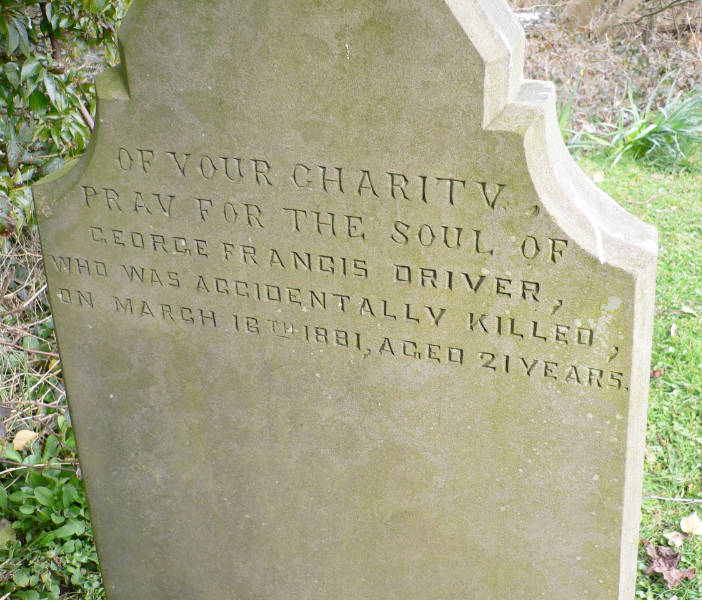
25 March 2013
OF YOUR CHARITY
PRAY FOR THE SOUL OF GEORGE FRANCIS DRIVER
WHO WAS ACCIDENTALLY KILLED ON MARCH 16TH 1881,
AGED 21 YEARS
Where is the grave?
Go past the Catholic Chapel to the furthest possible point, then turn right onto the grass. The stone is next to the hedge.
The Barrow Herald Saturday March 19 1881 reported:
Barrow Herald, Saturday March 19 1881A MAN KILLED AT BARROW
On Wednesday last a sad and fatal accident took place in Mr. Charles’ siding at the Furness Railway Company whereby a young man named George Francis Driver, a stoker, was run over by an engine whilst shunting some wagons, which caused his death.
An inquest was held on the body yesterday, before Mr. John Poole, coroner, Mr. Messenger, Dalton-road, being the foreman of the jury.- John Driver, 5, Egerton Buildings, assistant engineer, said that deceased was his son, and was 20 years of age, and resided with him. He was a fireman in the employ of the Furness Railway Company. He had not seen the deceased previous to the accident, but saw him after he was killed.
– John Moore, 6, Lower Lumley-street, said that he was an engine-driver. He knew the deceased who was working with him as fireman, on the 16th, on the same engine. They were shunting in Charles’ Yard, near the docks, about 6.40. They had been at work since half- past five in the morning. At the time of the accident they had seven empty and five full wagons attached to the engine. They went in to attach the laden wagons, and also the empty ones that were in the same row. The rails being greasy the engine would not fetch them out. There were a pair of points at the place where the accident occurred to the deceased. Witness said, “George, get off and hold the points and we will have another try.” He got off to do so and they went down the same road again in order to bring them out, and at the time of doing this the accident happened. After passing the place where the deceased was he heard someone cry out. He at once reversed the engine and went across the footplate to apply the brake, but the guard had got hold of it before him. Witness got off to see what was wrong and saw the deceased lying under the wagon adjoining the engine. Deceased told him that his arm and his leg had been run over. They conveyed him on a board to the hospital immediately afterwards.
- John Kemp, 19 Lumley-street, said that he was with deceased and last witness the day of the accident. He saw the deceased holding the points and afterwards making a spring to get on the engine. Before doing so he was standing beside the point whilst the engine was passing. He could not say whether his foot slipped or the point handle caught him. He fell down, and the engine wheels passed over him.
- By the Coroner: It was usual to get on whilst the engine was in motion. The speed was between 10 and 12 miles per hour.
- By the Foreman: It was not necessary for him to get on to the engine, as the train was coming down the next line. He would have stopped him if he thought he intended getting on. He was only set on that duty on Monday morning.
- By Mr. Cook: He had been an occasional fireman for a considerable time.
- Dr. L. P. Booth, surgeon at the hospital, said that deceased was admitted at half-past seven on the date named, and died from his injuries about half-past twelve o’clock. Deceased had received a fracture to both thighs, and a compound fracture of left leg and right shoulder.
- Mr. Forrester said that, as a member of the jury, he would like to hear something further in reference to the greasy state of the rails, as described by the engine driver.
- The engine driver, on being re-called, said that he only referred to the effects of the rain, which made the rails slippery.
- The Coroner, in summing up, said that it was evident to all that the deceased by want of caution had contributed to what had happened, as there was no apparent necessity to go on to the engine at the time he had done, and the cause f his death was purely accidental.
- The jury brought in a verdict of “Accidental Death”, and exonerated all connected with the accident from any blame.