Died
14 January 1898 - William
17 April 1911 - John
Born
c1870 - William
c1878 - John
Sources
Ancestry
Geddes "Burlington Blue-Grey" 1975
Barrow News
Place
Themes
Walks
The Denney Brothers
I am still searching for information about William’s accident.
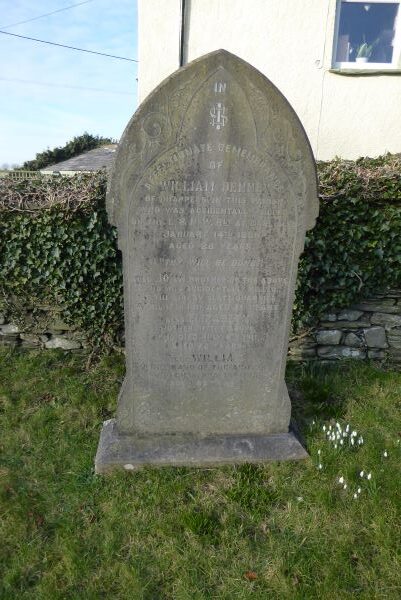
IN
AFFECTIONATE REMEMBRANCE
OF
WILLIAM DENNEY
OF CHAPPELS IN THIS PARISH
WHO WAS ACCIDENTALLY KILLED
ON THE L. & N. W. RLY AT CARLISLE
JANUARY 14TH 1898
AGED 28 YEARS.
“THY WILL BE DONE”
ALSO JOHN, BROTHER OF THE ABOVE
WHO WAS ACCIDENTALLY KILLED
AT THE KIRKBY SLATE QUARRIES
APRIL 17TH 1911, AGED 33 YEARS
ALSO ELIZABETH,
MOTHER OF THE ABOVE,
WHO DIED JULY 8TH 1911
AGED 72 YEARS
ALSO WILLIAM
HUSBAND OF THE ABOVE
WHO DIED JULY 15TH 1921
AGED 82 YEARS
The Barrow News 22 April 1911 reported:
A FATALITY AT KIRKBY
A QUARRYMAN KILLED: TWO MATES INJURED
THE INQUEST AND VERDICTThe inquest on the remains of the man John Denny, who was killed the previous day whilst following his employment at Kirkby Quarries, was held at the Kirkby Institute on Tuesday afternoon, before Mr. Coroner Poole and a jury, of whom Mr. W. Minnikin was foreman. Mr. Leck, H. M. Inspector, was present, and Mr. J. Trenwith represented the company.
John Postlethwaite, Wallend, a quarryman, deposed that on the day in question he was working in the quarry along with the deceased, John Casson, and Matthew Lewis. Casson was the headman. They went to work at the place just after 8 o’clock. They were engaged blasting in the face of the quarry about 36 feet from the bottom of the quarry. They had blasted a piece of rock which had fallen, and had come back to examine the result of the explosion. About three minutes after they got back he and the other three men were standing together, when they heard something coming down. They ran away in different directions, but a piece of rock came down and caught his three companions after having broken on the ledge of an old working above them. When witness turned round he saw Casson and Lewis standing near the fallen rock, and deceased was lying on his back, quite dead.
Mr. Leck explained that the piece of rock fell from a height of about 120 feet, and the quarry was 230 feet high.
By the Coroner: There were no ambulancemen at work that morning, there not being many men at work. They lifted the deceased’s body onto a bogey.
In reply to Mr. Leck, witness said the quarry face was often inspected, but they had not been down with the ropes for some time. They could usually tell from the bottom of the quarry when something was loose. When they went to work that morning they looked up the quarry in the usual way to see that everything was right. He had worked in the quarries for three years. There was only one fall of rock at the time in question. There were always rock hands in each company, and two of the four in his company were rock hands. If they noticed a dangerous place on the face of the quarry, they tackled it themselves, and did not wait to tell the officials. The last time he inspected the place by means of a rope was about five weeks ago. That was about ten yards from the place from which the rock fell. He was not aware that any irregular times were set apart for making the inspections. There had not been much rain that morning, and, therefore, he did not expect it would have any effect on the rock after the spell of fine weather. He agreed that under ordinary circumstances rain coming after a long dry spell might have an effect. The practice at the quarries was to at once remove any loose stones they might notice in the face of the quarry. Inspections were made in accordance with the regulations each day by Mr. Jones and Mr. Boulton. It might be an improvement to have fixed days for inspection. He could not say. He was not an ambulance man himself, and had not attended the ambulance classes which were held in the village, but several ambulance men were present when they brought deceased down.
In reply to a juror, Mr. Jones said there were three stretchers at the quarries.
James Denny gave formal evidence of identification.
Wm. Bolton, inspector of the quarries, was called, and in reply to Mr. Leck, said the places were inspected by him twice daily, and Mr. Jones also went about once a day. He produced his report book. The accident occurred in Fisher quarry.
What experience have you of quarrying?
Witness: About 28 years.
How old are you? – 42. I started at Kirkby quarries when I was 14 years of age, and have worked there all my time.
When did you examine the face of Fisher quarry? – Last Thursday.
Did it occur to you that after the spell of fine weather a downpour of rain would make a fall more likely? – Yes; I think it has something to do with it. This place looked like solid rock.
In reply to further questions, Mr. Boulton said there was no systematic examination of the quarries by means of ropes, but they were examined periodically. In his opinion the best system was to make these examinations when the appearance of the quarry face suggested an examination was necessary.
By a juror: The men were not hemmed in in any way, and had room to get away if they had time.
Mr. Jones, manager of the quarries, explained the mode of working at the quarries, and said as a rule they were worked on the gallery system. Whilst agreeing with Mr. Leck’s suggestion that there should be a fixed time for making an inspection of the places, he would insist on the present system of inspections being made twice a day being continued. He gave dates on which the place in question was examined.
By the foreman: He estimated the weight of the piece of rock which fell at about four tons. Of course it broke into several pieces.
The Coroner, in summing up, said all the jury had to consider was whether the quarries were worked in a proper and efficient manner. They had been told that not only were the regulations carried out, but that two inspections were made each day, so that the officials were realling (sic) doing more than they were legally required to do. Personally, he thought the evidence went to show that the quarries were worked in a proper and efficient way, and that was one of those accidents which must occur in such dangerous occupations from time to time. It was cause for congratulation, in fact, that fatal accidents had been so few. That, he suggested, spoke well for the management, and he hoped it would be a long time before there was another.
The jury returned a verdict of “Accidental death”.
Mr. George Trenwith, J.P., asked to be allowed, on behalf of Lord Richard Cavendish, (the owner), Colonel Higson, and the management generally of the Burlington Quarries, to express their profound sorrow and regret that such an unfortunate accident should have occurred, and to tender to the parents and other relatives their deepest sympathy in this sad bereavement, a loss doubly sad from the fact that it was the third fatality in the family. John Denny, he said, was an exemplary character – a good workman, honest, straightforward, and manly – and one ever ready to help on any cause or object which concerned the good of his fellows. In fact, there were few like him, and his place would be difficult to fill. He was sure the young fellows of Kirkby would do well to profit by the bright example his life had left on record.
The expression of sympathy was unanimously endorsed by the jury.
R. Stanley Geddes’s 1975 book “Burlington Blue-Grey: A history of the slate quarries, Kirkby-in-Furness” published by the author, has the following (p338 in 2nd ed 1991):
1911 April 17th (Easter Monday). John Denny of Chapples. Killed in Fisher Quarry. Matt Lewis injured shoulder and John Casson injured back and hip, were with John when he was killed, but they walked home.
From Ancestry:
1881 Census
The 1881 Census has living at Chapels, Kirkby-in-Furness, William Denney (42) Head, Slate Quarrier, born Kirkby Ireleth (as were the whole family); Elizabeth Denney (42) Wife; William Denney (12) Scholar; Anthony Denney (9) Scholar; Walker Denney (6) Scholar; and John Denney (3). For some reason Ancestry records John Denney as John Walker.
Chapels is spelt in a variety of ways in the Censuses: Chapels; Chappels; Chapples.
1891 Census
In the 1891 Census John Denny was living away from his parents at Croglin (Farm), Kirkby-in-Furness. Living there were James Robinson (29) Farmer, born Kirkby-in-Furness; Rebecca Robinson (24) Wife, born Dalton; Mary Anne Postlethwaite (15) General Servant (Domestic), born Kirkby-in-Furness; John Russel (22) Farm servant, born Kirkby; John Denny (sic) 13, Farm servant, born Kirkby. The rest of the family: parents, William and James, but not Anthony, were still at Chapels.
1901 Census
In the 1901 Census William Denny (sic) (62) Slate Quarryman (River), born Kirkby-in-Furness, was still at Chappels, along with Elizabeth Denny (62); John Denny (23) Slate Quarryman (River), and James Denny (18) Apprentice Slate Quarryman.
1911 Census
1911 Census living at Chapples, Kirkby-in-Furness, were William Denney (72) Slate River Maker, born Kirkby-in-Furness; Elizabeth Denney (72), born Kirkby-in-Furness; John Denney (33) Slate Quarrier, born Kirkby-in-Furness, and James Denney (28) Slate River Maker, born Kirkby-in-Furness. Both sons were single. NB Riven slate is naturally split, aided by a River.
National Probate Calendar (Index of Wills and Administrations) 1911
National Probate Calendar (Index of Wills and Administrations) 1911 has Denny (sic) John of Chappels Kirkby-in-Furness Lancashire died 17 April 1911 at Burlington Slate Quarries Kirkby-in-Furness Administration Lancaster 14 June to William Denny quarryman. Effects £196 5s. (This was a significant amount at the time for a labouring man – equivalent to nearly £25000 in 2022)
The brothers:
Walker Denney
Walker Denney was a school caretaker in Kendal in 1911 Census. In the 1939 Register he was the Curator at Kendal Cemetery, living in Cemetery Cottage, and he died in Leeds in June 1955 (though he was still living in Kendal).
Anthony Denney
Anthony Denney was a limestone quarryman living at Storth, near Beetham, Westmorland, in the 1901 Census. By the 1911 Census he was a Lime Drawer in a Lime Works at Storth. He was still at Storth in the 1939 Register, though he was now a Timber Merchant’s Labourer. He died in June 1941.
James Denney
If it’s the right James Denney, in the 1939 Register he was a Wagon Builders’ Labourer, living at 26 Chandos Street, Newton-le-Willows, Lancs, with his wife Emma. His date of birth is given as 28 Feb 1883. His death was registered in Barrow in Furness in Q4 1957.