Died
8 September 1911
Born
28 October 1894
Sources
Ancestry
Barrow News
Family member
Place
Themes
Walks
Tom Garde
This memorial plaque is inside the church. It commemorates death through an industrial accident.
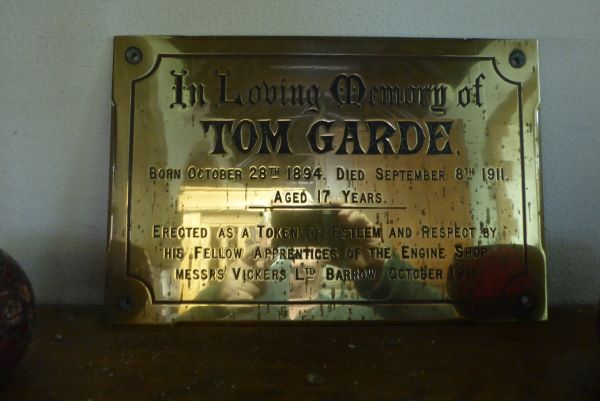
In Loving Memory of
TOM GARDE
BORN OCTOBER 28TH 1894 DIED SEPTEMBER 8TH 1911
AGED 17 YEARS
ERECTED AS A TOKEN OF ESTEEM AND RESPECT
BY HIS FELLOW APPRENTICES OF THE ENGINE SHOP
MESSRS. VICKERS LTD, BARROW. OCTOBER 1911
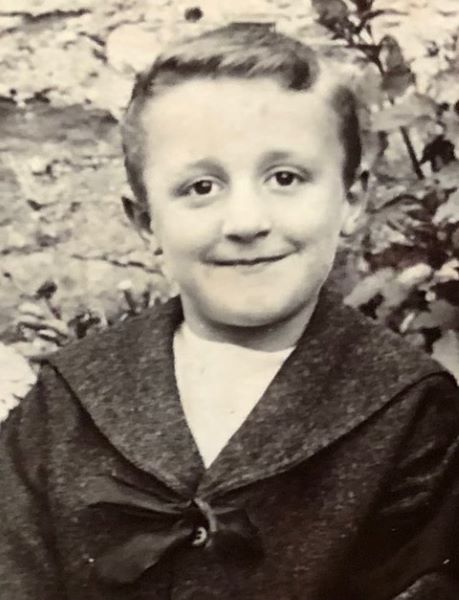
The delightful picture of Tom Garde as a young boy was kindly sent to me (with permission to use) by a family member who I contacted through Ancestry.
Ancestry tells us the following:
1911 Census
In the 1911 Census living at Belmont Cottage, Grizebeck, Kirkby-in-Furness were Ernest Garde (44) Shipyard Driller, Naval Construction Worker, born Manchester, Lancs; Mary Edith Garde (40) Wife, School Mistress, Elementary, Lancashire Education Authority, born Ashton-upon-Mersey, Lancs.; Tom Garde (16) Apprentice Fitter & Turner, Naval Construction Works, born Ashton-upon-Mersey, Lancs.; Mabel Garde (15) Single, Helps with housework, born Middleton, Lancs; Annie Berry (16) Sister of Wife, Single, Helps with housework, born Ashton-upon-Mersey, Lancs.
1901 Census
In the previous 1901 Census the family had been living at School House, Gressingham, Lancs. Ernest was a mason’s labourer. Instead of Annie Berry, the fifth person in the household was Mary Hannah Garde (65) widow, born Ashton. In this Census, Ashton is identified as being in Cheshire. The 1881 Census confirms that Mary Hannah Garde is Ernest’s mother. At that point Ernest was living in Queen Street, Tranmere, and at 14 was a boilermaker. Ernest Osbeldeston Garde married Mary Edith Royle at St Mary’s, Edge Hill, West Derby, Liverpool on 5 July 1894. He is listed as an engineer. He also appears on Ancestry having left his ship, S.S. St. Tudno, in 1893 without giving notice.
The Barrow News 9 September 1911 reported on Tom’s death:
SHOCKING FATALITY AT BARROW
KIRKBY YOUTH’S SAD END
Yesterday morning, about 11 o’clock, a distressing fatality occurred at the engine side of Vickers’ Works, the victim of which is a youth from Kirkby, whose name is Thomas Garde. He is only about 18 years of age, and was employed as an apprentice fitter in the new extension of the engine shop.
The official particulars are to the effect that slight alterations were being carried out to one of the large doors at the entrance to the gun-mounting department, which are lifted by hydraulic power, and the deceased appears to have been passing when a portion of the door fell outwards and struck Garde on the head. Members of the works ambulance corps were quickly in attendance, and did all possible for the unfortunate lad, who was in a very bad condition. He was removed with great care to the gatehouse, where he received further attention from Dr. Alexander, but all efforts failed to restore him and he never rallied before death, which occurred shortly afterwards. The deceased’s father is also an employee at the Shipyard, and to him falls the sorrowful duty of having to break the sad news to the deceased’s mother, who is the head mistress at Grizebeck School.
Mr. Coroner Poole will conduct an inquest at the Barrow Police Court to-day, at 2.30.
The following week came an extremely lengthy account of a contentious inquest (Barrow News 16 September 1911):
THE SHIPYARD FATALITY
SAD DEATH OF A KIRKBY YOUTH
DECEASED’S FATHER’S DRAMATIC EXCLAMATION
THE CORONER’S ENQUIRY
JURY DISAGREE ON THE VERDICT
The circumstances attending the painful death of the youth, Thomas Garde, residing at Kirkby, who succumbed to injuries sustained by an accident at the Shipyard on Friday week, were investigated by the Deputy-Coroner, (Mr. N. E. Barnes) and a jury at Barrow Police Court on Friday afternoon.
Mr. Jas. Fisher was foreman of the jury, and there were also present in Court Mr. W. J. Law, His Majesty’s Factory Inspector, representing the Home Office; and Mr. R. D. B. Bradshaw, solicitor, who represented Messrs. Vickers, Limited.
Evidence of identification was given by Ernest Oswald E. Garde, residing at Belmont Cottage, Grizebeck, Kirkby-in-Furness, who appeared to be considerably affected by the fatality. Witness was a fitter by trade, but at present was employed as a driller at Messrs. Vickers, Limited. The deceased was his son, and was 16 years of age. His name was Tom Garde, and he was employed as an apprentice at the Shipyard.
The Coroner stated that before they proceeded with the actual inquiry as to the accident itself, he thought perhaps it might have been desirable for the jury to see the place, but owing to the courtesy of Messrs. Vickers he had had an opportunity of looking at the doors, and witnesses had explained the working of them to him. With the aid of the photographs which had been taken, he thought that it was perfectly plain for them to see exactly the position of the doors, and the way they were working, without troubling the jury to go over to the yard.
Mr. Walter Kent (a juror): I think it is most desirable for me, personally, to go over, Mr. Coroner.
Mr. Lowes (another juror): With the photographs we have got here, I think it would be better to leave it with you (the Coroner) and the inspector as to whether it is necessary for us to inspect the door.
The Coroner: Suppose that we hear the evidence of the witnesses and look at the photographs. Then you might, have an opinion as to the cause of death. Probably after that Mr. Kent would consider further about going over.
John Lewis, foreman slinger in the gunshop at Messrs. Vickers, and residing at 50, Powerful-street, Walney, said on Friday last he was carrying out his work at the yard, and caused the two sideways of the big doors to be open. He then lowered the bottom half of the centre portion by hydraulic power. The top part of the door came down with the lower part, the top part resting on four flanges on the bottom part. Both parts were lifted up and down by the operator at the lever. Witness was lowering the bottom part for the purpose of repairing a plate in the corner of the door. The bottom portion jammed about four feet from the ground and tilted on one end, and he placed a block and tackle underneath to square it. When he was doing so the top corner of the upper portion became displaced. The door fell out, struck the ground, and fell over on to the deceased as he was passing. Witness shouted for help, and other men lifted the door whilst he pulled the deceased from underneath. There seemed to be life in him. Immediately afterwards the ambulance men took charge of the lad. The deceased never spoke after the accident. He was not engaged on this job, but simply happened to be passing the door at the time.
In reply to the Inspector, witness said he was present during the whole of the operations. The door in question had been up for some years.
The Inspector: When the lower door is on the ground, how is the upper door supported?
Witness: With two brackets on the wing doors.
By the Inspector: Before you can open the wing doors, you must raise the lower door to support the upper one.
The Inspector: Is there any possibility of the wing doors being opened accidentally?
Witness: No, sir.
By the Inspector: The lower door acts as a cradle to the upper one. What is the height of the upper door?
Lewis: Ten or twelve feet.
At this stage Mr. E. F. Norris, draughtsman, was called, and testified that he produced a plan, in sections, of the large doors of the gun shop. He also produced photographs of the doors.
The witness Lewis was further questioned by the Inspector, and said that the height of the guides of the lower door from the ground was 15 feet.
The Inspector: As you lower, it would be possible to lower the upper door right out of the guides. The only support for the upper door would be the bracket at the bottom? – Yes.
The Inspector: It was clearly due to the upper door coming out of the guides that the accident occurred?
Witness: The upper door jammed, and the lower door came down.
The Inspector: Is that always likely to occur? = No, sir. It would not occur unless the door was out of the guides.
The Inspector: If the upper door had been released truly on the guides again and lowered on to the brackets, it should not have come out of the guides? – No, sir.
The Inspector: Can you account for the lower door allowing the upper one to come out of the guides?
Witness: The upper door did not go truly on to the brackets, but hit the edge of them.
Replying to further questions, witness said he had not had any previous accident with these doors. One particular man always worked the gates.
Do you consider the present arrangement a good one? Asked Mr. Law.
Witness: Yes, sir, very good.
Can you suggest any safer means in view of this accident? - No sir, I cannot.
If I suggested that the doors were lowered on to blocks, what would you say to that? – I think it would be better.
Witness further stated that the door was only lowered for repairs. He would not call the operation a dangerous one. He would not agree to save (sic – have?) anybody there to warn passers-by of the work going on.
In answer to Mr. Bradshaw, witness said he just took charge of the doors to assist in lowering them.
Mr. Bradshaw: If you had to do it again, would you do the same thing?
Witness: Yes; only I might use the blocks.
Questioned further by the solicitor, Lewis said he could not suggest anything that he had done or undone that could have prevented the accident. All the tackle and other things were in good order.
The Inspector informed the jury that the weight of the upper door was about 15cwt.
Mr. Kent: It would be more like 15 tons.
Witness Lewis: Impossible.
In reply to the Foreman, Mr. Lewis said this door was not struck by the travelling crane inside the doors or anything that was carried by it.
At this stage the deceased lad’s father rose and said: Why not postpone the inquest, and I will get a solicitor here? I can get Mr. Tilley, from Lancaster. I am not satisfied with what is going on at present. What I have heard this morning and what I have seen at the yard, I am not really satisfied with it. It is moral murder. Oh, my Lad! He (Lewis) said he was at the side of the gate. Why did he not warn the lad?
Lewis said he could not do so because he was inside the doors.
The Coroner (speaking to the father): It is absolutely impossible to hear you now.
After a short consultation with the Inspector, the Corner said he thought that they had conducted the inquiry as fairly as they could up to that point. This case was one where the relatives ought to have an opportunity of asking such questions as that for more witnesses to be called before them. He proposed to adjourn the inquest until next Tuesday, to enable the deceased’s father to be professionally represented.
The Foreman: When would it be best for the members of the jury to view the place?
The Coroner: I have no doubt that Messrs. Vickers will make all arrangements for you to view the place.
It was decided that the jury should visit the scene of the fatality that afternoon, and the inquest was adjourned.
THE INQUIRY RESUMED
The inquiry was resumed by the deputy-coroner (Mr. N. E. Barnes) and a jury at Barrow Police Court on Tuesday morning.
There were again present in court: Mr. W. J. Law, his Majesty’s Factory Inspector, representing the Home Office; Mr. R. B. D. Bradshaw, solicitor, who appeared on behalf of Messrs. Vickers, Limited; Mr. E. Atter, of Whitehaven, who represented the deceased’s relatives, and the Chief Constable (Mr. J. Berry).
RELATIVES APPRECIATION
Prior to the commencement of the inquiry, Mr. Atter expressed his appreciation, not on behalf of himself, but on behalf of the relatives of the deceased boy, for the coroner’s kind consideration to them in having the inquest adjourned for their own convenience. They very much appreciated that consideration. He (Mr. Atter) was glad to know that the jury had been able to view the scene of the accident.
The Coroner: I thank you, Mr. Atter. As it was the father’s request, I think it was the obvious and right thing to do.
DELAY OF THE INQUIRY
The Coroner further explained that the reason for the delay of the inquiry was the train service. At Ulverston he thought, according to the timetable, that he would have sufficient time to get here, but man proposed and the Furness Railway disposed. (Laughter) His Majesty’s Factory Inspector had originally expected to arrive there at 11 o’clock, but he had not yet arrived, and they would have to wait until he did arrive.
A Juror: Is he on the road?
The Coroner: I should say so. I think the train is late.
A Juror: Cannot we adjourn the inquiry for half an hour?
The Coroner: We had better wait a few minutes.
The Inspector arrived soon afterwards.
CROSS-EXAMINATION BY RELATIVES’ SOLICITOR
Mr. John Lewis, the first witness called, in answer to Mr. Atter, said the work in this particular department commenced at 6 a.m., and he supervised the slingers and the cranemen. His duty extended from 6 a.m. until 5 p.m., with a half an hour and an hour for breakfast and dinner respectively. He had been foreman for about 25 years in various parts. There were 40 or 50 men under his charge during the day. When anything went wrong with the door, as rigger, he was sent for. The doorway had been up since the new gunship was built, perhaps, about 12 years. During that time there had not been constant repairs to the door. He had never had, or even known of, another accident to the door, nor had he ever known the door to fall in such a way. He gave directions for the repair of the door at 8 a.m. He personally superintended and never left the door whilst being repaired. He had to leave the manner of repair to a plater, and had no idea at all how long it was likely to take to do the repairs. He did not realise it was a (sic) dangerous work. Repairs to the same extent as on this Friday had been necessary some months ago. On that occasion it was repaired in about a day, and it was then repaired under his supervision. Witness was on the inside, and had his hand on the door at the time, and did not see the deceased until the door was just striking him 12 or 14 feet away. He never saw any other person near. He did not think there was any risk of the door falling. The accident occurred some two hours after the work had commenced. The upper door became jammed, but witness did not notice it until three minutes before the accident. The only “stops,” which were at the bottom of the door, were still on it, and were rivetted on.
By the foreman: He had not known of any defect in this door until that morning. He was not aware of any defect in the hydraulic machinery. The leakage which existed on Saturday could come on any minute with the backing of the ram. He could not say that the door dropped a few inches while the leakage was on, but there was no doubt that if there was a leakage, the door would gradually crawl down. It would be possible to attach a steel wire rope to the top door similar to the two ropes attached to the bottom door. He could not say whether an accident would have resulted had such a rope been attached.
In reply to Mr. Bradshaw, witness said this was a simple repair job, carried out in the usual way. The door had been used before that morning.
Re-examined by the Foreman, witness said the door was used probably four or five times a day. Sometimes it was not used for two or three days.
When we visited the place on Saturday, was the tackle in the same place as before? – Yes.
Questioned by Mr. Bradshaw, witness said that when anything went wrong, he was sent to assist in taking down the door, etc.
James Gornall, plater, residing at 64, Mount Pleasant, said that on Friday morning he was sent to the big door leading into the gun shop to remove the plate in the top portion of the door. He and his mates had taken out three bolts. Previous to that, a block and tackle had been fixed to the corner of the plate to keep it square. The door had been lowered down, and they were going to pack it up with blocks. Then they were going to take the other three bolts from the plate, so they could put the bottom door into the slide. They were lowering the door because the door was out of the slide at the corner where the bolts were. Witness was pulling the rope attached to the block and tackle behind the door. The bottom door kept still. He heard the crash outside the door, and heard Mr. Lewis shout. He did not see the accident itself. Witness assisted to get the deceased from under the door by lifting the door.
By the Inspector: He had not worked on repairs on this door before. He had been employed at the Shipyard two years, and on this particular morning he was taking his instructions on this job from the last witness. There was an intention to block the door up. He heard the last witness saying so. He did not know why this was not done. He had nothing to do with the actual movement of the door, his job being confined to the repair. The first noise he heard was the upper door striking the ground. The door sounded as if it first struck the brackets and then the ground. The bottom door at the time he was near was three or four feet from the ground.
In answer to the foreman, witness stated that he noticed the lower door sway, whilst they were pulling with the block and tackle. He thought the upper door fell whilst they were pulling the lower door square. He did not think that it would be possible, whilst the plate was off, to pull the door out of the groove with the block and tackle.
By Mr. Atter: In addition to himself, his helper was working on this job. There was no one to give warning to persons outside.
John Halston, motor attendant, living at 15 Roose-road, said on Friday morning he was passing the top of No. 1 bay into the engine shop, when he heard Lewis shout. He was inside No. 1 bay gunshop at the time. He saw the door belonging to the shop fall out, and he noticed the deceased there. The latter appeared to make an effort to get out of the way when Lewis shouted. The door fell flat, not on its edge, and Garde was caught underneath the door. Witness helped lift the door from off him (sic). He (deceased) was afterwards attended by the ambulance men.
The Foreman: When you helped to take the door off the deceased, was he under the door altogether? – Yes. He could not be seen.
Fred Mayne, electrician, residing at Wheatclose-road, stated that about 11 o’clock on Friday last he was passing the doors in question. He heard a shout, and noticed the deceased jumping back. He was facing the doors and appeared to be standing still, apparently watching the job going on. He appeared to be whistling when he was passing. Immediately the deceased jumped back, he gave a sudden exclamation, and was then overwhelmed with the door. He helped to lift the door off the deceased. He was going from the submarine department to the loft at the time.
By the Inspector: He was quite certain the boy was looking at the door, and appeared to be well inside the door.
In reply to the Foreman, witness said he thought the door fell on its edge first, and then forward. He could not say whether the door struck the four plates above or not before coming to the ground.
By Mr. Atter: The deceased was in his sight for about two minutes, during which time he was standing still. Deceased was by himself. He heard no noise from the door before it fell.
Norman Bateson, slinger, living at 69, Oxford-street, said he was working with Mr. Lewis on Friday at the doors. He was engaged in releasing the tackle rope. Which had got fast between the two doors. Just prior to that, they levered the lower half up with a plank to straighten it. They had not used the block and tackle then. They afterwards used the tackle because they found the plank was of no use. They then straightened the door. He did not remember hearing a sound. They were releasing the rope when the door came down. The next thing he knew was that Mr. Lewis shouted out. Witness stood back about half a step, and saw the deceased outside standing opposite to him (witness). As near as he could judge, the door fell flat on the deceased. He saw the door knock the deceased down, and went to assist in lifting the door off him.
In answer to the Inspector, witness said they went to this job about three-quarters of an hour or an hour before the accident occurred. He went to the job to give a hand in the work. He did not recollect any orders being given to him. When he got there, two big doors were up well above his head, and the two wing doors were closed. The man in charge of the doors (Mr. Hornby) had been there, but had gone away when he arrived. There was no one in charge of the movement of the doors. They were working the doors on suggestions made amongst themselves. The door jammed two or three times. He could not say how many men were there at the time; there were so many looking on.
The Inspector: Were any of these onlookers free to come forward with any suggestions? – Yes. If they were any good. (Laughter).
The Inspector: Who was to tell them if they were any good or not? – Ourselves.
The Inspector: Did you hear anyone say the door ought to be blocked up? – Yes, Mr. Lewis. – To whom did he say that? – I expect it was said to the lot of us. Continuing to answer the Inspectors questions, witness said that before the blocks were removed from under the door, it was perfectly secure. The blocks stood about four feet high. They had to remove the blocks to get the door in position to carry out the repairs. They wanted to get the door out of the guides. At the moment the door fell, he was releasing the rope of the tackle. He had not seen the deceased prior to the accident.
Answering the Foreman, witness said he had never seen the big door slip, and could not say whether it swayed inwardly when he had the block and tackle on it.
Answering Mr. Bradshaw, witness said he had been a slinger for about seven months. He had nothing to do with plater’s work.
In reply to a question by Mr. Atter, Bateson said there were about four of them making the suggestions as to the workings of the doors. They had been on the job about half-an-hour or three quarters before Mr. Lewis came.
Mr. Atter: Under whose directions were you doing this work during that time? – We all had a say in it. (Laughter) – If the suggestions were good you adopted them? We did a lot of looking at it. (Loud Laughter) Witness added that he was positive the deceased was not there more than half a minute.
Mr. Bradley, head timekeeper at the Shipyard, stated that he saw the deceased immediately after he was taken from under the doorway. They rendered first aid on the spot, and then removed him to the gatehouse infirmary, and sent out for a doctor. Dr. Alexander was got in, but when he arrived the deceased had expired. Deceased did not speak.
Mr. Lowe, foreman engineer in the marine department, gave evidence to the effect that the deceased had worked with him for 18 months, and was an intelligent and industrious boy. He (witness) greatly regretted the accident and sympathised with the boy’s parents.
Mr. Bradshaw also spoke of the firm’s sympathy to the boy’s parents.
Mr. Atter said he was much obliged to his friend, Mr. Bradshaw, for putting the question as to the firm and the accident.
The inquiry was then adjourned for lunch.
The next witness was Thomas Hornby, employed at the yard as an attendant for the gunshop No. 1 bay doors. Last Friday morning he was not at the doors which fell out, but was working in another portion of the shop. In answer to a juror, witness said the hydraulic pressure was leaking. He had been working with the doors for four years, and had never had an accident with them. The particular hydraulic ram had been in use for some long time. He could not say whether the present leakage warranted repairs or not.
By the Inspector: There was no “creep” on the particular hydraulic gear on Friday morning. He had last worked on the doors earlier the same morning, and they were all right then.
The Inspector: I put it to you that if there is a leak in the hydraulic machinery supporting the doors, then the doors must move? – I have never seen them move.
The Inspector: Then there must not have been a leak, or else the doors would move.
A juror asked if it would not be advisable to call the witness Lewis, as one of the other witnesses had said that he was not on the job for three-quarters of an hour.
The Coroner replied that Mr. Lewis had said he was on the job. Where they had a statement like that, they must attach the greater credibility to a man who, perhaps, was in a superior position. At any rate, they had to judge between the two witnesses. It would not help them to call Lewis back, only to affirm what he had already said.
The juryman replied that he was satisfied.
THE CORONER’S SUMMING-UP
The Coroner and the Inspector then retired. On returning into court, the Coroner summed up, and after stating the facts of the case, remarked that all they had to consider was how the deceased met his death, and whether anyone was criminally responsible, and in doing that he asked them to dismiss from their minds anything they had heard outside or any opinion they themselves might have formed, unless it was based on evidence which had been given. All the witnesses they had had were employees of Messrs. Vickers, and generally speaking had given their evidence straightforwardly, although he might say that the evidence of the witness Bateson was so extraordinary that it called for some comment, because if what he said was true, the evidence of discipline at the works was very unsatisfactory indeed. That, however, only concerned them, in so far as they were bound to see that the work was properly carried out, because if it were not, they might come to certain conclusions. But the evidence before them showed that these doors were deemed to be in such working order that no special precautions were necessary. There was one point on which he desired to have some information, and it had been supplied in the course of the evidence of the witness Lewis. That was the reference to a wire rope being put through the eyebolt in the top door. They now had it in the evidence that the eyebolt was for the purpose of putting a lashing through when the whole structure was taken out for the passage of very large material, but otherwise the top door was never used apart from the lower one. There was also the question to consider as to whether steps should have been taken to prevent people not employed on the work coming within the danger area. They had had it very clearly explained that the work people going in and out of the work did not go through the big doors, but through another door higher up, and these particular doors were simply opened to allow big castings, etc., to pass through. It was possible that Messrs. Vickers might possibly find a different method of lowering and removing the doors, although he did not want to suggest anything of the kind. Whilst the doors were being lowered, and taken out under the present system, no doubt in view of the present experience, they would appoint someone outside to warn people when coming near. The question arose, and they had to consider the fact, was anyone criminally responsible. If anyone, it could only be the witness Lewis. He explained that if a person who does a lawful act uses such a degree of caution and prudence as to make it improbable that any danger or injury will arise from it to others, and notwithstanding this, something happens which causes death or injury, he is not criminally responsible, but the death or injury is deemed to have occurred from accident or misadventure, and went on to say they had nothing whatever to do in that court with any question of compensation or civil action whatever. They had, therefore, to keep clear of all issues which might be involved later on. The relatives might possibly take some action and be advised to do certain things in the civil courts or elsewhere, but that had nothing to do with their case. The matter had been very carefully thrashed out, and he thought that they would come to the conclusion that under the circumstances the falling out of this door could not have been foreseen, and that the deceased, who was not engaged in the work of the lowering the doors, but was an apprentice fitter and turner in the witness (Mr. Low’s – sic) department, and happened to be casually on the spot, met his death by misadventure or accident. The witness Lewis had shouted out, and did all he could, but it was too late to prevent the fatality. In conclusion, the Coroner said they all expressed to the deceased’s father their sincere sympathy which had been so admirably voiced that day, and he was sure that the jury in this case had given the matter every consideration, and in coming to a verdict that they would do justice, and in accordance with the oath they had taken, return a verdict according to the evidence.
THE VERDICT
JURY DISAGREES
The jury then retired to consider their verdict, and on their return into court, after an absence of about forty-five minutes, the foreman intimated that they could not agree upon their verdict. The great stumbling block appeared to be that some of the jury were of (the) opinion that the door was defective. There were ten of one opinion and three of another.
The Coroner regretted the departure of H.M. Inspector, but so far as the enquiry was concerned he might say that the Inspector had reported that so far as the Factory Acts were concerned, the machinery and plant were in order. If twelve of the jury agreed he was prepared to take their verdict. He could not discharge them because they had had the view of the body, and no jury could take their place. If they were so unfortunate that they could not agree at all, he would have to bind them over to appear at the Assizes to receive the charge of the Judge.
The jury again left the court, and on returning declared to have found a verdict “That the deceased was killed by the falling of the door.”
The verdict was signed by twelve of the jury, but the thirteenth, Mr. W. Kent, remarked, “I refuse to sign, Mr. Coroner.”
The Coroner answered. “All right.”, and afterwards closed the inquiry.
FUNERAL OF THE DECEASED
The interment of the late Thomas Garde took place at St. Cuthbert’s Churchyard, on Monday afternoon, there being a great many people present to pay their last tribute. The remains were conveyed from Barrow on the 3.0 (sic) p.m. train. At Kirkby there were a great many of his friends and fellow-workmen waiting, some of the latter having travelled by an earlier train, a good many also coming at the same time. The coffin was borne from the station to the churchyard by the apprentices out of the shop he worked in. The Rev. A. Partridge, vicar, officiated, impressively reading the burial service, there being some touching scenes at the graveside. Mr. E. N. Lewis, the organist, was in attendance. The chief mourners were: Mr. and Mrs. Garde, father and mother; and Mabel Garde, sister. Much sympathy is extended to the bereaved family in their great loss. Wreaths, flowers and crosses were sent by deceased’s father, mother, and Mabel, Uncle Arthur, his fellow workmen (engine department, Vickers, Limited), Florence, Tamar Berry, Mr. and Mrs. T. Irving …. the list continues.