Died
25th December 1888
Born
1804 (corrected July 2024)
Sources
Barrow News
Wikipedia
Grace Darling factsheet - RNLI Grace Darling Museum, 1 Radcliffe Road, Bamburgh, Northumberland, NE69 7AE Tel: 01668 214910 Fax: 01668 214912
Place
Walks
Barrow 1 point 5
Themes
James Gall
Survivor of SS Forfarshire. Origin of the Grace Darling story 1838.
This is the grave that got me interested in the research into Barrow Cemetery, and later, the other graveyards and cemeteries in Furness. In 2012, when I started, I did not have access to Ancestry, nor the British Newspaper Archive. I now (2024) have both, but the information can be difficult to find, and can be overwhelming in volume. This sheet was updated in July 2024, primarily as a result of the listing of the monument at Grade II by Historic England. An important correction to the original sheet published is James Gall’s year of birth: 1804, not 1822.
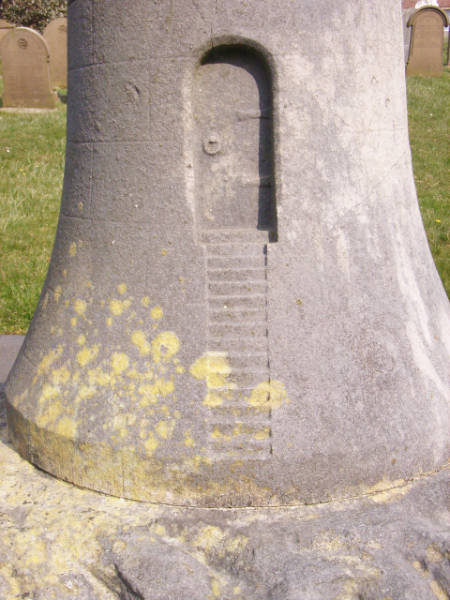
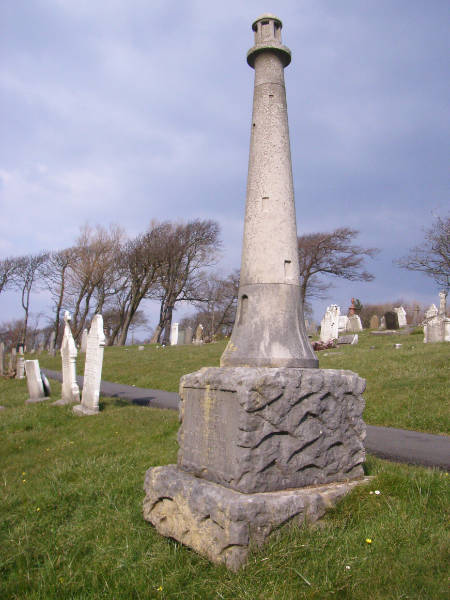
The Monument
Capt Stokes, local secretary to the Royal National Lifeboat Institution, drew attention to the presence in Barrow of someone supposed to be the last survivor of the SS Forfarshire in a letter to the Barrow News in Sept 1888. In December James Gall, who had been living with his son, died. In January 1889 there was an evening of song at the Town Hall, Barrow, to raise funds for the erection of a memorial to Mr Gall, and thereby invoke the memory of Grace Darling (and raise funds for the Lifeboat Institution?).
The letters pages of the News over the following months indicate a dispute about where the memorial should be sited: on the grave of James Gall or in the ornamental gardens of the cemetery.
More detail can be found below.
James Gall
The Barrow News of Thursday Dec 27th 1888 reported that James Gall had died at the age of 84, having lived in Egerton Buildings. It was thought that he was the last survivor of the SS Forfarshire. He had been a ‘fireman’ on board the ship.
‘Gall had the good fortune to be rescued through the heroism of Grace Darling, but he had three ribs broken, and had to stay at the lighthouse for some little time where his injuries were tenderly ministered to by Grace Darling and her father, ..’
From information available, it appears that Gall survived on the ship’s lifeboat, rather than being taken off by the Darling’s efforts.
James Gall’s death notice can be found in Barrow News 5 Jan 1889. Another death notice announced the death of James’ widow Betsy Wilkie Gall on 30th October 1890 (Barrow Herald and Advertiser 8 November 1890). Although she is not listed on the gravestone, Betsy is buried in the same plot, as are Mary Elizabeth Gall, (buried 14.4.1913) and Andrew Gall (buried 16.5.1941). The dates of burial suggest that these are James Gall’s daughter-in-law, and his grandson.

The Story of the SS Forfarshire
SS Forfarshire set off from Hull for Dundee on 5 September 1838, with a mixed cargo and 60 people (passengers and crew) on board. In the early hours of 7 September 1838, her engines failed after a boiler leak.
Grace Darling, the keeper’s daughter, spotted the wreck from an upstairs window of the Longstone lighthouse on the Farne Islands, with survivors of the Forfarshire on Big Harcar, a nearby low rocky island. The Forfarshire had foundered on the rocks and broken in half: one of the halves had sunk during the night. The weather was very poor, and Grace’s father, the lighthouse keeper, judged it too bad for the launching of the lifeboat at North Sunderland.
In their rowing boat, William Darling and his daughter Grace rescued nine people from Big Harcar rocks. Her heroism in managing the rowing boat while her father landed on the rock earned her national acclaim.
Nine other people, included James Gall, survived the wreck in the ship’s lifeboat and were taken ashore.
Grace Darling (b. 24 Nov 1815 – 20 Oct 1842) died of tuberculosis and is buried at Bamburgh, where there is a memorial to her.
The story of the Barrow lighthouse memorial
Captain Stokes was a conscientious Secretary of the local Royal National Lifeboat Institution, keen to publicise its existence and raise money for its activities.
In the Barrow News Tuesday 25 September 1888 can be found a letter from Capt. Stokes:
GRACE DARLING, IN MEMORIAM
SIR, - as you have at all times allowed me the use of your influential paper to advocate the cause of the Royal National Lifeboat Institution, I venture to trespass on your kindness with a view to touching on a kindred topic, in which I feel assured many of your readers will take an interest, viz., the presence in Barrow of one of the survivors of the ill-fated steamer Forfarshire, with which the name of that splendid type of heroic girlhood, Grace Darling, must for ever be associated. Doctor Fell having kindly informed me that James Gall, one of the survivors of the Forfarshire, was living with his son at 6D Egerton Buildings, I paid the old man and his wife a visit yesterday, and was rewarded by hearing a touching and graphic description from an eye-witness of the disastrous wreck. The old man, who is 84 years of age, and has seen much to interest one during his last 50 years service at sea, principally as an engineer, was a fireman on board the Forfarshire when she was wrecked, and has a clear recollection of each thrilling incident in the sad disaster. Being in full possession of all his faculties, and evidently gifted with a good memory, he treated me to a most interesting narrative, while his wife, who is 82 years of age, and an exceptionally fine looking old lady, looked approvingly on. Our “crack” seemed as pleasant to the old man as it was to me, and we parted with mutual expressions of goodwill, he stipulating that I should renew my visit, which I certainly intend to do, and if this little sketch should induce others to pay the old couple a friendly visit they will be well awarded (sic), and I will feel that I have not written these few lines in vain. - I am, yours faithfully, EDWD. P. STOKES. Hon. Secretary Royal National Lifeboat Institution.
The Barrow News Thursday 27 December 1888 had news of James Gall’s death:
GRACE DARLING
DEATH OF A SURVIVOR OF THE FORFARSHIRE
In September last Captain Stokes drew attention in our columns to the fact that there was residing in the Egerton Buildings, Barrow, an old man, 84 years of age, named James Gall, who was a fireman of the ill-fated steamer Forfarshire when she was wrecked on the Farne Islands 50 years ago. Gall had the good fortune to be rescued through the heroism of Grace Darling, but had three ribs broken, and had to stay at the lighthouse where his injuries were tenderly ministered by Grace Darling and her father, and of whose kindness Gall always spoke in the most grateful terms. We are sorry to announce that Gall died on Monday last, at the ripe old age of 84. He was said to be the last survivor of the Forfarshire.
NB Other reports make it clear that he was NOT one of those rescued by the Darlings, and it cannot be clear whether he was taken to the lighthouse. This report would also make his death 24th December, contrary to the date on the gravestone. The Census returns below suggest he lived at Devonshire Buildings, not Egerton.
The Barrow News 29 January 1889 – only a month after James Gall’s death, reported on a musical evening at the Town Hall, chaired by Capt. Stokes in the absence of Mr. F. J. Ramsden, the purpose of which was to “erect a handsome monument in the Barrow Cemetery to the memory of Grace Darling in connection with the recent death in Barrow of James Gall, …”
On 23 March 1889 and 30 March 1889 the Barrow News carried an exchange of letters between Capt. Stokes and the members of the committee organising the memorial. Extracts from one, published on 30 March and from S. McNair, Hon. Sec. 11, James Watt Terrace, contains the following (edited extracts):
THE GRACE DARLING MEMORIAL
… It appears that Capt. Stokes takes exception to the use by us of the title “Grace Darling Memorial”, which he says is misleading to the public, thereby implying that it is not our intention to memorialise Grace Darling. He also charges the committee with the intention of appropriating what he regards as a public fund to a private purpose. Now, with reference to the charge of misleading the public, I would respectfully submit that the stone we intend to erect will be to all intents and purposes a memorial to Grace Darling in connection with the death of James Gall, … who was until lately supposed to be the last survivor (of the “Forfarshire”), the only issue between the committee and Capt. Stokes being the site where it should be erected. We say on the grave of Mr. Gall, as originally intended, he contending that it ought to be placed in the ornamental grounds of the Cemetery.
…. I can say without fear of contradiction, that not one member of the committee, with the exception of Capt. Stokes, ever thought of the stone being placed anywhere else but on the grave of James Gall. ….
Where is the Grave?
The lighthouse monument is directly below the crematorium on a path parallel to the main driveway into the cemetery. Walking up the main driveway, pass the Thorncliffe Road/ North Lodge exit on your right. Take the next pathway on the left and follow it as it bends to the right. Take the next left, then first right. The lighthouse memorial is 100m along, next to the path on the left-hand side.
30m further on, again on the left with its back to the path, is an interesting memorial to Christopher Wilson, a Salvation Army bandsman killed in an accident at work.

This photo of an impressive painting of James Gall was sent to me by M. Bartlett after a talk to the Walney Guild in 2016. Mr. Gall was her friend’s great grandfather.
ERECTED
BY PUBLIC SUBSCRIPTION IN MEMORY OF
JAMES GALL
ONE OF THE CREW OF THE “FORFARSHIRE”
[DIED DEC. 25TH 1888]
AND TO COMMEMORATE THE HEROISM OF GRACE DARLING
IN RESCUING 9 MEN FROM THE WRECK OF THAT UNFORTUNATE VESSEL A.D. 1838
Since subscribing to Ancestry I have been able to find more about James Gall’s biography:
Baptised 9 August 1804 Tannadice, Angus. Mother: Helen Watson. If this is accurate, James had an elder brother John Gall (1803 – 1880) who was transported to Australia c1827 for stealing cattle. (Family tree on Ancestry).
James Gall married 7 Jul 1837 at Dundee, Angus to Elizabeth Wilkie.
1841 Scotland Census (Summary only)
James Gall (38) born Angus; living Exchange Street, Dundee. Occupation: Merchant Seaman. Also Elizabeth Gall (38); John Gall (5), James Gall (2).
1851 Scotland Census (Summary only)
James Gaull (sic) (45) born Tannadice, Forfar; Living 15 Exchange Street, Dundee. Occupation: Engineer. Also Elizabeth Gaull (45), John Gaull (15), James Gaull (12), David Gaull (9), Andrew Gaull (6).
1861 Scotland Census (Summary only)
James Gall (55) born Panadise (sic), Forfar; living 8 & 9 Dud Cres, Dundee. Occupation: Engineer. Also Elizabeth Gall (55), Andrew Gall (15).
1871 Scotland Census (Summary only)
James Gall (65) born Jannidiee (sic) Forfarshire; living Land(ing) 8 & 9 Dudhope Crescent), Dundee. Occupation: Engine driver. Also Elizabeth Gall (62).
1881 Scotland Census (Summary only)
Jas. Gall (76) born Tannadice, Forfarshire; living Kirriemuir, Angus. Occupation: Engineer (retired). Also Elis. Gall (73).
1881 England Census
Living at 6H Devonshire Buildings, Barrow Island, were:
Andrew Gall (34) Engine Smith, born Scotland; Mary E. Gall (32) Engine Smith’s wife, born Hull, Yorkshire; Elizabeth Gall (6); Fanny A. Gall (5); James Gall (3); John D. Gall (1); C. Steel (29) Unmarried, Boarder, Ship Smith, born Beverley, Yorkshire; William K. Neave (27?) Widower, Boarder, Ship Smith, born Scotland.
Andrew Gall later moved to 6D Devonshire Buildings, (1891 Census); 11 Earle Street, (1901 Census), and 21 St. Patrick’s Road (1911 Census).