Died
Tyrinz 17th/30th March 1915
Dobronravov 13th December 1907
Kopitin 30th October 1906
Sources
Sankey Family Photographic Collection
Wikipedia
Barrow Herald
cityofart.net
Place
Russian graves (7606)
Where are the graves?
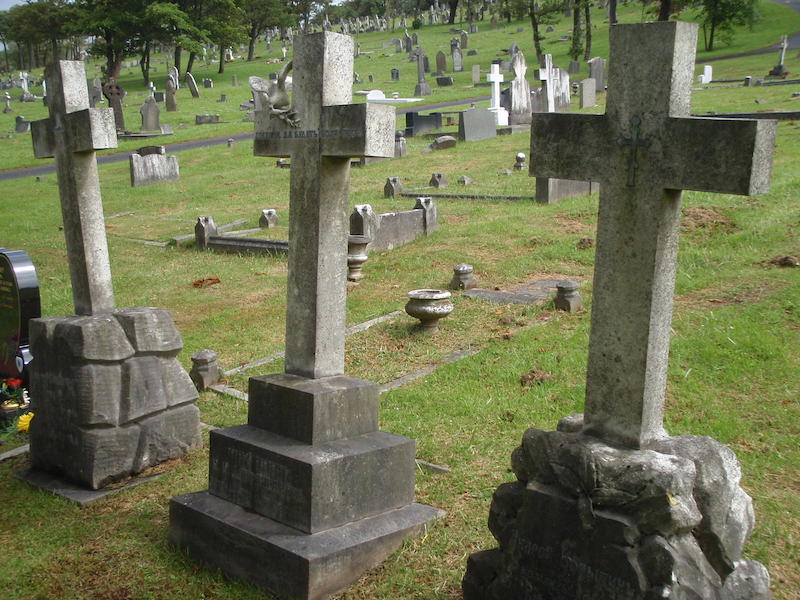
Towards the low part of the Cemetery, above a thicket of bushes. From Devonshire Road, take the second left path, bend right and then bend left downhill. They are on the right as a straight path comes in from the right.
24 October 2012

Barrow’s shipyard was building the Rurik (Рюрик) for the Imperial Russian Navy in 1906, laid down in August 1905 and launched on 4 November 1906. She has been described as one of the best armoured cruisers built, with advanced sprinkler protection for the magazines. She was designed by KA Tennison and AP Titov, and the contract was arranged by Basil Zaharoff. The ship had a prolonged work-up while defects were rectified. Rurik was commissioned in 1908. She carried out a deployment to the Mediterranean in company with the battleships Tsesarevich and Slava, where she represented Russia at the coronation of King Nicholas of Montenegro She was the flagship of the Baltic Fleet during World War I and saw much action, being damaged by mines on several occasions. The ship was worn out by 1918, she was hulked in 1922 and sold for scrapping in 1930.
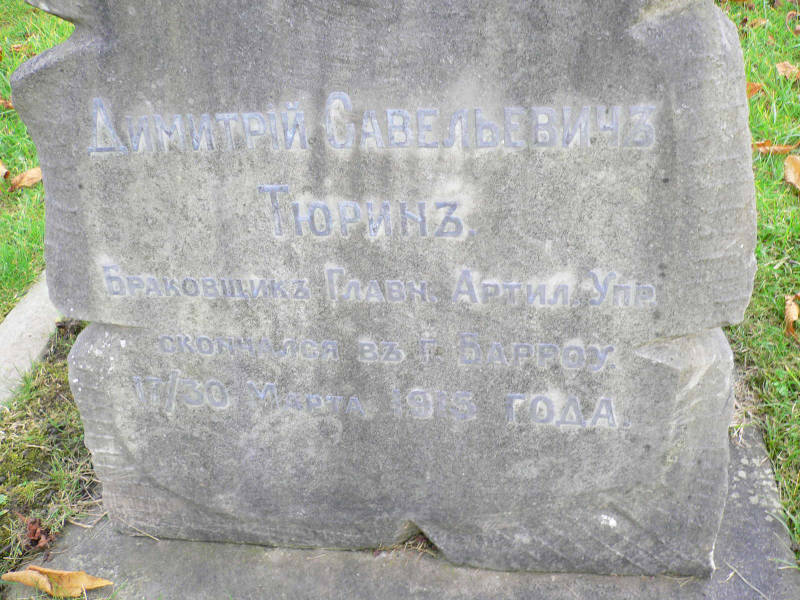
The memorials proved difficult to translate, being written in old Russian. Thanks to Pat Blackburn & Malcolm Mancey-Jones for their work in making sense of them:
Dmitry Vavelevich Tyrinz
Chief Inspector of the Artillery Unit
Passed away in Barrow 17/30 March Year 1915
God, thy will be done (on cross-piece)
Mining Engineer
N.I. Dobronravov Passed away on December 13th Year 1907
Andrei Kopitin
Crew member of 1st class cruiser “Bogatyr”
Passed away in Barrow 30th October 1906
BARROW HERALD, Tuesday October 23 1906THE RUSSIAN FLEET
VISIT TO BARROW
The London correspondent of the ‘Glasgow Herald’ says:- A Russian naval squadron, which is now making a cruise for the instruction of cadets, will steam around the north of Scotland and down the West coast this week: but although it may put into some of the harbours on the Scotch coast, the visits will be private, and thus there will be no formal receptions. As it is desired that should have an opportunity of seeing through one of the most modern British naval construction works, I learn from the Embassy here that arrangements have been made for an anchoring of the squadron at some convenient point near Morecambe or Fleetwood, probably in the Lune Deeps, and for the debarking of the officers and cadets to visit the Vickers Works at Barrow-in-Furness and the gun ranges of the company further up the coast. The ships comprising the squadron are the battleships Slava and Tsarevitch and the fast cruiser Bogatyr. These are respectively of Russian, French and German construction. The Bogatyr belonged to the Vladivostock Squadron during the recent war, made many successful sorties, and although she grounded badly on the rocks when escaping from an attack by Japanese armoured ships, was salved and repaired.
This visit was eagerly anticipated, with an article in the Barrow Herald on Saturday October 27 1906 (the day of their arrival) describing the Squadron being met by the Furness railway boat Lady Evelyn and their itinerary, which as well as a visit to the shipyard and armament works, included a visit to the firing range at Eskmeals and to the River Don steelworks in Sheffield to view the manufacture of armour plate. The launch of the Rurik was imminent.
A further, lengthy article on Tuesday November 6 1906 covered two columns describing their visit to the shipyard, including the ‘splendid luncheon’, which included Whitstables on Half Shell; Real Turtle; Sole a la Percy; Sweetbreads a la Financiere; ....
At the time of writing (April 2013), this last dish sounds especially repulsive!
BARROW HERALD, Saturday November 17 1906Russian Squadron’s visit
STOKER DIES AT THE HOSPITAL
A melancholy event in connection with the visit of the Russian Squadron to this district has occurred in the death of Andreas Kopjikin, aged 24, who was a stoker on board the cruiser Bogatyr. He was conveyed to the North Lonsdale Hospital on Monday week after the arrival of the squadron in Morecambe Bay. The deceased, who died on Monday afternoon, had been ill eleven days before going to the Hospital, and he died of heart disease. A touching story was told by Mrs Jas. Dunn, when opening the new balconies at the Hospital on Saturday afternoon. The Admiral of the Squadron jokingly told the deceased as he left the ship to go to the Hospital that he had chosen the wrong time to be ill, as he might have had three or four days pleasure in Morecambe Bay. The stricken sailor, however, reverently replied, ‘It is God’s will.’ He seemed quite resigned, and though absent from his friends passed peacefully away.
IMPRESSIVE FUNERAL
On Thursday afternoon an impressive funeral took place of the Russian stoker, Andreas Kopjitin, aged 24 years, who succumbed from an illness whilst lying in the North Lonsdale Hospital on Monday afternoon. It was unfortunate that unfavourable climatic conditions prevailed for the funeral. At about 10.15 the cortege left the hospital and proceeded to the Barrow cemetery, where the Ven. Archdeacon Campbell officiated at the graveside. Amongst those at the ceremony were Lieut. Col. Newman, Naval Constructor Tennyson, Mrs. Tennyson, Lieut. Ovander, Mrs. Ovander, Capt. Barrowski, Mr. Scar, Mr. Tromimoff, etc. Six members of the crew of H.M.S. Thames also attended to show their sympathy with the deceased.
Note that the gravestone indicates October 30th 1906 as the date of death: the news article above suggests November 12th. This is explained by the difference between the Russian Julian calendar, and the British Gregorian calendar, 13 days.
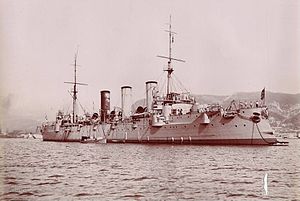
Name: Bogatyr
Operator: Imperial Russian Navy
Builder: Vulcan Stettin
Way number: BauNr. 247
Laid down: 22nd December 1899
Launched: 30thJuly 1901
Commissioned: August 20th 1902
Decommissioned: 1918
Renamed: 1918
Fate: Scrapped 1922
Wikipedia says that Bogatyr comes from Russian mythology, meaning folk hero, folk warrior or ‘epic hero’ (my translator). Wikipedia suggests Hercules as an acceptable Western alternative.
BARROW HERALD, Saturday December 28th 1907PAINFUL DEATH AT BARROW
RUSSIAN INSPECTOR SUCCUMBS
We regret to learn that Colonel Dobronvavoff, one of the Russian overseers at present with H.I.M. cruiser Rurik, died on Tuesday night in the North Lonsdale Hospital after a painful illness. The distinguished officer was held in high esteem by his colleagues, and his demise is deeply regretted.
I have been unable to find any news report of the third death (Tyrinz) in March 1915. It is possible that he was part of the crew of an ice-breaker visiting at the time. Alternatively he was in Barrow examining the latest armaments, with a view to buying for the Russian Imperial forces.
The Barrow Cemetery Register records his burial on April 1st 1915, listing him as Dmitry Turin (as far as is legible), aged 28yrs, Russian Artillery Inspector, of 139 Abbey Road.
No-one is certain why Edward Sankey took photographs of graves in the period 1910-1920 or later. Were they advertising the skills of his friend William Hull, or later Hull and Fairbairn? Were they to be made into postcards that the bereaved family could send to members who were not able to attend the funeral?
The historic photograph is from the Sankey Family Photographic Collection, courtesy of Cumbria Archives.