Died
Mary Pepi 7th December 1915
Rino Pepi 17th November 1927
Sources
cinematreasures.org/theaters/26537
The Stage
The ERA
Ancestry
The Leamington, Warwick and District Daily Circular
Chris Lloyd's book, Of Fish and Actors (with Permission)
Place
Mary Pepi (7257)
Countess de Rossetti
Updated August 2024
Rino Pepi became a theatre entrepreneur in the north of England, and owned the Tivoli Theatre in Forshaw St. This later became the Regal, on the site of Portland Walk shopping centre. The Cemetery register notes Mary De Rossett Petracchi Pepi, of 44 Victoria Road.
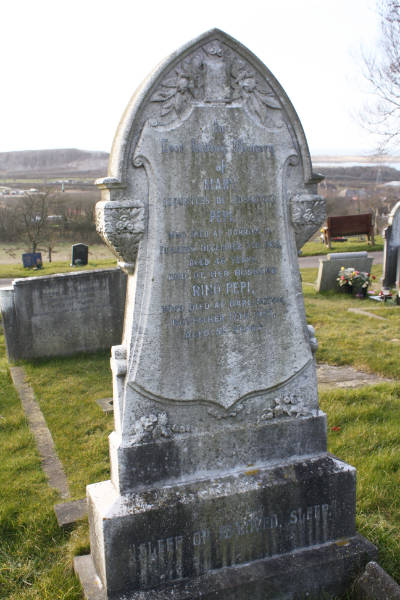
IN
EVER LOVING MEMORY
OF
MARY
(COUNTESS DE ROSSETTI)
PEPI
WHO DIED AT BARROW-IN-
FURNESS DECEMBER 7TH 1915
AGED 46 YEARS
AND OF HER HUSBAND
RINO PEPI
WHO DIED AT DARLINGTON
NOVEMBER 17TH 1927
AGED 55 YEARS
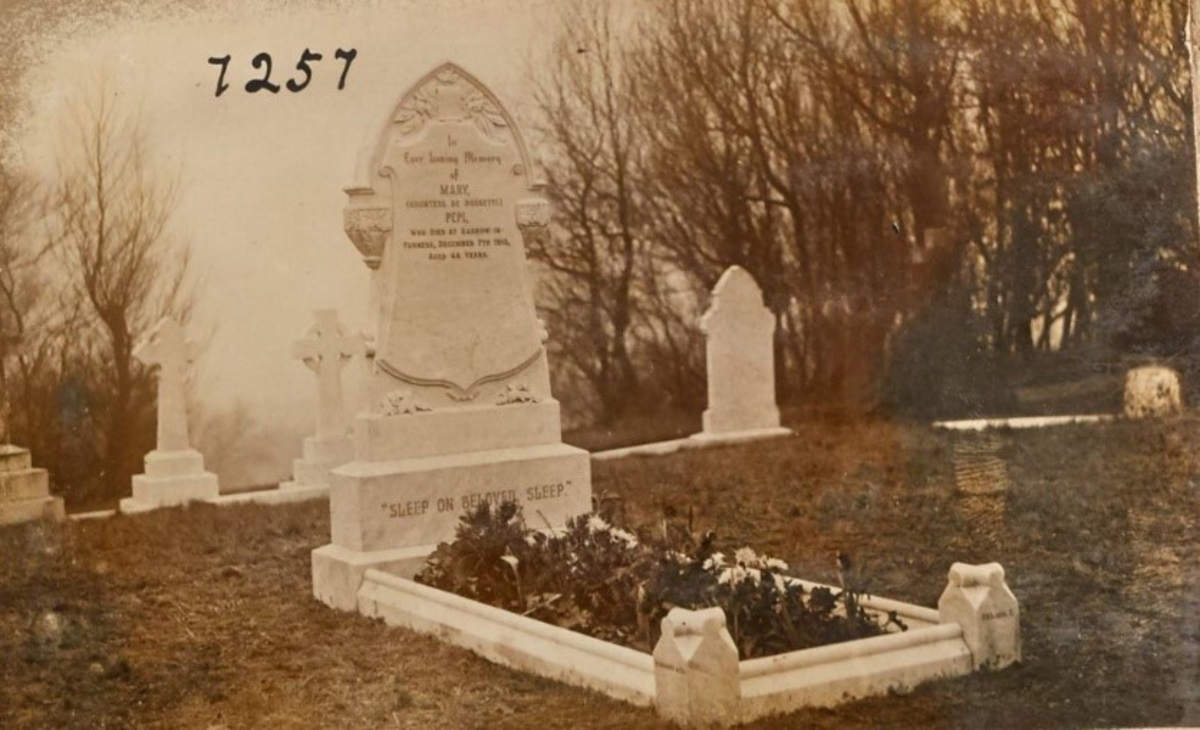

Probably taken Dec 1915 or early 1916
The Tivoli was one of the theatres commissioned by the famous entrepreneur, Signor Pepi:–
He started building a chain of theatres. After Barrow came Blackpool (acquired by ABC as the Hippodrome and rebuilt in 1963 as the ABC – ‘Europe’s most luxurious theatre’ and from where many lavish live shows were televised) and then Carlisle. Then, early in 1907, in partnership with the Birmingham theatre specialist George Ward, he began work on an “Opera House and Empire” on some recently-cleared land in Parkgate, Darlington. Within seven months, the theatre was complete and, named the New Hippodrome and Palace Theatre of Varieties, it opened on September 2.
Even as Pepi received the opening night acclaim, building was beginning on another of his hippodromes, this one in Middlesbrough, on top of an old Quaker burial ground. After Middlesbrough came Bishop Auckland Hippodrome in 1909 followed by Shildon in 1910.
But even as it was growing, Pepi’s empire was crumbling at its peripheries. He sold off Middlesbrough after just eight months, losing £10,000 in the process. Shildon lasted a year, its disposal coinciding with the Bishop Auckland Hippodrome being declared bankrupt in 1911. By the outbreak of the First World War, our principal character owned just two theatres: Darlington and Barrow. To make matters worse, on December 7, 1915, his wife Mary, Countess de Rossetti, died at their modest mid-terrace home in Barrow. She was only 46.
This article is an abridged version of a chapter in Chris Lloyd's book, Of Fish and Actors: 100 Years of Darlington Civic Theatre - Permission grantedSignor Rino Pepi was one of the leading quick-change artistes of the late 19th century and at the age of 30 bought the Star Theatre of Varieties in Barrow – later the Tivoli in Forshaw Street. He came to Barrow as a performer on a tour of the provinces but found out the theatre was for sale and embarked on the building of what would become a theatrical empire. He had strong links with the development of the theatre in the North East and his story is told in Of Fish and Actors: 100 Years of Darlington Civic Theatre by Chris Lloyd. (2007)
Signor Pepi was born in 1872 as the son of a merchant in Florence, Italy. By his early 20s he was a star across Europe. Queen Victoria liked him so much she gave him a diamond scarf pin. Along the way, he fell in love with Mary, Countess de Rossetti, a widow who was half-Italian and half-Irish. She taught him English and 1898 he came to London and for three months he topped the bill at the Pavilion in Piccadilly Circus – now the Trocadero shopping centre – with a 15-minute sketch called Love Always Victorious. He played all seven characters in this show, male and female. Signor Pepi took his show to Austria, Belgium and Holland, before starting the British tour which brought him to Barrow in September 1902.
An account of the funeral of Mary Pepi appeared in The Stage 16 December 1915:
Funeral of Mme. Pepi.
The funeral of Mme. Mary Pepi, wife of Signor Pepi, lessee of the Tivoli, Barrow-in-Furness, and the Hippodrome, Darlington, took place at the Cemetery, Barrow-in-Furness, on Friday last. Mme. Pepi died on December 7, after a ong and painful illness. Present at the funeral were Signor Pepi, Mrs. Duncan and Miss Betsy Duncan, Mr. Fred Newman (lessee of the Palace), and Mrs. Newman, Mr. S. Dring (representing the proprietors of the Walney Theatre), Mr. E. Evans (representing the Royalty), Mr. Hugh Rainey (Gaiety), the staffs of the Tivoli and the Palace, Mr. and Mrs. Steele, Mr. Whewell (Bolton), Mrs. Robertson, Major Smith, Mr. T. Harrison, Mr. H. Walker, Mr. Parker, Mr. Morgan, Mr. Valerio (Hippodrome, Darlington), Mr. W. Wilkins, Mr. and Mrs. Tralfall (sic), Mrs. Cooper, Mr. W. Jones (Lancaster). There was a very large collection of wreaths, from amongst others, Signor Pepi, a harp 5ft. deep in flowers and tied with ribbon representing the Italian colours, … Wee Georgie Wood, Mr. and Mrs. Geo Formby, Mr. Fred Karno’s company (Mumming Birds), … (edited).
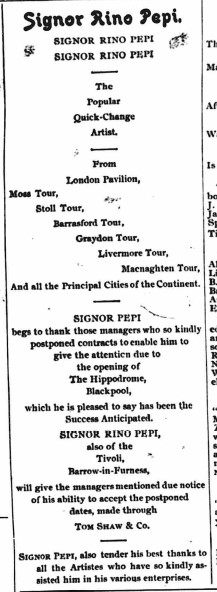
Advert (above) from The ERA 26 December 1903

Advert (above) from the Leamington, Warwick and District Daily Circular 27 July 1899.
1911 Census
In the 1911 Census the Pepis were living at 10 Pensbury Street, Darlington, though Rino signs his postal address as “Palace, Darlington” (now the Hippodrome). Rino Pepi is 40, Music Hall Manager, born Chiensi, Italy, while his wife Maria Pepi (39) was born in Livorno, Italy.
The National Probate Calendar (Index of Wills and Administrations) 1928 had:
PEPI Rino of 2 Tower-road Darlington died 17 November 1927 Probate London 6 January to George Gosling Plant solicitor and Trevor Morris bank manager. Effects £11127 13s 9d.
No-one is certain why Edward Sankey took photographs of graves in the period 1910-1920 or later. Were they advertising the skills of his friend William Hull, or later Hull and Fairbairn? Were they to be made into postcards that the bereaved family could send to members who were not able to attend the funeral?
The historic photograph is from the Sankey Family Photographic Collection, courtesy of Cumbria Archives.