Died
16 June 1914
Born
24 January 1845
Sources
Place
Walks
Theobald Fitzwalter Butler
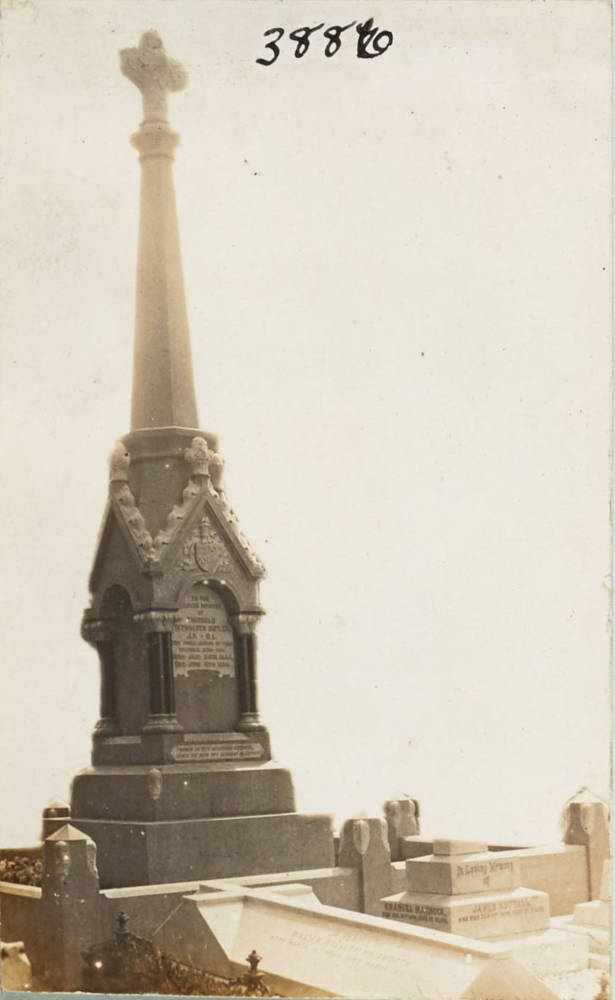
Sankey has blanked the background from this photograph, making it look as though the grave stands in splendid isolation. This is not the case, but it is difficult to isolate its splendour, being surrounded by trees.

Its four sides carry various names:
TO THE
BELOVED MEMORY
OF
THEOBALD
FITZWALTER BUTLER
J.P. – D.L.
FIVE TIMES MAYOR OF THIS
BOROUGH 1905-1911.
BORN JANY 24TH 1845,
DIED JUNE 16TH 1914.
AND HIS WIFE
CATHERINE ELIZABETH
DAUGHTER OF
MAJOR JOHN BARRACLOUGH
OF HEATON, YORKSHIRE.
BORN JULY 27TH 1856,
MARRIED JUNE 16TH 1883,
DIED FEB, 2ND 1946.
ROSE GEORGINA
BORN MAY 3RD 1887
DIED APRIL 2ND 1939
FRANCIS JAMES
BORN JUNE 12TH 1891
DIED APRIL 28TH 1945
MAJOR M.C.
LANCASHIRE FUSILIERS
KATHLEEN TERESA
BLAKE
BORN 26TH SEPT. 1883
DIED 2ND JULY 1950
MISTRESS OF
GIRTON COLLEGE CAMBRIDGE
1942 - 1949
ELIZA MARIAN
BUTLER M.A. D. LITT.
BORN DECR 29TH 1885
DIED NOVR 13TH 1959
THEOBALD BLAKE
BUTLER
BORN SEPT 10TH 1888
DIED JAN 1ST 1965
FITZWALTER BUTLER
BORN SEPT 29TH 1889,
DIED SEPT 29TH 1979
THEOBALD
FITZWALTER BUTLER
13.09.1921 – 13.10.1999
SON OF
FITZWALTER BUTLER
PENELOPE
PATRICIA BUTLER
4.07.1931 – 1.08.2013
WIFE OF
THEOBALD FITZWALTER

The epitome of dapper, this carte de visite of the Mayor of Barrow, Coun. T.F. Butler, is from the collection of Harper Gaythorpe, courtesy of Barrow Archives.
The Barrow Guardian 20 June 1914 carried news of Councillor Butler’s death:
DEATH OF Coun. T. F. BUTLER
We regret to announce the death of Councillor T. F. Butler, J.P., D.L., which took place on Tuesday afternoon at his residence, Infield, Barrow, after a somewhat lengthy illness.
Councillor Theobald Fitzwalter Butler, J.P., D.L., was born at Glenwilliam, Co. Clare, Ireland, on January 25th(sic – the grave says 24th), 1845, and was the youngest son of the late Mr. James Blake Butler, J.P., of Stammer Park, Co. Clare, and Juliana Helena, daughter of the late Mr. George Comyn, of Holywell, Co. Clare. When but a few years old Councillor Butler’s parents died. He lived with his grandmother at Mount Vernon, Co. Galway, and received his education early on under a private tutor. Subsequently he attended a day school near Islington Square, London, and was afterwards at the grammar school at Barnet, and at the Kingsland Academy, Shrewsbury. Early in life he went out to Australia, and for two years was in Victoria, but at the end of that period he returned to the Old Country, and entered a bank in Ireland as one of the clerks. Subsequent to this he went to Liverpool, and was one of the staff in a mercantile office in that city. In the year 1870 he came to Barrow, and was the manager for Messrs. Ross, Willis and Co., and was in Barrow the following year, when there was a great boom in the iron and steel trades. At a later date he was with Messrs. George Bargate and Co., iron and steel merchants and ship owners, whose offices were in Ramsden Square, - those at present occupied by Messrs T. F. Butler, Limited. Mr. Butler was made a partner in Messrs. Bargate and Co., and with Mr. Bargate purchased from the Swansea Blast Furnace Co., Limited, the Landore blast furnaces, which concern they worked under the style of the Swansea Hematite Iron Co., until the sale of the property in 1889 to Messrs. Wright, Butler, and Co., Limited, and now Baldwins, Limited. The partnership in Messrs. G. Bargate and Co. was dissolved in 1889. Since that time Councillor Butler carried on business in his own name, later on the style of the firm being T. F. Butler, Limited, as an iron and steel and coal merchant and railway wagon owner at Barrow and at Workington. Councillor Butler was also interested in many iron and steel and coal concerns in West Cumberland and Furness, and had a monetary interest in the coal syndicate formed for the purpose of endeavouring to find a continuation of the West Cumberland seam or seams supposed to underlie Barrow. Some months ago he was made a director of the Whitehaven Colliery Co., when it was turned into a limited company, he being Barrow agent for the firm. Councillor Butler, among other interests, was a shareholder in the Barrow Public High School Co., Limited, and assisted in the formation of the Barrow Athletic Association by becoming a debenture holder. For many years he was a member of the Iron and Steel Institute of Great Britain, and also of the German Iron and Steel Institute (Essenhüttenleute). From 1883 to 1890 he resided in Bardsea, and then removed to Infield, known at one time as Clay’s Mansion, this house being built by Mr. S. J. Clay, wagon builder, etc., of Derby and Barrow.
Councillor Butler took a very great interest in public affairs. He was first elected as a representative of Hawcoat Ward in 1883(?), and continued to be a member for this ward on the Barrow Town Council until the time of his death. He was chosen as the mayor of the borough on November 9th, 1906, and on four subsequent occasions he was elected to that high office. His period of office was marked by many brilliant functions in the Town Hall and also in the grounds of his beautiful residence. During his mayoralty he and Mrs. Butler were made the subject of a handsome presentation on the occasion of one of the mayoral balls in the Town Hall. Councillor Butler was made a Justice of the Peace in 1897, and during the period of his mayoralty was made a Deputy Lieutenant for Lancashire. He was chairman of the Watch Committee at the time of his death, and a representative of the Barrow Town Council on the Lancashire Territorial Association, and was largely instrumental in the building of the fort at Walney. The National Reserve was one of the movements that had his hearty support, and he expressed in the Town Hall, at a meeting to further the scheme, that he would, being an old Volunteer, have joined had age not prevented him. He took a deep interest in open-air swimming, and was the chief mover in the establishment of the open-air swimming baths in the Ramsden Dock, and presented for competition amongst school boys “The Butler Trophy”. One period of his mayoralty was marked by a keen depression in the iron trade of the district, and Councillor Butler was the prime mover in the matter of concerted action with a view to relieving the distress in the town. He met many deputations of the unemployed and worked hard in many ways to alleviate their distress. During his mayoralty he met a large number of Japanese naval officers and officials, who had business in Barrow, and the Emperor of Japan bestowed upon him the Imperial Order, third class, of the Sacred Treasure. He was a man who had strong views on most questions. In politics he was a Conservative, but never allowed his opinions to interfere with any of his civic duties. He was a member of the Church of England, attending St. Paul’s Church, the Rev. W. Berry being his chaplain during the time of his mayoralty. His term of office during the five years was a difficult one in many respects, his services were often heavy, but that his services were appreciated by the inhabitants of Barrow was very evident. As Mayor he conducted the business of the Town Council in an impartial manner, earning the good will of every member of the Council, although opinions frequently differed. After his mayoralty he retired more into private life, but took part in much important Council work, more especially in connection with the duties of the Watch Committee, one of the subjects frequently under discussion being the matter of a new police station, upon which he took a firm stand as to the necessity of an adequate building.
In 1883 he married Catherine Elizabeth, daughter of the late John Barraclough, of Rossfield, Heaton, Bradford, by whom he had a family of four daughters and three sons, who survive him.
Ancestry tells us:
14 November 1840 at St George’s, Hanover Square was baptised Theobald Fitzwalter Butler, son of Theobald Fitzwalter and Julia Celestina Maria Butler, of Hampstead. He was born on 19 July 1840. Under occupation is listed “The Honble” i.e. The Honourable. The marriage records for the same church have them marrying on 14 November 1832. Her maiden name was Brander. This family were living at 10 Runswick Place, Hampstead in the 1841 Census.
National Probate Calendar
The National Probate Calendar (Index of Wills and Administrations) 1878 notes the death of the Honourable Theobald Fitzwalter Butler, died 19 November 1877 and of Knoppogue Castle, Co. Clare and 2 Lower-Fitzwilliam-street, Dublin. His executors were his brothers, the Honourable James Fitzwalter Clifford Butler of the Sanctuary, Crediton, Devon, and the Honourable Robert St. John Fitzwalter Butler of Rutland Lodge, Knightsbridge, Middlesex.
1851 Census
By the 1851 Census he had become Lord Dunboyne, and was a lodger at 68 Mount Street, Westminster. But in spite of having the same name, this is NOT the Barrow T.F. Butler.
There is another Theobald Fitzwalter Butler, son of Rev. Henry Walter Blake Butler, vicar of East Marden, and his wife Charlotte Daly Butler, born 16 January 1871 and baptised by his father on 12 February 1871. This T. F. Butler joined the navy, and is a sub-lieutenant in the 1902 Navy list. The Blake in the father’s name suggests a relative. The Belfast Newsletter 27 February 1902 Births column gives: BUTLER – February 21, at Ilford, the wife of Theobald Fitzwalter Butler, R.N.R., of a son.
At the age of sixteen, a Theobald Butler, farmer, sailed to Melbourne, Australia in the clipper Blue Jacket. I cannot be certain that this is the right Theobald Butler, but the newspaper obit. says that he went to Victoria early life.
1881 Census
In the 1881 Census the Barrow T. F. Butler is staying at Conishead Priory Hydropathic Establishment. He is listed as 36, Married (sic), Iron Merchant, born Innis, Co. Clare. There are over 50 other boarders, with a range of occupations: wool merchant; mine owner; retired bank manager; Wholesale Shoe Factor, etc.
Theobald Fitzwalter Butler married Catherine Elizabeth Butler in Scarborough, North Yorkshire in Q1 1883. If this is January, and not June as it clearly states on the gravestone, then it legitimates Katheleen Teresa Blake Butler, born in September 1883.
1891 Census
By the 1891 Census they are living at Infield, Barrow. Theobald F. Butler (46) Iron & Ore Agent and Merchant, born Ireland, is living with wife Catherine E. Butler (34) born Bradford, Yorks; Kathleen F. B. Butler (7) Scholar, born Ulverston (as were all the following children); Maud J. Butler (6) Scholar; Eliza M. Butler (5) Scholar; Rose G. Butler (3); Theobald B. Butler (2) and Fitzwalter Butler (1). The rest of the household is Eliza Thompson (70) Single, Aunt-in-law, born Leeds, Yorkshire; Louise H. Melsom (29) Single, Governess, born Norway; Jane A. Postlethwaite (50) Widow, Cook (Domestic), born Westmorland; Bessie Palmer (33) Married, Nurse (Domestic), born Cornwall; Mary Ann Walker (25) Single, Housemaid Waitress, born Flint, Wales; and Ellen A. Mitchell (18) Housemaid, born Millom, Cumberland.
1901 Census
In the 1901 Census living at Infield were Theobald Butler (56) Iron Merchant, born Ireland; Catherine Butler (44), born Bradford, Yorks; Fitzwalter Butler (11), no occupation recorded, born Bardsea, Lancs; Francis Butler (9) no occupation recorded, born Barrow, Lancs; Eliza Thompson (81) Single, Aunt-in-law, Living on own means, born Woodhouse Hall, Yorkshire; Matilda Butler (61) Widow, Sister, Living on own means, born Ireland; Hortense Milsom (41) Governess, born Norway (Naturalised British Subject); Elizabeth Bryan (25) Lady’s Maid (Domestic), born Barrow, Lancs; Janet Keir (35) Cook (Domestic), born Scotland; Norah (or Sarah) Hodgson (25) Housemaid (Domestic), born Broughton-in-Furness, Lancs; Mary Allan (19) Housemaid Waitress, born Kendal, Westmorland; Margaret Christian (14) Kitchen Maid, born Bardsea, Lancs. Several of the Butler children were probably away at school e.g. Theobald Blake Butler was a Fettes College, Edinburgh.
1911 Census
In the 1911 Census they are at Infield, Barrow-in-Furness. The full household on Census day was Theobald Fitzwalter Butler (66) Iron and Coal Merchant, born Parish of Crusheen, Co. Clare; Catherine Elizabeth Butler (54) born Parish of Heaton, Bradford; Julianne Maud Butler (26) Single, no occupation recorded, born Parish of Urswick, Lancs; Eliza Marian Butler (25) Single, no occupation recorded, born Parish of Urswick, Lancs; Rose Georgina Butler (23) Single, no occupation recorded, born Parish of Urswick; Theobald Blake Butler (22) Single, Shipyard Draughtsman Engineering, born Parish of Urswick; Francis James Butler (19) Single, Apprentice Fitter, Shipyard, born Barrow-in-Furness; Matilda Helena Butler (71) Widow, Visitor, Private Means, born Crusheen, Co. Clare; Louise Hortense Melsom (51) Single, Lady Companion, born Laurvig (sic), Norway; Elizabeth Chandler (39) Married, Parlour Maid (Domestic), born unreadable; Annie Gardner (25) Single, Cook (Domestic), born Dalton, Lancs; Henrietta Bateman (25) Single, Housemaid, born Dalton; Mary Maria Barlow (20) Single, Kitchen Maid, born Barrow.
NB Hortense Louise Melsom (sic) (13) was living in Bedminster, Bristol with her siblings and widowed mother in the 1871 Census. She died on 8 August 1946 in Cambridge, and the death notice in the local paper says she was “for 56 years the devoted friend of the family of the late T. F. Butler, D. L., J. P., of Infield, Barrow-in-Furness. Elsewhere on Ancestry, her birthplace is listed as Larvik, Vestfold, Norway.
The National Probate Calendar (Index of Wills and Administrations) 1914 has:
BUTLER Theobald Fitzwalter of Infield Barrow-in-Furness Lancashire died 16 June 1914 Probate London 11 August to Catherine Elizabeth Butler widow and the Public Trustee. Effects £36724 18s 5d. (approx. £5.2m today [2023])
Kathleen Butler
Kathleen Butler’s Wikipedia entry reads:
Kathleen Teresa Blake Butler (born Bardsea, 26 September 1883 – died Cambridge, 2 May 1950) was an academic specialising in Modern Languages.
Butler was educated at Newnham College, Cambridge. She was on the staff of the Royal Holloway College from 1913 to 1915 when she returned to Cambridge as a Fellow of Girton. She was a Lecturer in Modern Languages from 1915 to 1942; Director of Studies in Modern Languages from 1917 to 1938; University Lecturer in Italian from 1926 to 1949; Vice-Mistress of Girton from 1936 to 38; and Mistress of Girton from 1942 to 1949. Her publications included "A History of French Literature" (1923); "Les Premières Lettres de Guez de Balzac" (1934); and "Tredici novelle modern" (1946). Her sister, Eliza Marian Butler, was an academic specialising in the German language.
Eliza Marian Butler
Her sister Eliza Marian Butler’s reads:
Eliza Marian Butler (29 December 1885 – 13 November 1959), who published as E. M. Butler and Elizabeth M. Butler, was an English scholar of German, Schröder Professor of German at the University of Cambridge from 1945. Her most influential book was The Tyranny of Greece over Germany (1935), in which she wrote that Germany has had "too much exposure to Ancient Greek literature and art. The result was that the German mind had succumbed to 'the tyranny of an ideal'. The German worship of Ancient Greece had emboldened the Nazis to remake Europe in their image." It was controversial in Britain and its translation was banned in Germany.
Life
Eliza Butler, known as "Elsie", was born in Bardsea, Lancashire, to a family of Anglo-Irish ancestry. She was educated by a Norwegian governess (from whom she learned German) and subsequently in Hannover from age 11, Paris from age 15, the school of domestic science at Reifenstein Abbey from age 18, and Newnham College, Cambridge from 21. As a teenager, she watched Kaiser Wilhelm II inspect his troops. In the First World War she worked as an interpreter and nurse in Scottish units on the Russian and Macedonian fronts (she had learned Russian from Jane Harrison) and treated the victims of the German assault. From 1926 to her death Butler lived and travelled with her companion Isaline Blew Horner. After working in hospitals, she taught at Cambridge and in 1936 became a professor at the University of Manchester. Her works include a trilogy on ritual magic and the occult, especially in the Faust legend (1948–1952).
Butler also wrote novels. Her autobiography, Paper Boats, was published by William Collins, Sons in 1959, the year of her death. She died in London on 13 November 1959.
She may have inspired the scholar Suzanne L. Marchand to research German Orientalism, as Marchand emphasized the political overtones of Orientalistik, in reaction to Edward Said's assumption that Germany has had a mostly "classical" interest in the Orient (Said overlooked Germany in his Orientalism).
No-one is certain why Edward Sankey took photographs of graves in the period 1910-1920ff. Were they advertising the skills of his friend William Hull, or later Hull and Fairbairn? Were they to be made into postcards that the bereaved family could send to members who were not able to attend the funeral?
The historic photograph is from the Sankey Family Photographic Collection, courtesy of Cumbria Archives.