Died
26th May 1931
Sources
North Western Daily Mail
Barrow News
Kevin Alexander (Grandson)
Cumbria BMD
Ancestry
Place
William Alexander
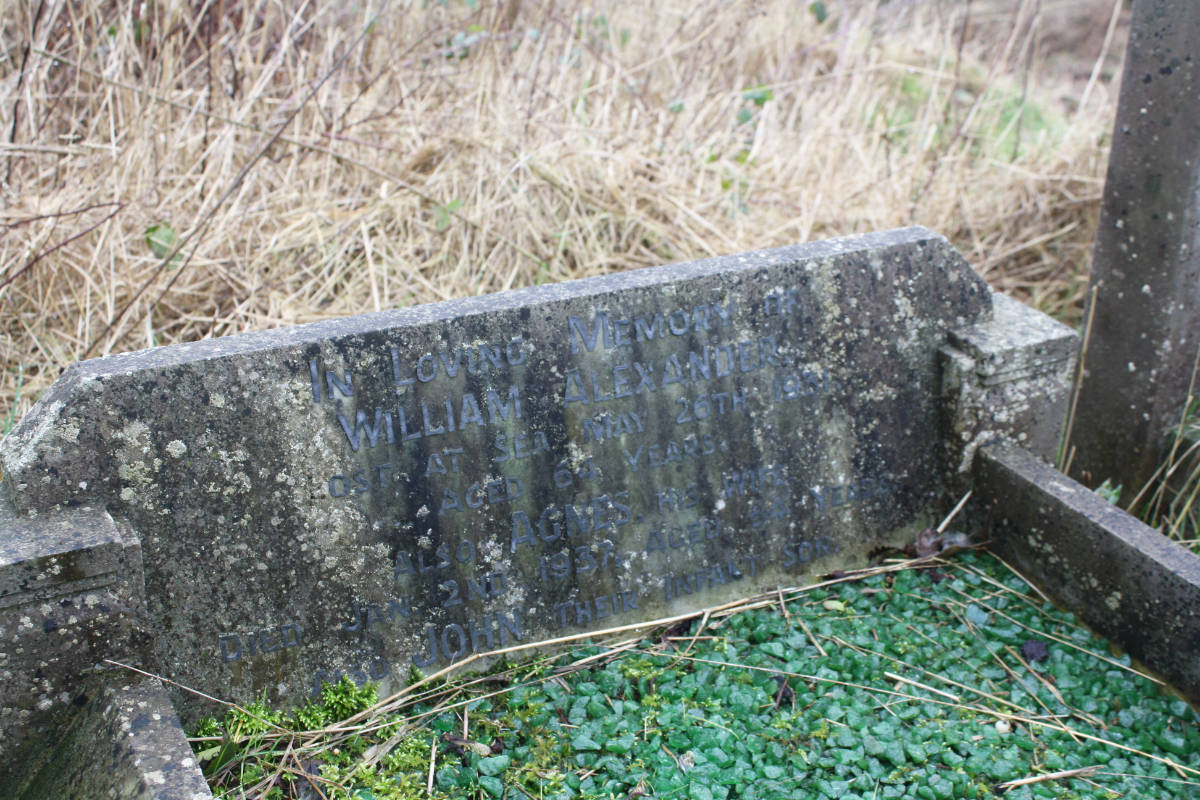
IN LOVING MEMORY OF
WILLIAM ALEXANDER
LOST AT SEA MAY 26TH 1931
AGED 64 YEARS
ALSO AGNES, HIS WIFE
DIED JAN 2ND 1937 AGED 64 YEARS
ALSO JOHN, THEIR INFANT SON
The disappearance of William Alexander is connected with a court case over a dispute between two Askam families. The account in the newspaper of the day (North Western Daily Mail, Monday 25 May 1931) took virtually a whole page – 4 out of 5 columns; 2 columns the next day, and 1 for the Assize court trial.
ASKAM MAN COMMITTED FOR TRIAL
Witnesses’ Story of Affair on Duddon Sands
CHARGES AGAINST TWO OF THE MEN DISMISSED
Hearing of Case to be Continued
At Ulverston Magistrates Court, on Saturday, the hearing was resumed of the case in which seven fishermen belonging to Askam are charged with being concerned in an alleged affray on Duddon sands in which some of them were severely injured. The men belong to two families of fishermen, who are stated to have been in dispute over the placing of fishing nets on the sands. Owing to the number of cross charges and the necessity of investigating each particular one by the interrogation of witnesses, the hearing has already occupied a considerable time, the court sitting until 6.30 p.m. on Thursday.
The names of the accused, and the charges against them, are:
Henry Birbeck (35), charge with maliciously wounding William Alexander, senr., and Samuel Alexander.
James Birbeck (30) and William Birbeck (22), charged with the same offence.
William Alexander, senr. (60), charged with maliciously wounding Samuel Birbeck.
William Alexander, jnr. (39), James Alexander (17), and Samuel Alexander (21), charged with the same offence as William Alexander, senr.All the accused were further charged with assault.
The first three accused were represented by Mr. Stanley Fisher, and the others by Mr. F. W. Poole.
WITNESS’S ILLNESS
The witness who fainted at the last hearing (James Alexander), again went into the box, and the Chairman asked him if he had recovered. He was accommodated with a chair, when Mr. Stanley Fisher proceeded with his cross examination, but immediately showed signs of collapse again. The Magistrates Clerk asked witness what was the matter with him, and he stated that he was “feeling bad.”
Mr. Fisher: You spoke to Stevenson. Was it before the Birbeck’s returned? Was it about the time your father shouted to you?
Witness: Yes.
Was the net at which you were working about the spot of No. 5 pit? – No, nearer the locks.
Do you remember what time it was when you went to your net? – About half-past seven. When I left home.
Would it take about a quarter of an hour to get to the net? – Yes.
You had been working at your net about an hour before the Birbeck’s arrived? – No, about half an hour.
When they left your net was it still light? – It would be closing in dusk.
Had they to go another 300 yards? – Yes.
Could you see them at their net? – Yes.
Was your Teddy at your net? – No.
WOMAN’S EVIDENCE
The next witness was Jane Alexander, residing at 34, Furnace-place, Askam, who said that between 8.30 and 9.00 o’clock, when she went down on to the Askam foreshore in consequence of what she had been told, she there saw a crowd of men, including the three accused, surrounding her brother, Samuel, who was lying on the ground. Her brothers, James and William, were also there. She also saw her father, who was bleeding from the ear, and his face was covered with blood. Immediately, her brother Samuel got up from the ground, and she saw that he was bleeding from the face. William Birbeck had a net stake in his hand (similar to the one produced). The four Birbecks were chasing her brothers James and William. Her brother William had called for her to go for the police.
Cross-examined by Mr. Fisher, the witness said it was practically dark when she got on to the shore.
It was so dark that you could not see more than a few yards in front of you? – No, sir; not when I first got on to the shore.
Was John Bodley there also? – Not then.
He was actually on the shore when you got back the second time? – Yes.
Did you say “If it had not been for my father there would have been none of this”? – No, sir.
Did Bodley ask you who the men were on the other side of the channel? – No.
Did you hear him call, “Where’s Birbeck”? – No.
Did you hear you brother William shout: “You know as much as I b***** well do”? – No.
WENT FOR THE POLICE
In reply to further questions witness said, the fight had started before she went for the police. Her brother Samuel was on the ground, and her father had just got up and was going home.
Where was your brother Teddy? – He was not there, he was ill in bed. He got up and went on the shore afterwards to meet my brother, after the fight was over.
Edward Alexander was the next witness called. He said he was a labourer on the L. M. & S. Railway Engineering Department, residing at 34, Furness-place, Askam. About 8.30 p.m. on the date in question he was in bed suffering from influenza. In consequence of what his mother told him he struggled out of bed and went down to the beach, when he saw his brother Sam coming off the shore. Blood was falling from his head on to his clothes down the front. He did not see any of his other brothers or his father; neither did he see any of the Birbecks.
It would be turned 9 o’clock when he reached the place where he met his brother Samuel. It was dark.
In reply to Mr. Fisher, witness said he did not see his sister Jane on the shore, nor his brother William. He saw John Bodley, who was quite near to him.
Did you pick up a stake and strike Birbeck? – No.
And did Henry Birbeck ward off the blow and strike you with his fist and knock you on to the sand? – No.
How long had you been in bed with the ‘flu? – Since 3 o’clock the day before.
Wm. Hewitson, iron-ore miner, residing at 94, Steel-street, Askam, said that about 10 o’clock on Saturday, April 25th, he was shown the spade produced by P.C. Parkinson and identified it as his property, and the one he had lent to either Henry or William Birbeck about a month previously.
William Maxwell Stevenson, an unemployed labourer residing at 123, Sharp-street, Askam, said he remembered about 8.30 p.m. on Thursday, April 23rd, being on the shore at Askam, when his attention was drawn to Samuel Birbeck, whom he recognised by his voice. He could see he was fighting with two or three more, and he heard the blows, stakes being used. A few minutes later he heard William Alexander shouting, “Come on, you three.” Witness was shrimping, and walked down the Channel to the nets. He also saw James, and two others. He could see a lot of figures, and a crowd had assembled on the shore before he left.
Mr. Fisher cross-examined witness at some length.
IN THE DUSK
Joseph Bodley, a labourer, living at 153, Sharp-street, Askam, said that shortly after 9 o’clock on Thursday, April 23rd, in consequence of what his sister-in-law told him, he went down to the shore, just on the dry-water channel. When he got there he saw Jane Alexander with a net stake, and Wm. Alexander, junr. He also saw about four or five forms in the dusk.
In reply to Mr. Fisher, witness said he did not see any blows struck. He saw Samuel Birbeck, who came past where he was standing on the dry-water channel. Witness noticed he could scarcely walk and was staggering forward, and his clothes seemed to be wet.
John Bodley, of 90, Steel-street, Askam, said that about 8.30 he was on the shore at Askam and met Samuel Birbeck. After reaching home and hearing of the disturbance, he returned to the shore about quarter to nine. He met Jane Alexander and stopped there with her. He also saw William Alexander, junr., and his brother Edward, but saw nothing of the Birbecks.
In reply to Mr. Fisher, witness said he asked Jane Alexander what had been going on, and she replied “If it hadn’t been for my father, there would have been none of it.” He asked her who was on the other side, and she made no reply. He could not recognise the figures as it was too dark, although they were only ten yards away. He shouted across the channel “Where’s Henry Birbeck?” and he recognised William Alexander’s voice shouting back “You’ll know as much as I do.” He then went across the channel and saw both William and Edward Alexander.
Mr. Fisher: Edward Alexander has sworn in the box that he was not across the channel on that particular evening, what have you got to say to that?
Witness: I say he was.
How long were the police after you in getting to the shore? – Ten minutes.
How many would there be in the crowd? – About 30 or 40.
CUTS OVER HEAD
P.C. Parkinson, stationed at Askam, said at 9 p.m. on Thursday April 23rd, he was in company with Sergt. Law, and in consequence of what he was told went on to the shore at Askam, and saw a crowd of people coming from the shore. Near the water’s edge he saw Samuel Alexander, who was bleeding freely from the bridge of the nose and to cuts over the left eyebrow. Witness took him to Askam Police Station and rendered first aid. Shortly afterwards William Alexander, senr., came to Askam Police Station. Samuel Alexander’s left ear was almost severed from his head and he was bleeding profusely. About 10.30, the accused, Henry Birbeck, came into the police station, accompanied by his brother, Samuel. Samuel was in a fainting condition and had a deep scalp wound.
In consequence of a statement made by William Alexander, senr., he took Henry Birbeck into custody and charged him with unlawfully and maliciously wounding William Alexander and also with wounding Samuel Alexander by striking them with a spade. He replied, “How could I strike a man when I was on the ground with a man pointing a double-barrelled sporting gun at me. That was William Alexander, the old fellow’s son.” The constable later visited Birbeck’s house and took possession of the spade (produced), which he found in the back yard. It was very wet and covered with wet sand. The following day at 3.30 p.m. he interviewed James Birbeck, of Steel-street, Askam. After cautioning hi he told him he was making enquiries respecting an affray on the shore, the previous night. He also told him he would be detained, pending enquiries. At 1.15 p.m. the same date he took possession of the gun (produced) which was handed to him by the wife of William Alexander, junr., and later the same day cautioned and charged the three accused together. Henry Birbeck replied, “Carry on,” William Birbeck made no reply, and James Birbeck replied “We hadn’t a _____ spade; we are too _____ English to have one.” Whilst the men were in custody William Birbeck said he wished to make a statement. James Birbeck also made a statement.
The written record of these to statements were produced in court and read.
In reply to Mr. Fisher, witness said he asked Mrs. William Alexander if she had a gun and she said she had not one in the house. She later handed the constable the gun (produced) which was hanging up on the wall.
CUTS OF FACE
Sergeant Law, stationed at Askam, said that when he reached the shore he saw Samuel Alexander standing by the water’s edge. He had a deep cut on his nose and two over his left eyebrow. He asked Henry Birbeck if the spade was his and he replied, “I would rather not say.” Witness then asked him, “Did you not tell me that the spade was Alexander’s last night?” Birbeck replied, “I am not going to say anything about it until I see which way this thing is going.”
P.C. Parkinson, recalled, gave evidence as to serving copies of the statements (made by the accused) on each of the other Birbecks.
A previous witness, John Bodley, was also recalled and questioned by Mr. Fisher.
This closed the case for the prosecution against Henry Birbeck.
Mr. Fisher, for the defence, submitted that not enough evidence had been presented to support the charge against James Birbeck.
The magistrates retired for consultation.
On their return, the Chairman said the Bench proposed to listen to what the defence had to say with regard to James and William Birbeck, as they were of opinion (sic) their cases were of common assault, and they would not proceed with the more serious charge with regard to these two.
ONE MAN FOR TRIAL
The Chairman, addressing Henry Birbeck, the first of the accused, said: “You are charged with wounding Wm. Alexander with intent to do him grievous bodily harm, and similarly charged in respect of Samuel Alexander. Have you anything to say?”
Henry Birbeck: No, sir.
Mr. Fisher intimated that the accused would reserve his defence.
Henry Birbeck was then committed for trial at the next Lancaster Assizes. He was allowed bail in the sum of £25.
An application by Mr. Fisher for a legal aid certificate was granted.
Mr. Fisher said it was the contention of the defence in the two cases of common assault that the whole of the trouble arose out of jealousy on the part of the Alexander family, all of whom did a certain amount of fishing, and the defendant resented anyone coming to certain places on the foreshore and setting nets. He suggested that the Bench “could not possibly have heard more contradictory evidence.”
THROWN INTO CHANNEL
Samuel Birbeck, the first witness called for the defence, said he had no interest in fishing. On the evening in question he set off to go along the shore, leaving the house at 8.40 p.m. He kept to the shore, and when he got to the bridge he met Jack Bodley and Wm. Askew. He said he had walked some distance when five of the Alexanders ‘ran out at him,’ knocking him to the ground, and carrying him a distance of 50 yards, and throwing him in the channel.
James Birbeck said he went to his net in company with his brother William. They set off for home when Alexander, senr., shouted, “Come on lads, let the ________ have it now; we have got them all here.” There was a fight afterwards. He dragged his brother Sam away unconscious, to save him from any more blows. He heard his brother shout, “Is that you Harry?” When he got to his brother Samuel he took hold of him. At no time had he a stick, nor did he strike Samuel Alexander. He did not see his brother William strike, his whole attention being taken up with his brother Samuel.
Wm. Askew, of Queen-street, Askam said he visited the shore about 8.45 p.m. The first person he saw was Jane Alexander. James Birbeck remained with his brother. He did not see James Birbeck or William Birbeck strike Samuel Alexander.
In reply to the Chairman, he said he did not see any blows struck.
Wm. Birbeck said he was carrying a spade. He saw the Alexanders, and said they were knocking his brother Samuel with stakes. Four or five surrounded him. The stake belonged to Edward Alexander.
Mr. Fisher: Did you knowingly strike Samuel Alexander? – No, sir.
Did you use any more force than was necessary to protect yourself? – No.
Did you see your brother James? – Not at all.
CASES DISMISSED
The Bench hereupon dismissed the cases against James Birbeck and William Birbeck.
Supt. Crapper then proceeded with the prosecution of William Alexander, senior, William Alexander, junior, James Alexander and Samuel Alexander, charged with assaulting and wounding Samuel Birbeck. The Supt. said that the facts were largely as stated in opening the first case.
Samuel Birbeck, a general labourer, residing at 113, Steel-street, Askam, said he recalled a day last July when gathering winkles on the shore at Askam. He heard one of the Alexanders say to his brother Henry, “I will bring the gun and blow your ____ brains out.” His brother told William Alexander, junior, not to be so silly as he would fight him a fair fight any time. No further quarrel occurred until April 23rd, this year. He was walking along the beach, and saw the four Alexanders and another called Bob. He noticed that William Alexander, junior, had a gun under his right arm, and the other four had fish-net stakes. They ‘set about him’ right away.
“LET HIM DROWN”
He heard one of them say, “Take him to the Channel; throw him in and let him drown.” The second time he saw the Alexanders all three had stakes and all struck him with them. He later found himself at 84, Steel-street, Askam. His injuries, he said, included a cut over the head 2½ inches long. He was also bruised about the body and arms. After attention by ambulance men, he was attended by Dr. Southern.
Cross-examined by Mr. Poole, the witness said there was “nothing unusual” going on on the shore.
Mr. Poole: Why did you send Hewitson for the police?
Witness: Because William Alexander shouted “Come on, chaps, get to the other ______ .”
You were assaulted by five men, nearly drowned, and yet you went to assist your brothers? – No.
Could you see anything on the shore? – I could see a crowd.
When you got back on the second occasion, a crowd had assembled? – Yes.
Witness, in further cross-examination, denied that he was attracted to the shore by hearing voices, and went armed with a stick with a knob on it, and that he aimed a blow at the younger Alexander, who took the stick off him.
STAKING STAKES
Henry Birbeck, of 84, Steel-street, Askam, said he remembered about 8 a.m. on Thursday morning he went to his brother James’s net. One of the Alexanders (James) came out to their net to do fishing. When he passed him and put some stakes in, James Alexander went home. Five minutes later, Wm. Alexander, sen., came down and said, “What do you mean by putting those stakes in front of our Sam’s net?” Witness replied, “We have equally as much right to put those stakes there.” Alexander said to witness, “I think you are asking for trouble.” Witness asked, “Who with?” and he replied “My son, William. I’ll bring him to you, and he’ll knock hell out of you.” Witness said, “Go and bring him, and we’ll see if he’ll knock hell out of me.” When he was going away he said to witness, “You’ll see.”
About 8.30 the same evening witness went to the nets with his two brothers, William and James, and took the fish out of the nets. His brothers were cleaning the arm of the net while he was sanding the corner of the net. After they set off for home they passed three men – Edward and Harry Alexander and another. About 30 or 40 yards further on, Wm. Alexander, sen., came running across the bank, shouting to his sons, shouting “Come on, here they are!” One of Alexander’s sons shouted to his father, telling him to get himself home. They saw someone making towards them, heard the clattering of stakes, and then heard someone shout, “Harry, Harry!” Witness ran to his brother’s assistance, and there were the Alexanders – William, sen., William, jun., Edward, James, Samuel and Harry – all standing over his brother “braying” him with net stakes.
IN THE MELEE
His brothers, James and William, were following on behind, and as soon as witness got up Edward Alexander ran at him with a net stake. He was delivering his blow when witness guarded the blow off with his left hand and struck him in the jaw with his right fist. He was bruised on the arm between the wrist and the elbow by the blow.
“William Alexander (continued the witness) rushed at me with a gun, and I made a grab and got the gun by the barrel. Whilst I was struggling with him with the gun, old Alexander came and hit me at the back of the head with a net stake. I got up and ran perhaps 20 yards to where my brother William had left his spade. I went back with the spade and made for the man with the gun, and drove him across the dead water channel. A crowd gathered and he said, “Come on Harry, I’ve been waiting for you.” He was retreating. When the crowd said the police were coming Samuel Alexander was charging him with a net stake, and he was guarding him off, and jabbed him with the spade. Old William, likely, got in the road, same as the rest.” Later witness went for the police, with his brother Samuel.
Mr. Poole (cross-examining): Your object in going to the police station to make a voluntary statement was to mislead the police? – No, sir.
You didn’t say anything to the police about jabbing anyone with a spade then? – No, I didn’t say anything about the spade.
You say, in the voluntary statement, that you were knocked off your feet and young Will Alexander stood over you with a double-barrelled sporting gun? – Yes.
Yet in the box today you could not say definitely that it was a double-barrelled gun? – I felt it was by the barrel.
ATTACK OR DEFENCE?
You got the spade and went for the man with the gun. You do admit you attacked with the spade? – I did not attack, I defended myself.
Dr. Southern said that on being called to Askam Police Station he found Samuel Birbeck suffering from a deep cut in the scalp, 2½ inches long. Witness stitched the wound. He also found the man to be suffering from bruises on his scalp and weals on the body, shock, and loss of blood, and took him home in his car. In his opinion, the wound was caused by a blunt instrument. He saw the man the following day, when he was suffering from weakness as a result of loss of blood, and he advised his removal to hospital, but he refused to go.
James Birbeck, a labourer, residing at 84, Steel-street, Askam, said he was on the shore with his brothers, William and Henry, attending to the nets. He had just finished and was about to return home when he heard Alexander, senr., shout, “Come on, lads, give the _____s it while we have got ‘em together.” Before that one of the Alexanders shouted to his father, “Get yourself to _____ out of it,” and the elder Alexander said, “Come on, while we’ve got ‘em here!” A form was coming towards him in the dusk, and he recognised the voice of his brother, Samuel. The whole of the Alexanders were striking out with net stakes at his brother Samuel. He went to his assistance and while he was attending to him, they attacked Henry and William. He also heard William Alexander, junr., say to his brother, Henry, “I have been waiting a long while for you Harry, I’ll blow your ______ brains out as soon as you get in reach.” He heard the women in the crowd say to William Alexander, “For God’s sake think of your wife and kids.”
The witness was cross-examined by Mr. Poole, respecting the discrepancies appearing in his signed voluntary statement and his evidence given in court.
“FINISH THEM OFF”
William Birbeck gave evidence that at 8.30 on the evening of the 23rd he and his brothers went to the shore. They did not see any of the Alexanders until they were coming home, when they saw three of them. He saw his brother Samuel making towards him. As he approached he called out, “Make this way lads; they are waiting for you in this hollow,” and Wm. Alexander shouted, “Here they are lads, finish the ___ off.” The next thing he saw was that the Alexanders had ‘set upon’ his brother Samuel, and were beating him with net stakes. Wm. Alexander was carrying a gun, and witness heard somebody shout, “For God’s sake don’t do it! Think about your wife and kids.” He had dropped the spade some yards back.
Mr. Poole: How did your brother get the spade again? – My brother went back for the spade to shield himself in self-defence.
He got it and entered into the affray again with the result that he jabbed and injured two of the Alexanders? – No, I didn’t see that.
How far was your brother Samuel from you? – From 30 to 40 yards on the right-hand side.
He was nearer to you than Alexander, sen.? – Yes.
How many were there with Alexander, sen.? – Four.
The four you could see immediately attacked your brother Samuel, and you and your other brother went to his assistance? – Yes.
And they were still beating him? – Yes.
At 6.30 p.m. the Court adjourned, the Chairman intimating that the case would be proceeded with at 10 a.m. to-morrow (Tuesday).
(North Western Daily Mail, Tuesday 26 May 1931)
FIVE ASKAM MEN FOR TRIAL
THE ALLEGED AFFRAY ON DUDDON SANDS
CONCLUSION OF LENGTHY CASE AT ULVERSTON
The hearing of the case against Askam fishermen alleged to have been concerned in an affray on Duddon Sands, was resumed at Ulverston to-day, when the magistrate were Ald. S. Taylor (in the Chair), Mr. J. Walker, Mr. J. H. Ellwood, and Mr. D. Lawn.
The accused were William Alexander, sen. (60) charged with maliciously wounding Samuel Birbeck.
William Alexander, jun (39), James Alexander (17), and Samuel Alexander (21) charged with the same offence as William Alexander, sen.All the accused are further charged with assault.
Mr. F. W. Poole appears for the defence.
Henry Birbeck (35), has already been committed for trial at Lancaster Assizes, charged with wounding William Alexander, sen., and Samuel Alexander, with intent to do them grievous bodily harm, and has been released on bail. Charges against James Birbeck (30), and William Birbeck (22), in connection with the affair, have been dismissed.
William Askew, an iron-ore miner, residing at 139, Steel-street, Askam, was the first witness called. He stated that about 9 p.m. on April 23rd he was on the shore, and there saw Samuel Birbeck, bleeding from the head, which was running down each side of the cheek. His clothing appeared to be very wet. He also saw Jane, Ted and William Alexander, junr. He saw Samuel Birbeck come down and cross the channel. William Alexander, jun., came on the scene, and, making a motion to his pocket, warned them to stand back, saying to the crowd, “If you come over here, I’ll blow your brains out.” He saw fighting going on, but he could not tell who the men were, as he was too far away. He saw a figure on the floor on his hands and knees, and when he got there found it was Samuel Birbeck.
Mr. Poole: In consequence of what you were told, you went down to the shore and saw Samuel Birbeck come down after two or three minutes and cross the channel. Did you notice whether he was carrying anything? – No, sir.
At that time he was not bleeding from the head? – No.
And William Alexander was then about 10 yards away from you? – Yes.
Edward was with William at this time and a crowd was gathering? – Yes.
“TROUBLE GOING ON”
And the trouble was going on on the sands, about 150 yards away? – Yes.
And Samuel Birbeck made for where the trouble was going on? – Yes.
William Alexander had nothing in his hand to carry out his threat of shooting? – Not that I could see.
Sergeant Law, stationed at Askam said that at 9.30 p.m. on Thursday April 23rd, in consequence of what he was told, he went on to the shore at Askam in company with P.C. Parkinson, and later saw Samuel Birbeck at the police station. The latter then had a wound on the top of his head about 2½ inches long. At 11.30 the following day he saw the accused, James Alexander, in Furnace-place, Askam. He cautioned him and told him he was making inquiries regarding the affray on the shore at Askam the previous day; and that he would be detained pending inquiries. He took him to the police station. At 6.30 p.m. the same day he saw William Alexander, jun., in company with Det.- Constable Rothwell. He cautioned him and told him he was making inquiries regarding the affray on the shore at Askam the previous day; and that he would be detained pending inquiries.
HIT WITH A SPADE
Det.-Cons. Jas. Smith Rothwell said that at 1 p.m. on April 24th he interviewed William Alexander, sen. He cautioned him and told him he was a detective from Ulverston making inquiries into the Askam Affray. He made a statement, which witness took down in his pocket book. This was now read in court.
This contained the following:-
“Between 8.30 and 9 p.m. on April 23rd I went towards a group of my sons, Jim and Sam, and the Birbecks, who were ‘rowing’ on the shore. The Birbecks were striking my sons with stakes. When I got closer I saw seven Birbecks and mates around our Sam beating him. I ran off to call the police.
“IF I HAD A GUN ….”
As I was running away Harry Birbeck hit me four times on the head with a spade, and made a cut which nearly took my left ear off. There has been trouble for months over the fishing between the two families of us. I have no gun, but if I had a gun I would shoot the lot of Birbecks if I had plenty of shot. But I got lamed before I struck a blow. I only had a walking stick with me.
At 1.20 the same day, witness again saw William Alexander, senior, at his home, cautioned him and told him he would be detained pending inquiries. Witness was present later that day when accused was charged with the offence by P.C. Parkinson. At 6.20 the same day in company with Sergt. Law, he saw William Alexander, junior. He was also present later the same day when the latter was cautioned and charged by P.C. Parkinson.
Mr. Poole: Where was this gun found? – William Alexander junior’s, house hanging on the wall.
It was not a likely weapon for a man to take to a scrap, is it? – No.
P.C. Parkinson, stationed at Askam, related the event which occurred on April 23rd on the shore. He said that Samuel Alexander was standing by himself near the water’s edge. He had a deep cut on the bridge of his nose, and two deep cuts on the left eyebrow. Witness later dressed these injuries at the police station. Shortly afterwards, the accused, William Alexander, senr., came to the police station with his left ear almost severed from his head. About 11.30 p.m. the same day, Henry Birbeck and his brother Samuel came to the police station, the latter being in a fainting condition. His injuries had been dressed, and witness later saw a cut on his head. It was a deep scalp wound across the top. Both his arms were also bruised. On the following day he cautioned the three accused, Wm. Alexander, senr., William Alexander, junr., and Jas. Alexander. Charging them together that they did at about 8.30 p.m. on Thursday 23rd April, 1931, unlawfully and maliciously wound Samuel Birbeck by striking him on the head with sharpened wooden fish-net stakes on the shore at Askam. Wm. Alexander, senr., replied, “I can’t be charged, I was attacked.” Wm. Alexander, junr., replied, “We will reserve all evidence until the court. There is only one thing I will say, and that it will be very difficult for the Birbecks to get any witnesses except for the police.” Jas. Alexander made no reply.
“I WAS ATTACKED”
At 3.15 p.m. on May 18 he apprehended accused Samuel Alexander, on a warrant at his home. He cautioned him and read the warrant to him and he replied, “There is only one fault in it, that’s all.” Samuel Birbeck: “I never touched him.” The same day he served copies of statements made by Henry and James Birbeck on each of the accused. Wm. Alexander, senr., replied, “I should not be in it, I was attacked.” William Alexander, junior, James and Samuel Alexander, made no reply.
Samuel Birbeck, Henry Birbeck, James Birbeck and William Birbeck were here called whilst the statements he had made was (sic) read over to him by the magistrates’ clerk.
P.C. Parkinson, in answer to Mr. Poole, said he had not been able to ascertain that any of the Alexanders had had a gun during the past two years, with the exception of the rifle produced.
THE DEFENCE
Mr. F. W. Poole, for the defence, said some of the evidence had been proved to be absolutely false. That of the witness Askew, an entirely independent witness, was contradictory to that of the Birbecks’. He submitted that there was no case on which the accused could be committed for trial.
The bench retired for consultation, and on their return, the Chairman, addressing Mr. Poole, said they had decided to over-rule his submission.
The accused were then formally charged by the Clerk, with “wounding Samuel Birbeck with intent to do him some grievous bodily harm on the 23rd April.” And Mr. Poole proceeded to call evidence.
‘LET ME BE AT HIM’
Samuel Alexander, a fisherman, of 34, Furnace-place, Askam, said he was fishing at his nets on the evening of April 23rd. He and his brother, James, went down to the nets about 7.30, and Henry, William and James Birbeck came to them whilst they were down there. Henry Birbeck said, “Let me at him. I will cut him in two and throw him in the channel.” He was carrying a spade at the time, and was the worse for drink, and his two brothers, James and William, tried to get him away, and eventually they got him away, and they went down to their own net, 200 yards further away. Witness and his brother were still at their own net when the Birbecks came back again, passing within 300 yards. At that time his brothers, Henry and James were with him. He left his brother Edward in bed, and he never came to the net. His father was shouting to them to “Come off”, and the Birbecks were about 30 yards away from his father. As soon as he (witness) got near Henry Birbeck hit him with the spade. At that time he saw nothing of Samuel Birbeck. He denied that he and his father and brothers beat Samuel Birbeck.
James Alexander was also called.
William Alexander, junr., denied that any member of their family had a gun of any description during that evening. When he met Samuel Birbeck the man was carrying a net stake and was making in the direction of the nets.
Further questioned by Mr. Poole as to what happened on that occasion, witness said, “I said to him, ‘Where are you going Sam? Don’t go across there to make any bother, Sam; keep yourself back.’” Birbeck then struck at witness with a spar and he warded the blow and took the stick from him, pushing him in the face. He fell to the ground. Witness stayed by the edge of the dead-water channel, and a crowd began to collect shortly afterwards. They all came from the Steel-street side, and they also began to collect against the dead-water channel. He never saw his brother Edward. Witness did not see Henry Birbeck or his (witness’s) father. He was chased back across the dead-water channel by William and James Birbeck. He denied that he joined with his father and brothers in beating Samuel Birbeck.
HAD NO GUN
The Chairman: Did you say you would blow their ______ brains out? – Yes, sir.
Who were you addressing? – The whole crowd on the shore, who were threatening the Alexanders.
Had you anything to shoot with? – No sir.
Wm. Alexander, sen., replying to Mr. Poole, said he went down to the shore about half-past eight. He was carrying a hazel walking stick owing to his leg being bad. He went in the direction of the nets, and there saw his sons, Sam and Jim. He shouted to his sons to “come off” as they were quarrelling.
Mr. Poole: Where were the Birbecks; could you see them? – Yes, though it was a bit hazy.
Witness added that he saw the three Birbecks and his own sons when running when Harry Birbeck left them and came straight on to him and struck him with the spade. His son, Samuel, was surrounded by Birbecks. He denied that he and his sons beat Samuel Birbeck that night, and he also said that he had not seen the latter that night.The four Alexanders were committed for trial at the next Lancaster Assizes, and allowed bail in the sum of £25.
Mr. Poole also made an application for a certificate for legal aid, which was granted.
The Barrow News Saturday 13 June 1931 reported the denouement:
THE ASKAM SANDS AFFAIR
JUDGE’S STERN WARNING TO ACCUSED
MISSING MAN’S POSITION
The jury at Lancaster Assizes on Friday week, returned a verdict of ‘not guilty’ in the case in which William Alexander, junr., James Alexander, and Samuel Alexander, were jointly charged with wounding Samuel Birbeck, with intent to do grievous bodily harm, on April 23rd.
Wm. Alexander, sen., father of the three men, was also committed for trial, but in the meantime he had disappeared.
Mr. Blackledge, who prosecuted, said that although the man’s clothes had been found on the shore, his body had not been recovered. Therefore, he had to presume that he was still alive, and he applied for a Bench warrant.
Granting the application, Mr. Justice Macnaghten said it was not a new device either in fact or fiction for a person to leave his clothes on the shore in order that people might presume him dead.
Prosecuting, Mr. Blackledge said the Alexanders and the Birbecks had fishery interests and also had lusty families. The trouble seemed to have arisen over a struggle between the parties for the best places on the shore, wherein to put their nets. On the evening in question Samuel Birbeck, who was not interested in the fishing, went for a walk along the shore, and was suddenly set upon by the Alexanders, one of whom had a double-barrelled gun, and the others had stakes. He sustained injuries about the head, and was also bruised extensively about the body. It was further alleged that he was thrown into the channel, which contained two feet of water, and then William Alexander, junr., when the crowd had been attracted looked like interfering, threatened to blow out anyone’s brains who dared to come near.
The defence set up by Mr. Rupert Greene for the accused was a complete denial that either of the accused men had inflicted on Birbeck the injuries he sustained. Wm. Alexander, jun., alleged that he took a stake from him in self-defence, but the other prisoners denied having touched him. Another member of the family stated that when Birbeck was attacking his brother he struck him.
The jury were absent for only a few minutes before they returned with a verdict of not guilty.
Discharging the accused, his Lordship advised them to go home. “Let there be no more fighting in Askam,” he added.
Addressing the jury in relation to the case in which Henry Birbeck was alleged to have wounded two of the Alexanders with intent to do grievous bodily harm, the judge said that it might be that the jury thought that had been six of one and half a dozen of the other.
The Foreman: Yes, sir.
The Judge: If the Crown were to proceed with the other indictment, your verdict would probably be the same? – In all probability.
His Lordship (to Mr. Blackledge): Under those circumstances I think it would be right for the Crown to offer no evidence against Henry Birbeck.
After formal proceedings, Birbeck was found not guilty and discharged, his Lordship remarking that he hoped that this sort of thing would not be repeated in Askam. If there were any further disturbances and either of the parties who had been there that day were concerned in it, it would go hard with them next time.
His Lordship directed that the warrant for the apprehension of the father should remain, as there was certain evidence against him which was admissible against the other prisoners in his absence which might have had an influence on the cases already heard.
Having read the Barrow News up to 18 July 1931, there is no report of a body being found, nor of an inquest into the death of William Alexander, senr.
Samuel Alexander, buried in an adjacent grave, died in a quarrying accident in September 1949.
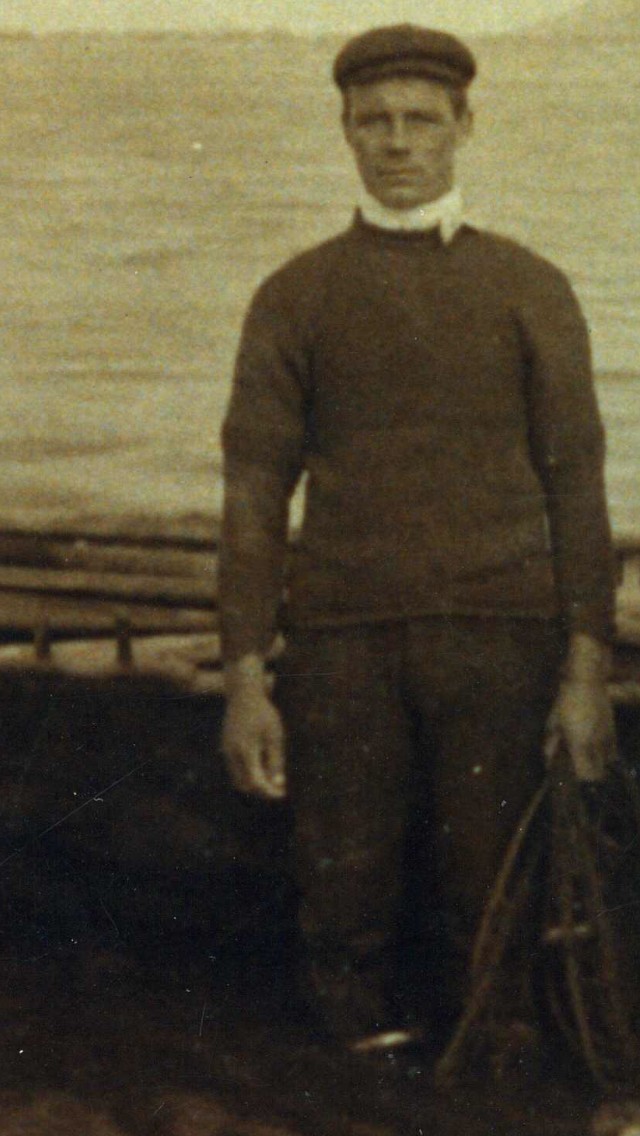
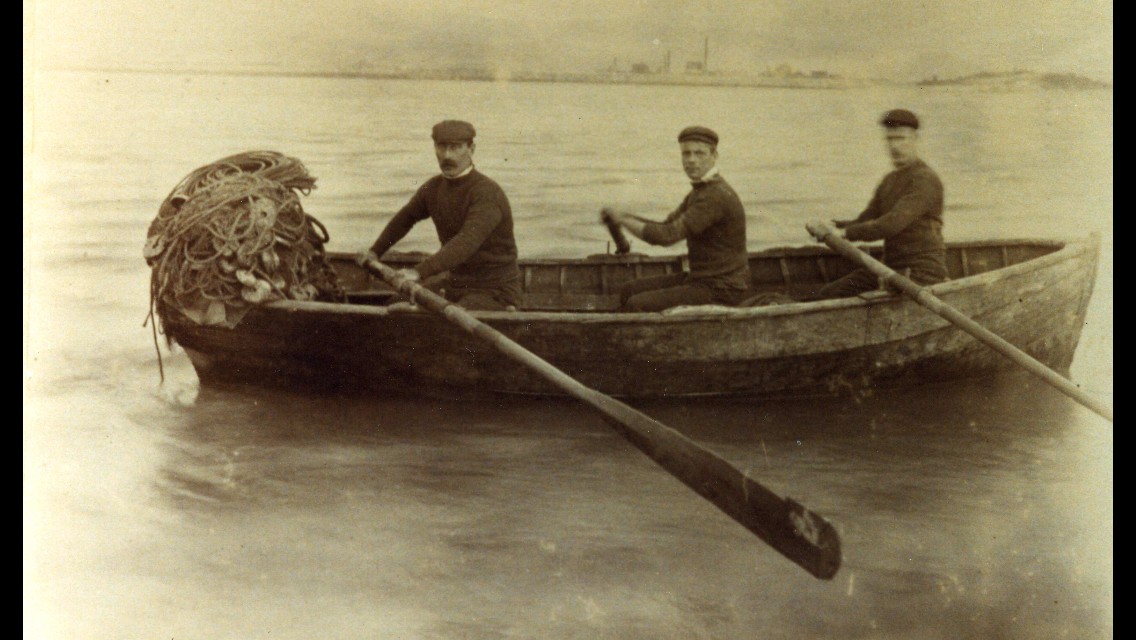
Two photos of William Alexander Snr., kindly supplied by his great great-grandson Kevin Alexander. The picture on the right shows him (centre) draw netting for salmon. It was taken near Dunnerholme. The boat was the Lunesdale. Kevin says there are three theories about what happened to him, but believes he moved to America to live with his son, rather than being “lost at sea” as the gravestone states.
The story can also be found in Kevin’s book “Tales of the Duddon Sands” (2023)
Briefly, from Ancestry we learn the following (NB some of the ages are inconsistent, but appear as written):
1871 Census
Living at Ireleth Marsh (i.e. Askam) with no street names identified, were William Alexander (30) Iron Miner, born Over Kellet, Lancs; Isabella Alexander (34) born Sedburgh, Yorks; James Alexander (5) born Ulverston, Lancs; William Alexander (3) born Ulverston; Edward Alexander (1) born Ulverston.
1881 Census
In the 1881 Census Ancestry misnames him William Alexandria (14), and he is a Farm Servant (Indoor) at Hall Waberthwaite, on the farm of Benjamin Jackson (88) Farmer of 42 acres, born Muncaster, Cumberland.
1891 Census
Living at 42 Sharp Street, Askam, were William Alexander (50) Iron Miner, born Over Kellet, Lancs; Isabella Alexander (52) born Sedburgh, Yorkshire; and William Alexander (23) Iron Miner, born Ulverston, Lancs.
William Alexander’s marriage to Agnes Rebecca Gilchrist was registered in Ulverston in Q2 1892.
1901 Census
Living at 115 Steel Street, Askam, were William Alexander (34) Fisherman (own Account), born Dalton; Rebecca A. Alexander (29) born Askam; William Alexander (9)born Walkden, Lancs; Thomas Alexander (7) born Walkden, Lancs; Arthur Alexander (5) born Askam; Edward Alexander (3) born Askam; Robert Alexander (8 mo) born Askam.
1911 Census
Living at 34, Furnace Place, Askam, were William Alexander (42) Fisherman (own Account) born Pennington, Lancs; Agnes Rebecca Alexander (39) married for 19 years, with ten children born, nine alive, born Greenodd, Lancs; William Mason Alexander (19) Fireman/Stoker of Stationery Engine, Iron Mines, born Walkden, Manchester; Elizabeth Gilchrist Alexander (22) no occupation recorded, born Askam, Lancs; Thomas Alexander (17) Iron Miner, born Walkden, Manchester; Arthur Alexander (15) Fireman/Stoker, born Askam – as were the following: Edward Alexander (12) Scholar; Robert Alexander (10) Scholar; Isobella (sic) Alexander (6) Scholar; Jane Alexander (3); and Samuel Alexander (1).
1921 Census
The 1921 Census shows a family on hard times, still living at 34 Furnace Place, Askam: William Alexander (54) Out of Work, Kennedy Bros Mines, Roanhead, born Ulverston, Lancs; Rebecca Alexander (48) Home Duties, born Askam – as were the following: Edward Alexander (22) Out of work, Kennedy Bros Mines, Roanhead; Robert Alexander (20) Out of work, Kennedy Bros Mines, Roanhead; Samuel Alexander (11) Scholar; James Alexander (8) Scholar; Harry Alexander (4); Isabel Alexander (16) Home Duties; and Jane Alexander (10) Scholar.