Died
17 June 1918 - William Edward Corkish
5 July 1918 - John Henry Corkish
1919 - William Henry Corkish
Sources
Place
Walks
St. Peter's, Ireleth 1 point 14
Themes
Corkish: brothers and father
Mrs Corkish had a dreadful war. Two of her sons died towards the end of the war, and her husband was killed the following year.

265061 PIONEER
J.H. CORKISH
ROYAL LANCASTER REGIMENT
5TH JULY 1918 AGED 22
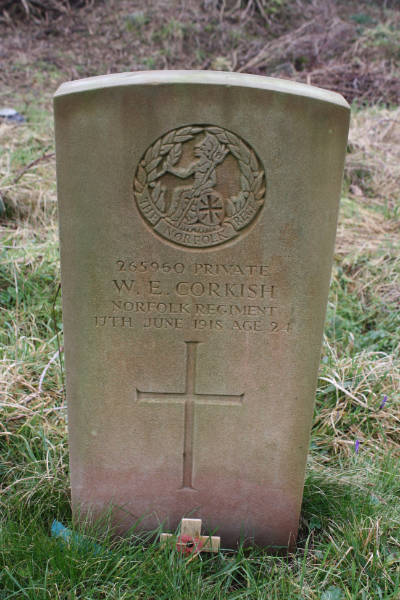
265960 PRIVATE
W.E. CORKISH
NORFOLK REGIMENT
17TH JUNE 1918 AGED 24
1918
| CORKISH | John H | Barrow | Cumbria Certificate Services | B/72/30 |
| CORKISH | William E | Dalton | Cumbria Certificate Services | D/44/414 |
1919
| CORKISH | William Henry | Barrow | Cumbria Certificate Services | B/74/298 |
1944
| CORKISH | Elizabeth M | Dalton | Cumbria Certificate Services | D/3A/83 |
The CWGC website says that John Henry and William Edward were both sons of Mrs. E. M. Corkish, of 53, Cobden St., Dalton-in-Furness.
(From Janice Cumming)
William Henry, the father who died in 1919, is next to the war graves. Their mother, Elizabeth Margaret, was buried on 6 April 1944, her address then being 41 King Street, Dalton. In 1918 when William Edward died the address given is 64 Duke Street, same as his father. John Henry died in Cambridge Street military hospital. The only other Corkish is Philip who is buried somewhere in Ireleth. He was buried on 28 May 1869 aged 23, his address given as Ireleth Marsh (which was the name for where Askam is now).
The Ancestry website suggests that the father and mother were from Isle of Man and the father was a tailor. They came over here and lived in Whitehaven (1911 census) and for some reason they came to Askam, probably because it was bit of a boom town around that time. The census records John as a Labourer at the coke ovens, and William as an apprentice blacksmith. There was a large family:
- Mary Grace 17
- William 15 - Died in WW1
- John 14 - Died in WW1
- Isabella Ellen 12 - An Islen Corkish died 1920 in Barrow (Cumbria BMD)
- Robert 10 - Robert JC Corkish married Emily Oates; died 1945; buried in Dalton; (Cumbria BMD)
- Catherine Jane 8
- Philip 5 - Philip W. Corkish married Freda J Atkinson in 1932; died 1936 in Dalton; (Cumbria BMD)
- Ethel 10 months - Ethel Corkish died 1950 in Dalton (Cumbria BMD)
There were 3 other children on 1901 census, but they are not with the family in 1911. Annie was in service with Mary Ann Noble at Sea View, St Bees, Priscilla and Dora I can't find in 1911.
Look at manxbmd.com There are plenty of Priscilla’s and Dora’s, none Corkish, but one Dora Corkill?
2nd/6th Norfolk Regiment (formerly 4th East Lancs) d 17 June 1918. Age 24
Barrow News 22 June 1918:
Mr. William Corkish of Duke-street, died on Monday evening. He had been in the army. Much sympathy is felt for his parents.
This is a very brief account. Does it hide something?
From records it seems William had suffered from rheumatic fever 6 years before the war and it had left him weak. He was called up in August 1914 but discharged in August 1914. He was recalled in September 1916. William was discharged from the army: he spent many weeks in hospital in Bridlington, Beverley and Leeds War Hospital.
10th Battalion King’s Own Royal Lancaster Regiment. Died 5 July 1918. Age 22.
(From Janice Cumming):
John was invalided home in 1916 after contracting pneumonia. He had history of injury which caused pain and swelling in his abdomen and hip and was operated on. It seems John did not recover from these illnesses and did not return to active service. John died in Cambridge Street Military Hospital, Barrow in Furness.
Barrow News 13 July 1918:

This is a particularly sad story as these two brothers died within a few weeks of each other and their father 1 year later. They were the sons of the William Henry and Elizabeth Margaret Corkish who we believe were originally from the Isle of Man; on the 1911 census the family with 8 children were living at 2 Church Street, Workington. The father’s occupation was a Taylor. William was 15 and a Blacksmith’s apprentice and John 14 a labourer at the coal mine. Their father died in 1919 aged 58 years and was living at 64 Duke Street, Askam, with their mother dying 1944. By 1921 when the information from the Commonwealth War Graves was issued their mother was living at 53 Cobden Street, Dalton. When their mother died in 1944 aged 78 years she was living at 41 King Street, Dalton. If you look very closely there is a plaque next to the boys’ graves which we believe marks the grave of their mother and father.
Barrow News Saturday 19 July 1919 reported on a road accident:
(Firstly)
Barrow News, 19 July 1919ACCIDENT TO ELDERLY ASKAMITE
While crossing the road near Barrow Central Station on Saturday morning, William H. Corkish, an elderly man (!!!!), residing at 64, Duke-street, was knocked down by a motor car and sustained severe injuries to the head. He was removed to the North Lonsdale Hospital, but succumbed to his injuries on Sunday.
(Secondly)
Barrow News, 19 July 1919FATAL SHORT CUT
MOTOR DRIVER’S EVIDENCE TOOK THE WRONG SIDE OF THE ROAD
The motor accident near the Barrow Central Railway Station, on Saturday morning, which resulted in the death in the North Lonsdale Hospital, of William Corkish, aged 58, of Duke-street, Askam, was investigated by the Furness Coroner, (Mr. F. W. Poole), sitting without a jury at Barrow on Tuesday.
The deceased, who was a tailor, employed by the Barrow Co-operative Society, had come into the town by the workmen’s train, which arrived at the Central Station about 8.50 on Saturday morning.
According to Mr. Robert Atkinson, a Furness Railway labourer, of Beckside, Kirkby, who had travelled on the same train, and who gave evidence, the deceased had only got nine feet from the pavement when he was struck by a motor-car. Corkish, while walking along, was talking to a man on the left-hand side of the road. He was in the centre of a number of men, and when the car struck him it was beginning to slow down. It caught him between the legs, threw him on to his back, and dragged him nine feet along with it.
A bricklayer named Thomas Williams, of John-street, Askam, who was walking along in conversation with the deceased from the railway station, stated that when the crowd in front of them was still dense his attention was drawn to the car, three or four yards ahead, by the sounding of the hooter. He shouted to the deceased, but before Corkish could move into safety it had struck him. If witness had been inches to the right, he, too, would have been unable to evade the vehicle.
If the car had been on the correct side of the road, witness told the Chief Constable, in answer to questions, he would not say it was travelling at a dangerous speed. Even as it was, he did not think the crowd was such that the vehicle should have been brought temporarily to a standstill. (There may be an answer missing from the report in this paragraph: the first sentence seems to be a non sequitur)
The driver of the car, William McCartney, 34, Hood-street, Barrow, said he had only had ten weeks experience of driving. He had never previously driven a car down the station approach, and on Saturday morning, as there were no people in sight he took the right hand side of the road “for a short cut”. When about 14 yards from the station the passengers commenced to emerge from the entrance.
The Coroner: And you continued to advance on the crowd?
Witness: I continued slowly to go on towards the verandah. I was travelling at the rate of between two and three miles an hour.
Mr. Morgan (for the relatives of the deceased and the Furness Railway Company): Don’t you know that there is an indicator showing the way in and the way out, and that when you crossed from the left side to the right you were not following the regulations?
Witness: I was in the fault. I admit it.
The Coroner said that the driver of the car was undoubtedly to blame for the accident, but under the circumstances he would find that the deceased had been accidentally killed, and while the driver was seriously to blame for doing what he had done he did not think that the driver’s negligence had been such as to compel him to summon a jury and to place the matter before them.
“My finding,” the Coroner concluded, “does not, of course, prevent the Chief Constable from taking any proceedings which he may think desirable.”
The Barrow News Saturday 2 August 1919 followed this up:
Barrow News, 2 August 1919A RECENT MOTOR FATALITY
BARROW MOTORIST’S ERROR OF JUDGEMENT
At Barrow Police Court on Monday, the recent motor accident in the approach to Barrow Central Railway Station, whereby an Askam workman named Corkish, received fatal injuries, was recalled, when the driver of the car, Mr. William McCarter, was summoned for driving to the common danger.
The Chief Constable, before calling the witnesses who gave evidence at the inquest to repeat their testimony, told the court that there was no allegation that McCarter had driven at an excessive speed. He had, however, driven his car on the wrong side of the station approach, at a time when a crowd of workmen were coming out of the station, and this, Mr. Berry contended, having regard to the conditions which existed at the time of the accident, was “driving in a manner dangerous to the public.”
Defending Mr. McCarter, Mr. J. Pickavance admitted that he had committed an error of judgement. He pointed out that the relatives of the man Cornish (sic) had threatened the defendant with an action for damages, and having regard to all the circumstances, he asked the justices, if they found the case proved, to impose a light penalty.
The defendant was ordered to pay 20s (£1) and witnesses fees.