Police Inspector George Murphy
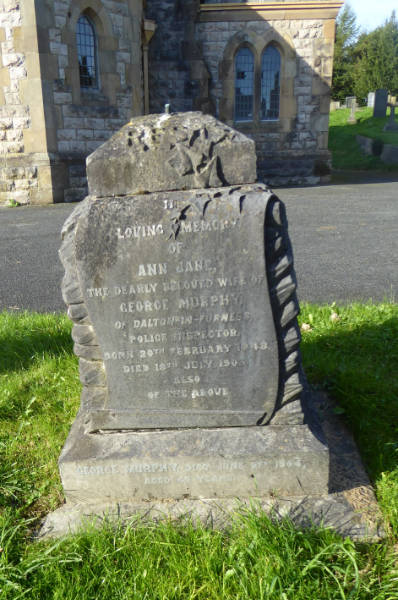
IN
LOVING MEMORY
OF
ANN JANE
THE DEARLY BELOVED WIFE OF
GEORGE MURPHY
OF DALTON-IN-FURNESS
POLICE INSPECTOR
BORN 20TH FEBRUARY 1848
DIED 18TH JULY 1903
ALSO
OF THE ABOVE
GEORGE MURPHY, DIED JUNE 2ND 1904,
AGED 49 YEARS

Picture from Mackereth’s Yearbook 1905
A shocked headline appeared in the Barrow News 4 June 1904, reading:
Barrow News, 4 June 1904ULVERSTON SENSATION
INSPECTOR MURPHY KILLED IN A COLLISION
On Thursday evening between 6 and 7 p.m., a most painful sensation was created in Ulverston by the circulation of a report, unhappily too well founded, that Mr. Inspector Murphy, of the North Lonsdale Constabulary, had met with a fatal accident on the main road between Swarthmoor and Lindal.
Mr. Superintendent Whittaker, in a report in which he deplores the loss of a much valued subordinate officer, states that Inspector Murphy had been to Grizedale Hall, near Hawkshead, to inspect an explosives stores. He went on his bicycle, and on returning called at the Ulverston office about 5 p.m. to see Mr. Whittaker. He left about 5.30 to return to his station at Dalton. It appears that when near High Carley-lane, distant about two miles from Ulverston, such lane leading into the main road, a young farmer named William Nelson Rowlandson, the occupier of Redmayne Hall, Urswick, was driving a horse and float to Ulverston conveying his mother-in-law to the railway station. Just as he was turning the rather sharp corner, he observed Inspector Murphy coming along on his machine. There is a rather steep incline on the main road at this point, and Rowlandson states that the Inspector was cycling very fast. Mr. Murphy put his hand up, and tried to get out of the way, but unfortunately his shoulder caught the horse’s head, and he was thrown very violently off his machine on to the road, his head coming into violent contact with the ground. Rowlandson quickly went to the poor fellow’s assistance, but he never spoke or moved beyond rolling over, and death was evidently instantaneous. Other assistance being now at hand, the body was lifted into the float, and conveyed to the mortuary at the Ulverston Cottage Hospital. Dr. Ashburner was soon in attendance, and pronounced severe concussion of the brain to be the cause of death. That the life of Inspector Murphy should have been cut off in the full vigour and prime of manhood with such terrible suddenness has naturally created a most painful and sorrowful impression throughout the Furness district, more particularly in the Ulverston and Dalton district, where he was best known, both officially and personally, and his death has aroused genuine feelings of regret, not only on the part of the officers and men of the police force, but of the community generally. He was about 49 years of age, and a widower.
So far as can be ascertained, the sad occurrence was a pure accident, no blame being attachable to anyone. The deceased, being a man of considerable weight, would fall very heavily, hence the violence of the injury. On being picked up it was noticed that blood was issuing from the eyes, and in addition to the concussion of the brain, there were indications of a dislocation of the neck.
THE INQUEST
AN EXPRESSION OF SYMPATHY
The inquest was held yesterday at the Ulverston Police Court, before Mr. F.W. Poole, the Deputy Coroner, and a jury, of whom Mr. Leonard Waring was foreman. The deceased was professionally represented by Mr. N.E. Barnes, deputy magistrates’ clerk.
Police-sergeant Forsyth gave formal evidence of identification of the deceased, Geo. Murphy, inspector of police, who was 49 years of age. He last saw him alive at 5.25 p.m. the previous day, when he left the Ulverston Police Office on his bicycle to go home to Dalton.
Wm. Nelson Rowlandson, farmer, of Redmayne Hall, Urswick, stated that the previous evening he was driving a horse and float from Urswick to the Ulverston Railway Station. He was accompanied by Mrs. Rawlinson, his mother-in-law. They came by way of the High Carley Hospital.
The Deputy Coroner: What happened when you reached the corner of the main road? – Just as we were about to turn in the direction of Ulverston the deceased, on his bicycle, dashed right into them. On seeing us he swerved to right, and the horse’s head caught him, and threw him off his machine.
The first thing you saw was the deceased swerving to one side to avoid the horse? – Yes.
Did he shout or ring his bell? – No: I did not hear anything. The horse’s head caught him on the shoulder, and he tumbled off his bicycle on to his head and the machine went under the horse’s feet.
On what side of the float were you sitting? – I was sitting on the right hand side.
And what speed were you driving at? – Slowly on turning the corner; I was going between a walk and a trot. I was driving a pony of about 15 hands.
By Mr. Barnes: I was going to catch the 6.11 train, and the accident happened about 5.30 or 5.45.
How far do you call the point where the accident occurred from Ulverston? – About two miles.
Then, how long were you allowing for the two miles? – About half an hour. I set off from home about 5.20, so that I was allowing nearly an hour.
Could you see anyone coming down the main road before reaching the corner of Carley-lane? – Well, the hedges are pretty thick just now, so that it is difficult to see.
So that more than ordinary care was needed? – Yes, and I slowed down before reaching the corner.
The first intimation you had that anything was wrong was when the cyclist came into you? – Yes.
How far did you get into the main road before the collision? – The horse’s head was perhaps two or three yards into the main road. The cyclist was coming between the middle of the road and the left-hand side.By the Foreman: I could not see anyone coming down the hill because of the high fence.
Eleanor Rawlinson, residing at Newton-in-Cartmel, gave corroborative evidence. There was, she said,
plenty of time to catch the train, and they were not hurrying. They did not hear any shouting or bell ringing. The deceased lifted his hand just as he came in front of the horse. She could not say if the cyclist was coming fast down the hill, as she did not see him. Deceased never spoke after being thrown off his machine.Mr. Rowlandson, recalled, stated that he took the deceased to the Ulverston Cottage Hospital in his float, and was present when Dr. Ashburner attended and pronounced life extinct.
The Deputy-Coroner, in summing up, said that this was one of those unfortunate accidents which might happen to anyone at any time; but perhaps it came home to them more closely because the deceased was well known to them all. The evidence showed not only that Mr. Rowlandson had plenty of time to catch the train, but that he slowed down on reaching the corner of Carley-lane. There was no evidence to show at what pace deceased was riding, but he appeared to have been on his right side. While there was a duty on the part of the drivers of ordinary vehicles to take every precaution to avoid an accident of this kind, there was also a duty thrown upon cyclists to ring a bell, or give some notice of approach. This did not seem to have been done, or otherwise the accident might not have happened. As they knew, the Carley-road was not a very frequented road, and cyclists might not take the usual precautions in passing it. No doubt directly deceased saw the horse he struck to the right- hand side to avoid it, but unfortunately he was caught by the horses head, and knocked off his machine on to the ground, thereby receiving injuries from which he died almost immediately. He would just like to say a word or two of a personal character before the jury considered their verdict. He was sure they would all agree with him that in losing Inspector Murphy they were losing a very valuable public officer, a man who could ill be spared, and had always striven to do his duty in a proper way. Some of those present probably knew the deceased longer than he did, but it seemed to him he could remember the deceased as Sergeant Murphy as far back as he could remember anyone, and he could only say he had always found him a very honourable foe to meet when engaged on the opposite side of proceedings in that court. He was sure they would all join with him in expressing their sympathy towards the relatives and friends of the deceased.
The jury, after returning a verdict of “Accidental death”, concurred with the Coroner’s expression of sorrow.
Mr. Barnes, on behalf of the relatives, acknowledged the expressions of sympathy by the Coroner and jury, which he would be glad to convey to the proper quarter.
The funeral has been fixed for Monday afternoon next, at the Ulverston Cemetery.
In the same edition of the News, a little note reads: THE LATE INSPECTOR – Inspector Murphy was a big favourite with the Askam people. In his early days he was stationed at Askam.
A long account of the funeral appeared in the next edition of the Barrow News 11 June 1904. It begins:
Barrow News, 11 June 1904THE LATE INSPECTOR MURPHY
IMPRESSIVE FUNERAL
One of the largest and most impressive funerals seen in Ulverston for some years took place on Monday afternoon, when the mortal remains of the late Police Inspector Murphy, of Dalton, whose tragic end has produced such a deep manifestation of sorrow and sympathy on the part of the public, were laid to rest in the grave in which his wife was interred a year this month. The solemn company, leaving the Ulverston Police Station at 2.30, was led by the whole of the members of the North Lonsdale Constabulary, walking with “measured tread and slow”. It was headed by Supt. Whittaker, Inspector McDonald, Sergeant Moon (Urswick), and Sergeant Hume (Grange), followed by Sergeants Sorrie (Ulverston), Forsyth (Ulverston), Tyndall (Ulverston), Moore (Dalton), Kay (Dalton), Stirzaker (Greenodd), xxxx[unreadable] (Hawkshead) and Dunn (Askam), and 20 constables, the six who were acting as bearers walking on either side of the glass pannelled (sic) hearse. Then came the Masonic brethren, there being a strong muster of the members of the Baldwin Lodge, Dalton (of which the deceased was a member) ..
There follows a list of Brethren from this Lodge, and the Ulverston Masonic Lodge, councillors, magistrates & clerks, licensed victuallers, retired police officers, relatives, including those from Ireland. It continues:
Captain Murphy (of Ireland), is under canvas in Wales, and was unable to be present. The coffin, which was of polished oak with heavy brass mountings, bore on the breast-plate the inscription: - “George Murphy, born November 13th, 1855; died June 2nd, 1904”. The whole of the service was taken in the open air, in the large space adjoining the Church of England chapel, the last rites being most impressively conducted by the Rector of Ulverston (the Rev. J. Udell Bardsley) and the Rev. J. W. Sumner (?), Dalton. The sad ceremony over, the sorrowing (?) mourners filed past the grave to take a last fond look at the coffin, and the Masonic brethren reverently placed thereon their sprigs of acacia.
There follows a list of bearers, and of the wreaths.