Died
23rd May 1898
Sources
Place
Themes
William Gilchrist
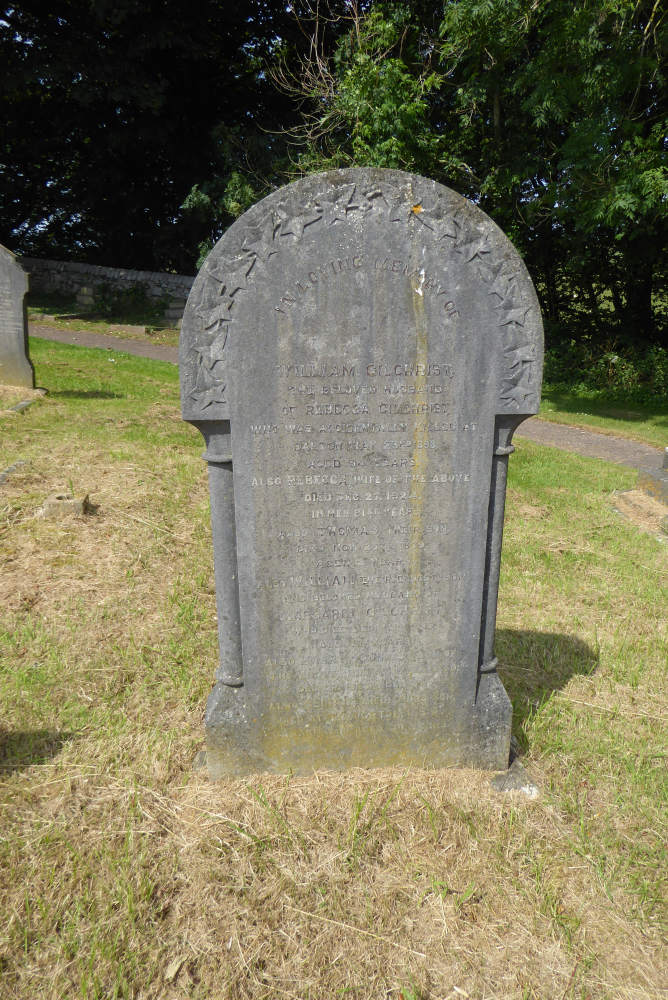
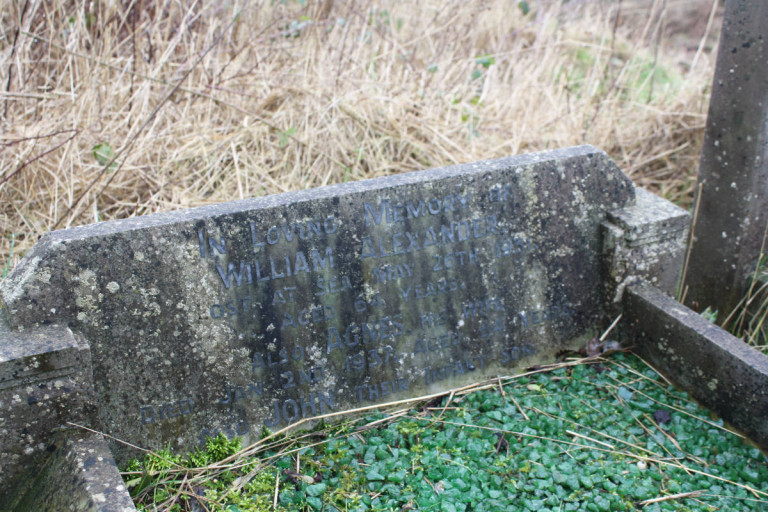
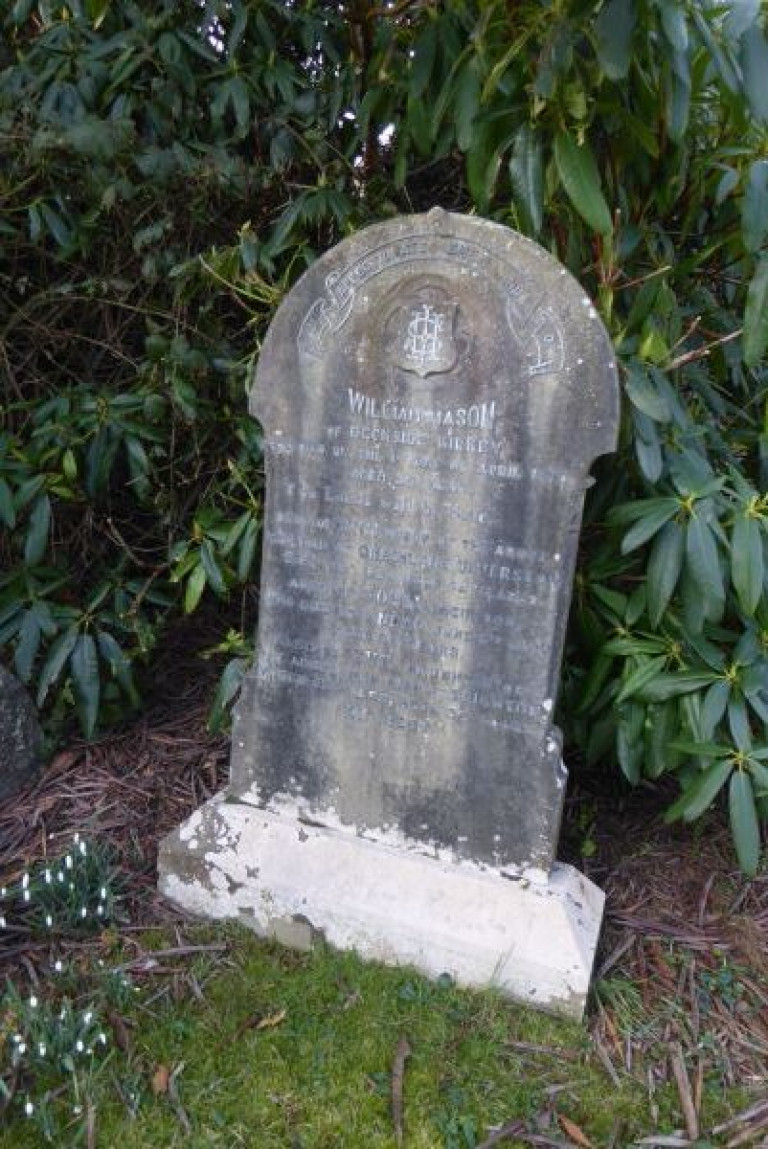
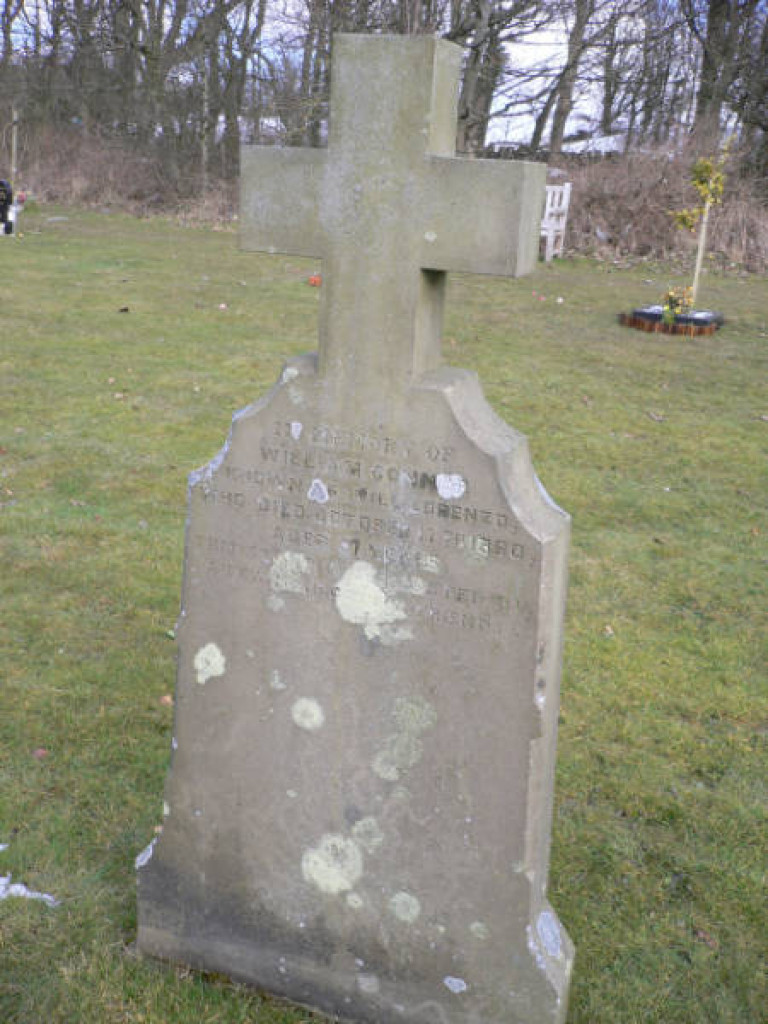
IN LOVING MEMORY OF
WILLIAM GILCHRIST
BELOVED HUSBAND
OF REBECCA GILCHRIST
WHO WAS ACCIDENTALLY KILLED AT
DALTON MAY 23RD 1898,
AGED 54 YEARS.
ALSO REBECCA, WIFE OF THE ABOVE
DIED DEC. 27. 1924
IN HER 81ST YEAR.
ALSO THOMAS, THEIR SON
DIED NOV. 25TH 1879
AGED 12 YEARS.
ALSO WILLIAM, THEIR ELDEST SON
AND BELOVED HUSBAND OF
MARGARET GILCHRIST
WHO DIED DEC 12TH 1909
AGED 37 YEARS.
ALSO HARRY, YOUNGEST SON OF
THE ABOVE, DIED AT WAKEFIELD
DEC 27 1923, AGED 37 YEARS.
ALSO GEORGE, THEIR THIRD SON,
DIED AT TREWORTH? U.S.A.
JAN 2ND 1911? AGED 40 YEARS.
NB the grave is not the easiest to read. Apologies for any errors in transcription.
The Barrow News 28 May 1898 headlined:
SHOCKING FATALITY AT DALTON
KILLED BY A CRANE
INQUEST & VERDICT
AN UNSAFE ROPEOn Monday a shocking fatality occurred at Garden’s Yard, Dalton, the victim being a sawyer named William Gilchrist, aged 53 years, of 19, Rawlinson-street. It appears the deceased, who has been employed by Gardens, contractors, for a number of years, was engaged about half-past one, along with the foreman and six other workmen, in erecting a large crane, weighing about 30 cwt. The deceased selected two large ropes, which were used on a block and two scaffolding poles. There were also bars and planks used for the purpose of raising the crane. They were successful in getting the crane upright, deceased holding a bar on one side of the crane. Along with the other workmen he was trying to turn the crane round, when suddenly one of the ropes broke and deceased, in attempting to run away, ran right underneath the falling crane, which struck him on the head and crushed him to the ground. The workmen immediately released him, but, on the arrival of Dr. Patterson, five minutes afterwards, the man was dead. In the doctor’s opinion he died from fracture of the skull and internal injuries.
(The convention in reporting inquests seems to have been to occasionally identify from whom the question came, and then print the witness’s reply.)An inquest was held at the Urban Council Office on Wednesday morning, before Mr. John Poole, coroner, and a jury, of whom Mr. John Myers was foreman. Mr. Low, inspector under the Factory and Workshops Act, was present.
Wm. J. Brewer said he lived at 63, Chapel-street, Dalton, and was foreman joiner for the Exors. of the late James Garden. He knew the deceased, who had lived at 18, Rawlinson-street. He was a sawyer in the same employ, and was 54 years of age. On Monday last the deceased was assisting in the erection of a crane, which was 15cwt. To a ton in weight, and for that purpose they were using a guide rope. Deceased had not hold of the rope. When the crane was about half up the guide rope broke, and the crane fell, striking the deceased in its fall, and killing him.
Who selected the rope? – The deceased.
How did it become his duty to select the rope? – I asked him to get the material for the erection of the crane. He knew where to get the tackle from, it being kept in the stores.
The rope had not been used lately? – No, not to my knowledge. It was used last at the new Police Station for the erection of a crane.
I should like to know why some one (sic) did not look at the rope before it was used? – The deceased examined the rope.
How do you know? – Because I asked him, and he replied that he had and the rope was good. That was on Saturday last.
Had you seen the rope? – Yes, and so far as I could see there was nothing wrong with it.
Had the deceased good eyesight? – Yes.
You really cannot tell the jury that the rope was the right one for the purpose? – We were of the opinion that it was a good rope. We could see no flaw whatever.
Were there other ropes in the stores? – Yes, thicker and stronger ones. Deceased was not compelled to get this particular rope, but deceased knew this rope had been used for a similar purpose.
I don’t understand, if he was a sawyer, how it was any part of his duty to select ropes for this work? – He had been used to raising cranes for the last 35 years.
You see now that a lot of the strands in the rope had been broken a long time ago? – Yes, looking at it now.
It is quite clear that the accident happened through the breaking of this rope, and it’s equally clear to me that the rope was not fit to be used for the purpose.
The only question seems to be did this man select the rope himself, and whose duty was it. You did not tell him to go and get this particular rope? – No, sir, I left the selection to him.
By Mr. Low: I have seen this rope since the accident, and notice that there are two or three bad places in it, but they could not be seen before the accident occurred.
The bad places were not caused through the accident? – They might have been caused by the weight of the crane.
But that would not break the rope? – No, but it would cut it.
But it does not appear as if it has been cut. If cut it would have been cut straight across. Some of these strands are long and the others short? – It might start it, and the weight of the crane would pull it.
In what kind of place do you keep the ropes? - In a dry place above the stables.
They never get oily do they? – No.
The rope is dry? – Yes, they are kept dry.
The Coroner: It has been kept sadly too dry; in fact it has gone through being too dry.
The Witness: We can see it now sir.
By the Foreman: A part of the rope was under the crane after the accident. There were newer ropes which the deceased could have selected, a two inch rope for instance. Witness did not examine the ropes minutely. He went over it casually; but the deceased examined it, and he was a man of great experience. Witness had no idea how old the rope was.
The Foreman: From appearances it is an old rope and rotten.
A juror explained that the witness had only been in the position of foreman a short time.
By the jurors: I cannot say when the rope was first used. I have assisted in the erection of cranes before. I know the rope has been used on different jobs. They are not allowed to remain out (of the store?) during the wet weather. When finished with they are put in the stores. The deceased had charge of the store room where the ropes were kept for between 35 and 40 years. He would know better than the witness did, which were the best ropes.
Mr. Low: Supposing the crane in falling caught this rope, it could not damage it because one end of the rope would be loose? – I think the crane would not slide down the rope. The rope was tight when the weight of the crane was upon it.
A juror: If the crane slided (sic) down the rope as suggested by the Inspector, it would give the rope a jagged appearance.
Another juror: Would not the weakest part give? – Yes.
A juror: When was the rope broken before? I see there is a splash in it? – I could not say.
The juror: I think it has been very unsafe.
The Coroner: It is not worth taking up the time of the jury in contesting the quality of the rope, but no one will say that the rope was fit to be used for the purpose. The only question now is as to the directions given to the deceased. Was there no one present when you told him, Mr. Brewer? – No, sir.
The Coroner: You can remain in the room, Mr. Brewer.
A juror (Mr. W. Robinson) objected to Mr. Brewer’s presence whilst the workmen gave evidence.
The Coroner said the objection was quite right, but he would like Mr. Brewer to hear the summing up.
Mr. Robinson did not object to that.William Duckett, a joiner, in the same employ, said he knew nothing about the selection of the rope. On Saturday when he was in the shop, the deceased sent a boy to ask him to go and give a lift with the legs. He went along with Arthur Fox. They got the ropes tied together, and commenced to haul up. Owing to the wind and rain, however, they desisted. He understood that the deceased had chosen the ropes. He knew the deceased had charge of them. The men who had charge of any lifting job generally looked after his own ropes. The deceased had attended to a lot of lifting work in the yard.
William Gilchrist, son of the deceased, said he had not heard his father say anything about the lifting of the crane. Witness did not know who had charge of the ropes. He had seen his father fixing cranes.
By the Foreman: He last saw his father on Friday. He had not heard his father express any fear about the ropes, and he had not complained to witness’s mother.Charles McKenzie said Mr. Brewer sent him for William Duckett and others out of the shop to help to erect the crane. He did not see anyone bring the ropes, but he saw the deceased using them. He appeared to be doing the work under Mr. Brewer’s orders.
By a juror: I was assisting at the same time. I did not hear Mr. Brewer give Mr. Gilchrist any orders.
Robert Jones said he worked at Garden’s Yard, and was with the deceased last Saturday.
What was he doing? – Getting the ropes out.
Where did he get them from? – In the loft above the stables.
Did he get out this rope which was broken? – Yes, sir.
Did you help him to carry it? – I wheeled it into the yard.
Were there other ropes in the room? – Yes, sir, lots of ropes.
Who looked at them? – Mr. Gilchrist.
Did he say anything about this one? – Yes. Sir. He said “This is just the very rope we want.”
Did he look it over and examine it? – Yes, sir, in the yard.
Did he say it was an old rope? – No, sir.
Was anybody else there? – No, not when we got that rope out.
Did you see any bad places in the rope at that time? – No, sir.
The Foreman: You didn’t hear him express any doubts about the rope in any way? – No, sir.
By jurors: There were other ropes of the same size, but they were hanging up. This one was on the floor, as if it had been lately used.
Mr. Low: Was it the handiest to get? – No, sir.
By a juror: No one ordered him to get that special rope.The Coroner in summing up, said the cause of the accident was very plain and evident, and that was that the rope was not fit for the purpose. The jury and the inspector had seen it, and he (the Coroner) thought that there could be no doubt whatever that the rope was defective. It appeared that the deceased had been employed in Garden’s yard for a great number of years, and had been used to assisting in the erection of cranes. Mr. Brewer asked the deceased to get all tackle necessary for the work, and left the deceased to select the ropes. The last witness told them that the deceased said that the particular rope was what he wanted, and that it was all right. How he could have come to that conclusion, he (the Coroner) could not imagine. There were matters which the jury should not touch, because it might be settled elsewhere. If they thought that the rope was defective, then they should say so. He would like to say that when there was a foreman about the place, he should have looked at the rope himself, knowing that it had not been used for some considerable time. He would tell Mr. Brewer and other foremen that they had certain duties, and in the Act which was coming into force shortly, so far as he was concerned he should require that all ropes be tested from time to time to see what strength they would bear. A rope should not have a strain put upon it more than one-eighth of what it would actually bear. He believed that there was an opinion that it should only be one tenth.
After the jury had deliberated in private, they returned the following verdict, “That the deceased met his death by the breaking of a rope and the fall of a crane on him.”
The Coroner: Do you say anything about the state of the rope?
The Foreman: No.
________________________________
THE FUNERAL
A very large concourse of sympathisers attended the funeral of Mr. Gilchrist on Wednesday afternoon. The deceased was well known and very highly respected by everybody. Along Rawlinson-street, Wellington-street and Market-street many of the blinds at private houses were drawn out of respect. There were a number of floral tributes placed on the coffin. All the fellow workmen of the deceased were present. It might be stated that Mr. Gilchrist had been employed by the same firm for nearly 40 years. He was one of the founders, and the first president, of the Successful Tontine Club, held at the Railway Arms, the members of the society attending the funeral. The Rev. R. Hindle officiated.
Ancestry tells us the following:
1891 Census
1891 Census the Gilchrist household lived at 25 Wellington Street, Dalton-in-Furness, and consisted of William Gilchrist (47), Sawyer, born Scotland; Rebecca Gilchrist (47) Wife, born Cark, Lancashire; James Gilchrist (22) Son, Painter, born Dalton (as were the following); Ellen H. Gilchrist (15) Daughter, Dressmaker; Annie Gilchrist (11) Scholar; Alice M. Gilchrist (9) Daughter, Scholar; and Harry Gilchrist (4) Son, Scholar.
1881 Census
Ten years previously, the 1881 Census has them at the same address. William Gilchrist (37) Sawyer, born Kirkubury (sic – probably Kirkcudbright), Scotland, shares the house with wife Rebecca Gilchrist (36 – though looks like 26), born Dalton, Lancs, as were all the following children; William Gilchrist (14?) Quarryer?; James Gilchrist (12) Scholar; George Gilchrist (10) Scholar; Jane Gilchrist (8) Scholar; John Gilchrist (6) Scholar; Ellen Gilchrist (5) Scholar; and Annie Gilchrist (1).
1871 Census
William had already moved to the district for the 1871 Census. At 19 Roper Row were William Gilchrist (28) Saw Sharper (sic), born Scotland; Rebecca Gilchrist (27) born Cartmel, Lancs; William Gilchrist (4), born unreadable; Elizabeth Gilchrist (3), born Dalton; James Gilchrist (2), born Dalton; and George Gilchrist (10 months) born Dalton.
Just below the reservoir can be seen a line of stone rubble, this is all that remains of a row of twenty cottages. There is a tale about the residents of Wagg Row that they were so poor they only had one frying pan between the lot of them. (N.B. further research suggests the correct name for these cottages was Ropers Row). Why the cottages were demolished is not clear. It is possible that when the reservoir was built it was considered too dangerous for people to live so close. In the event of the earth dam collapsing the wall of water would wash away all before it, a not uncommon occurrence in the nineteenth century. Read more >
William Gilchrist married Rebecca Cornthwaite in Q1 1866, in the Ulverston Registration District.
1861 Census
Before his marriage, William had come down from Scotland with his parents. The 1861 Census has them at Lindal Moor, Snipe Gill. William Gilchrist (43) Sawyer, born Scotland (as were the whole family) lived with wife Elizabeth (45); son William (17) Sawyer, six other children, plus lodger William Williamson (31) Widower, Iron Miner, born Ravenglass, Cumberland, and his daughter Janet Williamson (10 months), born Dalton.
Nearby in Marton is Robert Gilchrist (39) Sawyer, born Scotland, together with his wife and five children (including a William, an engine driver), some born in Scotland and others in Dalton. Robert could well be William’s brother.