Died
17th April 1949
Sources
Cumbria BMD
Ancestry
Barrow News
kingsownmuseum.com
heyshamheritage.org
lahs.archaeologyuk.org
Place
Walks
Themes
Darcy Benson Moffat
The exotically named Darcy Benson Moffat was brought to my attention by his grandson, Peter Naylor, of Carlisle, but still a proud Barrovian. Darcy was the superintendent of the Barrow (Vickers) Fire Service, in whose service he attended the White Lund Explosion in 1917, for which he was awarded the King's Police Medal for Gallantry.
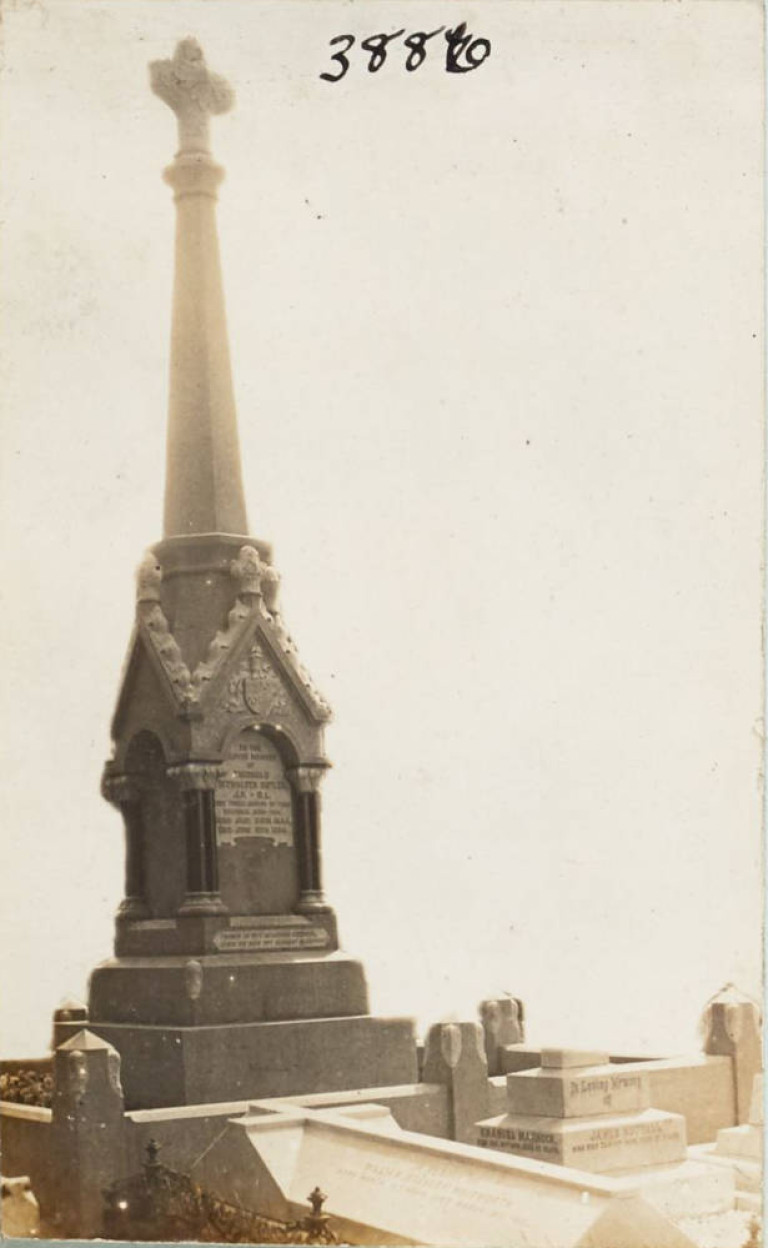
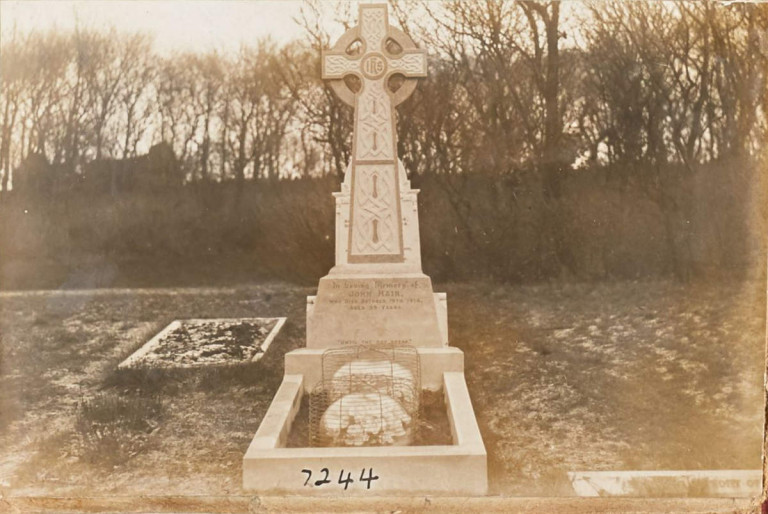
Peter kindly sent me a photograph of the original Moffat gravestone (below left), which has now been updated, and contributed greatly to the account set out below.


In Loving Memory
Of
DARCY BENSON MOFFAT
Died April 17th 1949, age 73
His beloved wife
BRIDGET MOFFAT
Died October 12th 1953, age 76
Their daughter
MARGARET NAYLOR
Died March 17th 1990, age 80
Their son-in-law
ERNEST NAYLOR
Died December 15th 1988, age 76
The infant son of Ernest and Margaret
Stillborn 1st September 1948
The hamlet of Barrow developed into one of the original Northern Powerhouses during the late nineteenth century on the back of economic migrants into Furness, coming from throughout the British Isles. Among them was a young couple from West Cumberland – Darcy Benson Moffat (DoB 5th July 1875) and his wife Bridget (née Campbell). Moffat’s father was in the wine & spirits trade and a hotelier/publican in West Cumberland; by 1901 Moffat himself was working in Barrow’s licenced trade as a barman.
Like many another, he was drawn into the town’s heavy industries, in his case in the Vickers shipyard, where he took a job as a Fireman. Clearly, he had an aptitude for the work, rapidly rising to the rank of Superintendent, in charge of the shipyard’s own fire brigade at a time where fire was an ever-present risk and the volume of work made for difficult working conditions.

Darcy Moffat (right) with two of colleagues, or possibly members of another Fire Brigade.

The picture of the Vickers Brigade dates from shortly after World War One and shows the brigade on their appliances, a Leyland petrol vehicle (left), the brigade car, and a Merryweather steamer (right) (probably that which was in operation at Morecambe). Darcy Benson Moffat is in the centre of the Leyland appliance, his KPM proudly displayed on his chest. He is pictured again (below), probably on Island Road, Barrow.
The Barrow News 7 December 1918 reported on his award:
LOCAL FIRE CHIEFS HONOURED
PRESENTATION OF POLICE MEDALS FOR GALLANTRY
On Tuesday Lord Shuttleworth, Lord Lieutenant of the County, (NB Lancashire – RMW) accompanied by a distinguished party, attended at Lancaster Town Hall, to present on behalf of his Majesty the King, a number of King’s police medals and British Empire Order medals to police, firemen, and industrial workers in Lancashire for various acts of gallantry.
Most of the awards were in connection with courageous conduct and devotion to duty during an explosion and fire at a Northern munition works just over a year ago, in connection with which two men have already been presented by the King with the Edward Medal in silver, and the Ministry of Munitions have presented gold watches and other awards to workmen now in different parts of the country.
Lord Shuttleworth inspected the guard furnished by the O.T.C. of the Lancaster Royal Grammar School before the ceremony in the Town Hall.
The recipients of the King’s Police Medal included Mr. R. Newsham, chief of the Barrow Fire Brigade, and Mr. D’Arcy (sic) B. Moffatt, (sic) chief of the Vickers (Barrow) Brigade.

Note that in spite of the war having been ended by the Armistice on 11 November, the location of the munitions factory is still kept secret. The only contemporary mention in the Barrow News (13 October 1917) cites a London paper:
GALLANT FIREMEN
BRAVERY WHICH DESERVES THE VICTORIA CROSS
The writer of notes in the “Evening Standard” has the following interesting paragraph:-
“I can endorse from independent eye-witnesses the Ministry of Munitions’s record of gallantry in connection with the recent fire and explosions in the vicinity of a northern county town. In particular there are firemen who deserve the Victoria Cross or its equivalent. Also I hear high praise of the local Volunteers.“It was a scene which reminds one in some details of the last days of Pompeii. Happily, no munitions workers lost their lives.” (sic)
We can add to the above that we have information to the effect that the question of making suitable acknowledgement of the bravery here referred to has been under consideration.
The same writer tells the following stories relative to this particular explosion:-
In one case nearly a hundred persons, mostly in night attire, took refuge in the bungalow of a well-known man, who possesses a pipe organ in his music room. An organist played selections, and the people sang hymns throughout the night to the accompaniment of exploding shells.Another story is of a lady who, having been through two air raids on the eastern side of the country, went to this district for peace and quietness. On the way she had a car smash, and within an hour or two of her arrival at her destination went through a prolonged series of explosions surpassing any of her raid experiences.
More information about the White Lund explosion can be found on various websites, including:
lahs.archaeologyuk.org which states that at 5.45pm on Tuesday 2 October 1917 “Vickers’ Barrow fire engine tackled burning wagons, filled with live shells”. Bravery indeed!
The Barrow News 23 April 1949 carried:
MR. D. B. MOFFAT, BARROW
Thirty-two Officers and firemen of the borough and Vickers-Armstrongs’ Fire Brigades attended the funeral on Wednesday of Mr. Darcy Benson Moffat, of 29, St. Luke’s-avenue, Barrow, who was for 30 years chief officer of the Vickers-Armstrongs force.
Mr. Moffat, who retired in 1945 at the age of 70, received the King’s Medal for services rendered at the White Lunn (sic) filling factory at Morecambe when it caught fire and caused many explosions in 1917. He came to Barrow from Cumberland as a young man, and became well known and respected. He is survived by his widow, one son and three daughters.
Requiem Mass was sung at the Sacred Heart Church, Barrow.
Chief Officer T. W. Platt, of Vickers-Armstrongs and Station Officer T. Towers, were in charge of the firemen.
Ancestry
From Ancestry we know that Mr Moffat was baptised on 18 July 1875 at St. James’, Whitehaven, the son of William and Ellen Moffat.
1881 Census
In the 1881 Census he was living at 14, Granby Cottage, Whitehaven, with William Moffatt (sic) (39), Commercial Traveller/Wine & Spirit Merchant), born Lamplaugh, (sic – should be Lamplugh) Cumberland; Ellen Moffatt (37), born Whitehaven; and his siblings: Joseph (14); Annie (12); James (9); Frances (7) – all scholars, and John (1), all born Whitehaven. John appears to have died in December 1881.
1891 Census
By the 1891 Census they had moved to 75 King Street, Whitehaven. William is now solely a Wine & Spirit Merchant; Joseph and James are Accountants; Frances is a Dressmaker; Darcy is a Draper’s Apprentice, Annie has no occupation and Ada Moffat (7) is a Scholar.
1901 Census
In the 1901 Census Darcy Moffett (sic) (25) Bar tender/Hotel worker is lodging at 6H Egerton Buildings in Barrow, along with his wife Bridget Moffett (23), born Cleator Moor, Cumberland, and daughter Ada Moffett (2 months), born Barrow.
1911 Census
In the 1911 Census the family is at 62, Ferry Road, Barrow, where Darcy is now the Night Foreman (Fire Brigade) at the Shipyard. Ada Moffat is now 10, and has been joined by Winifred (8); James (6) and Margaret (1).
1939 Register
By the time of the 1939 Register all the children had left home. D’Arcy (sic) and Bridget Moffat (DoB 10 June 1877) are at 60 Island Road, Barrow. Darcy Moffat is the Chief Officer, Fire Brigade.