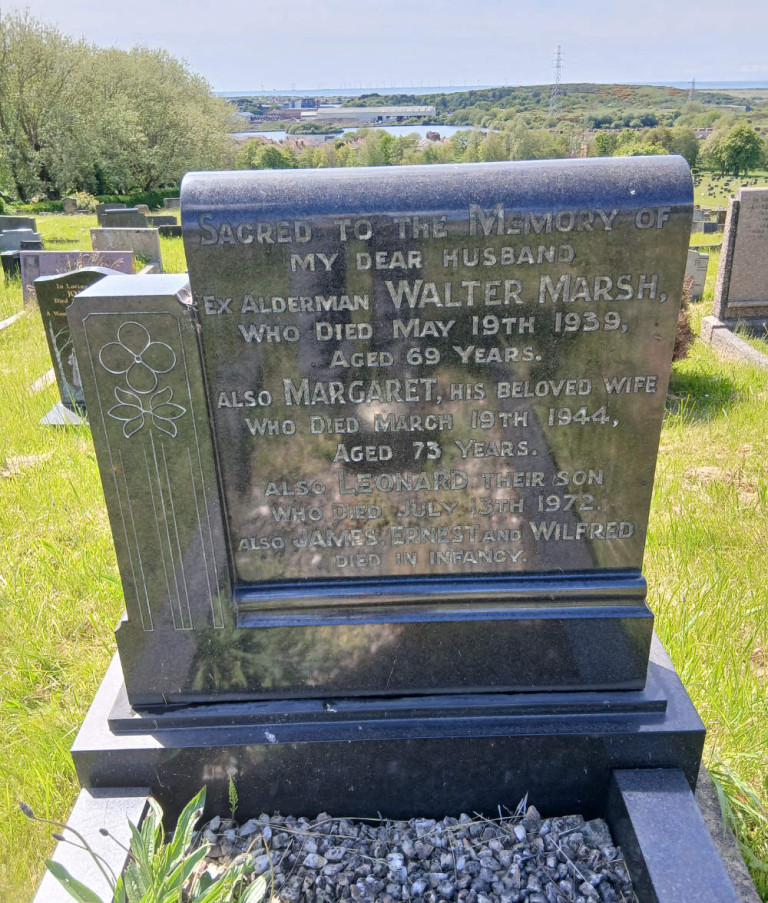
James Garden
Few people will have heard of James Garden, but he has left a significant legacy in the buildings of Furness.
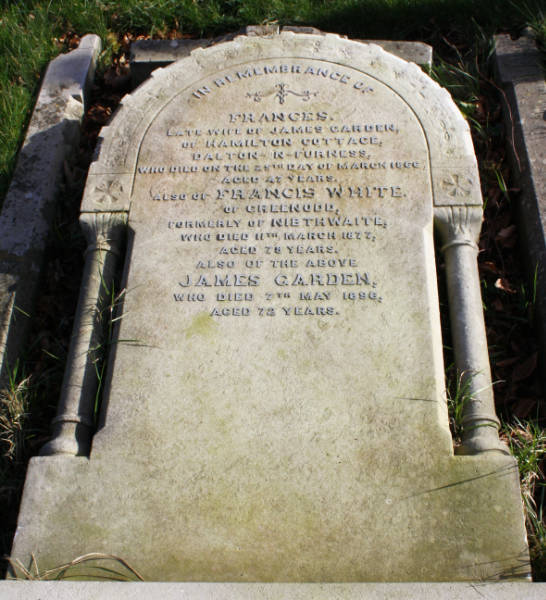
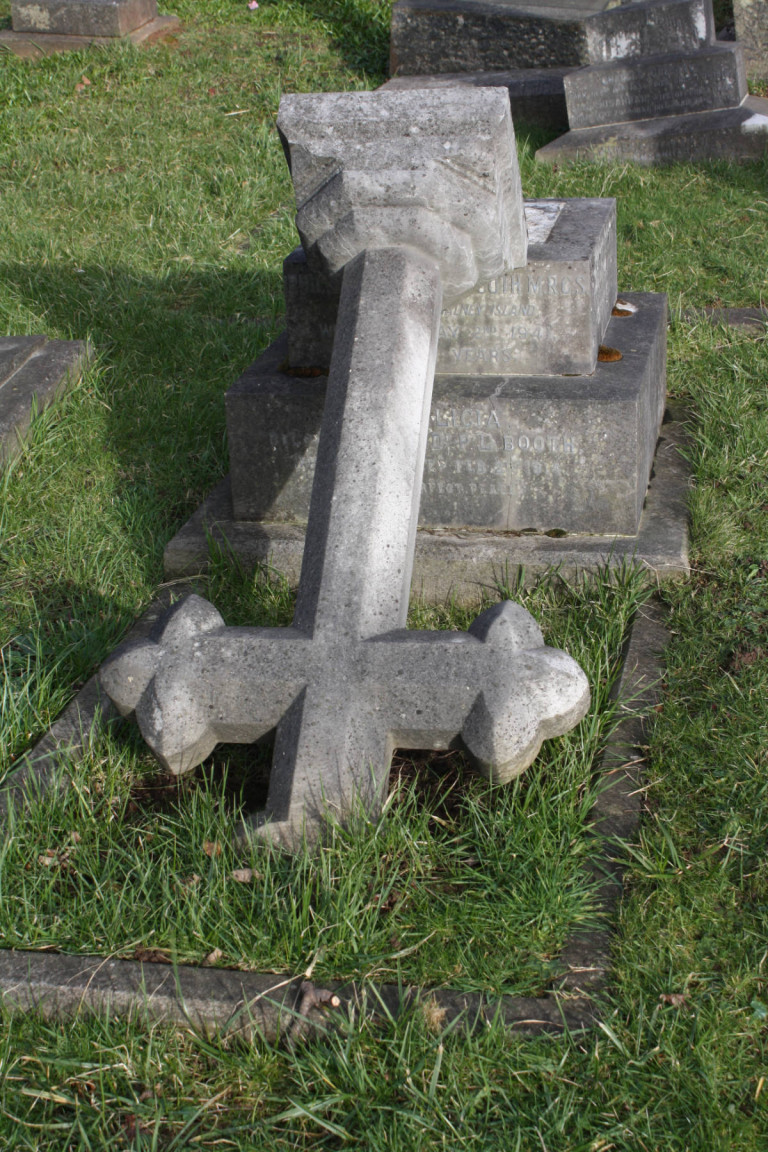
IN REMEMBRANCE OF
FRANCES
LATE WIFE OF JAMES GARDEN
OF HAMILTON COTTAGE
DALTON IN FURNESS
WHO DIED ON 25TH MARCH 1866
AGED 47 YEARS
ALSO OF FRANCIS WHITE
OF GREENODD
FORMERLY OF NIBTHWAITE
WHO DIED 11TH MARCH 1877
AGED 78 YEARS
ALSO OF THE ABOVE JAMES GARDEN
WHO DIED 7TH MAY 1896
AGED 72 YEARS
Where is the grave?
Lying flat, immediately to the west of the North Chapel.
The Barrow News of Saturday May 9th 1896 records (no paragraph breaks in original):
Barrow News, 9 May 1896DEATH OF MR JAMES GARDEN OF DALTON
It is with extreme regret that we have to chronicle the death, which took place on Thursday at his residence, of Mr. James Garden, contractor, Hamilton House, (78 Market St – currently Wilton’s Optometrist or the large house next door), Dalton. The deceased gentleman had had a lingering illness, having been attacked with Bright’s disease (inflamed kidneys) some ten years ago. He was not generally prostrated with that attack, however, but about 3 years afterwards he was once more afflicted, this attack being an additionally severe one. Since last Christmas Mr. Garden gradually became weaker, and died as above stated. The deceased gentleman was very well known, particularly throughout the entire Furness, South Cumberland and South Westmorland districts. Mr. Garden settled at Dalton about 50 years ago, entering the town as a young man, having served his apprenticeship as a working mason. Possessing the (sic) exceptional capabilities and being a shrewd business man, he at once commenced contracting, along with the late Alderman Wm. Gradwell, of Barrow, and worked side by side with Mr. Gradwell for many years, until at length he struck out on his own behalf, and for a number of years – up to the time of his death in fact – carried on a successful business. Between 30 and 40 years ago, Mr. Garden identified himself with public bodies, but for some 20 years prior to his death, he was unconnected with public institutions, although at all times he appeared to take a considerable amount of interest in the doings of the town and immediate neighbourhood. He was one of the first members of the Burial Board on its formation in June, 1860, but the following April he resigned. In 1866 and 1867 he was the surveyor of highways for the township or division of Dalton Proper, and was re-elected, along with 8 other gentlemen, in 1871. In 1856 he was appointed an overseer of the poor for the parish of Dalton, and from 1867 to 1870, before the parish of Barrow was severed from Dalton, he was one of the 6 Guardians, in pursuance of the Order of the Poor Law Board, of 1866. In the year 1858-9 he was a churchwarden of the Parish Church, and sometime afterwards he was elected a sidesman. In 1875 he was chosen a member of the Gas Committee, and retained his seat unmolested until 1881. He was one of the first six members elected on formation of the old Local Board, to represent the East Ward, but in the following year (1874) he withdrew on account of probable interference with his business. The deceased gentleman was known far and wide for his kindly disposition, and his generosity to any charitable object, but whilst dispensing his charity with no niggardly hand he did it in an unostentatious manner. Deceased leaves a widow (2ND wife?) and family, e.g. Mr. Wm. Garden, who is at present in Australia; Mrs. Cooper; Mr. Charles Garden, at present in Coolgardie (Western Australia), Mr. Gordon Garden, at present in San Francisco, and the Misses Fanny, Elsie and Bertha Garden. Amongst the hundreds of contracts carried out by the deceased might be mentioned Holker Hall, Stone Cross (Ulverston), Leighton House (Carnforth), Bellfield (Windermere), Oaklea, Dalton Church, Burton (Yorkshire) Church, Thornton (Yorkshire) Church, Holy Trinity Church (Ulverston), Kirksanton Church, Blawith Church, Harecroft (residence of Mr. J. Stirling Ainsworth, at Gosforth), Bootle Church, Whitehaven Joint Railway Company’s Station, Barrow Cemeteries, Dalton Wesleyan Church, Dalton Baptist Church, Dalton Primitive Methodist Church, Dalton Urban Council Offices, Ulverston Market House, Congregational Church Grange, the buildings of the Naval Construction and Armaments Co. Works, Barrow, alterations at Conishead Priory, when converted into a hydro, the masonry at the Barrow Hematite Iron and Steel Works, the railway tunnels, bridges and stations on the Furness Railway, the Dalton Board Schools, the Dalton Cooperative Stores, Ulverston Board Schools, Dalton Catholic Church, Coniston Station extension, Prior’s Lea, Barrow, Crosslands, Barrow, Kirkby Schools, extensions at the Furness Abbey Hotel, etc., etc., in fact, he was the pioneer of masonry work in Furness. The funeral takes place today.
I am indebted to Mr. Walter Johnston of Yarlside for providing further biographical details:
- He was born in Cullen, Aberdeenshire, in 1822.
- He married his second wife, also called Frances (née Garratt), in Manchester Cathedral in 1868 [Source]. She carried on the business after his death, and died in Fulham on 24 March 1930. The contents of their home, Hamilton House, were sold in 1906 by Lowden & Postlethwaite.
- He qualified to use the title ‘Master Builder’ in 1861
- Many of his buildings used a distinctive limestone (from Stainton quarry) with red sandstone (from Ormsgill/Hawcoat quarry) trim. James Garden leased Stainton quarry from the Duke of Devonshire, and employed Frank Trenough as Quarry Manager.
- In the 1861 Census he employed 78 men, and had 3 children. By 1871 he employed 350 adult men, 15 boys, 2 clerks and had 3 domestic servants.
- He made fireplaces, mantels and table tops, and had his own furniture-making section.
- He was one of the favourite builders of the well-known architects, Paley & Austin, of Lancaster.
- Mr. Johnston has a further list of Garden’s buildings in Dalton. His last major works were the Courts & Police Station on Market Street. After his death his company, now run by his second wife, built houses behind their house, and they were named to commemorate him: Garden Terrace and Garden Lea. The firm also built the Carnegie library (Chapel St/Nelson St); the Co-op buildings; chapels at Dalton Cemetery; Goose Green School buildings; Primitive Methodist Church (Ulverston Rd, now Seventh Day Adventist); Primitive Methodist Church (Cleator St. – which replaced the smaller one on Ulverston Rd and is now flats); Baptist Church (Broughton Rd – now Thomas’s Bakery); Ashburner House (at Dowdales School – built for George Ashburner); Chapel St School; Nelson St School and many others.
- For further information on Dalton churches, see source.
- Elsewhere he built Abbotswood Mansion (Barrow); Millwood (Barrow); Furness Abbey Station & Hotel; Barrow Market Hall; Crosslands Mansion (Barrow). He often worked with Gradwell e.g. on the Station at Ulverston. He built the Drill Hall and Market House in Ulverston, the latter designed by the Ulverston architect J. W. Grundy, for whom Garden erected other buildings. He built Duke St. School in Askam; Askam Station, St. Peter’s Church, Ireleth, and helped finance Askam Gas Works.
Pictures of Garden’s Dalton Buildings
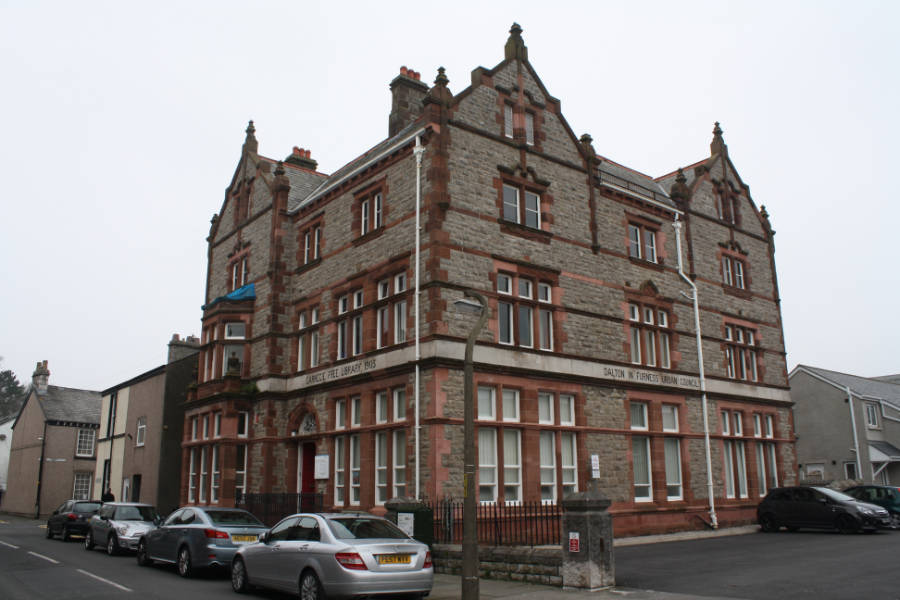
Carnegie Library & Council Offices, Nelson/Chapel St.
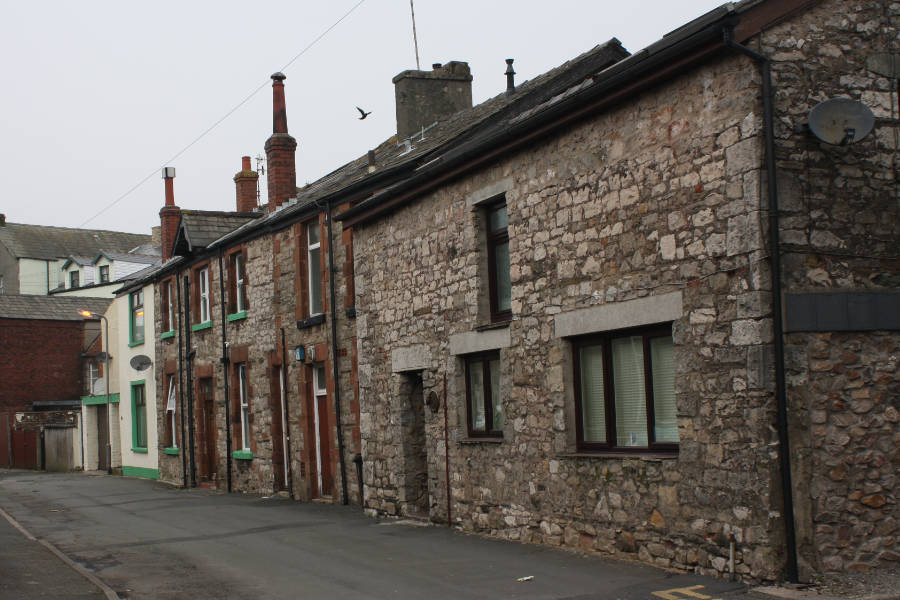
Garden Terrace
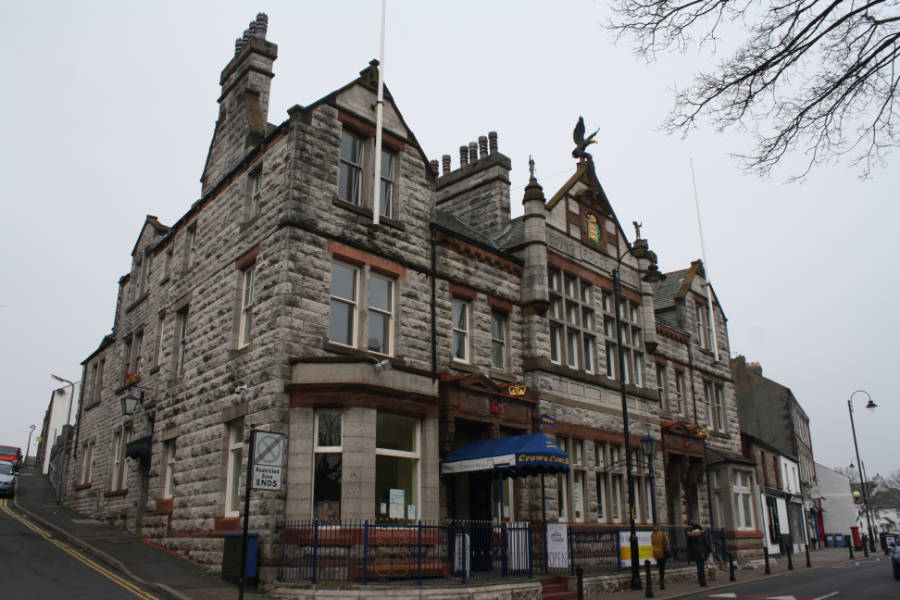
Police Station & Courts