Died
16th October 1942
Sources
Dock Museum
Barrow News
Place
Themes
Bram Longstaffe
Secretary of the Barrow branch of the Independent Labour Party and Mayor of Barrow from 1934-36

Source: formerly at www.dockmuseum.org
'Mourn not the dead that in the cool earth lie, Dust unto dust. The calm sweet earth who mothers all who die, As all men must But rather mourn the apathetic throng, The cowed and meek, Who see the world's great anguish and its wrong, And dare not speak.'

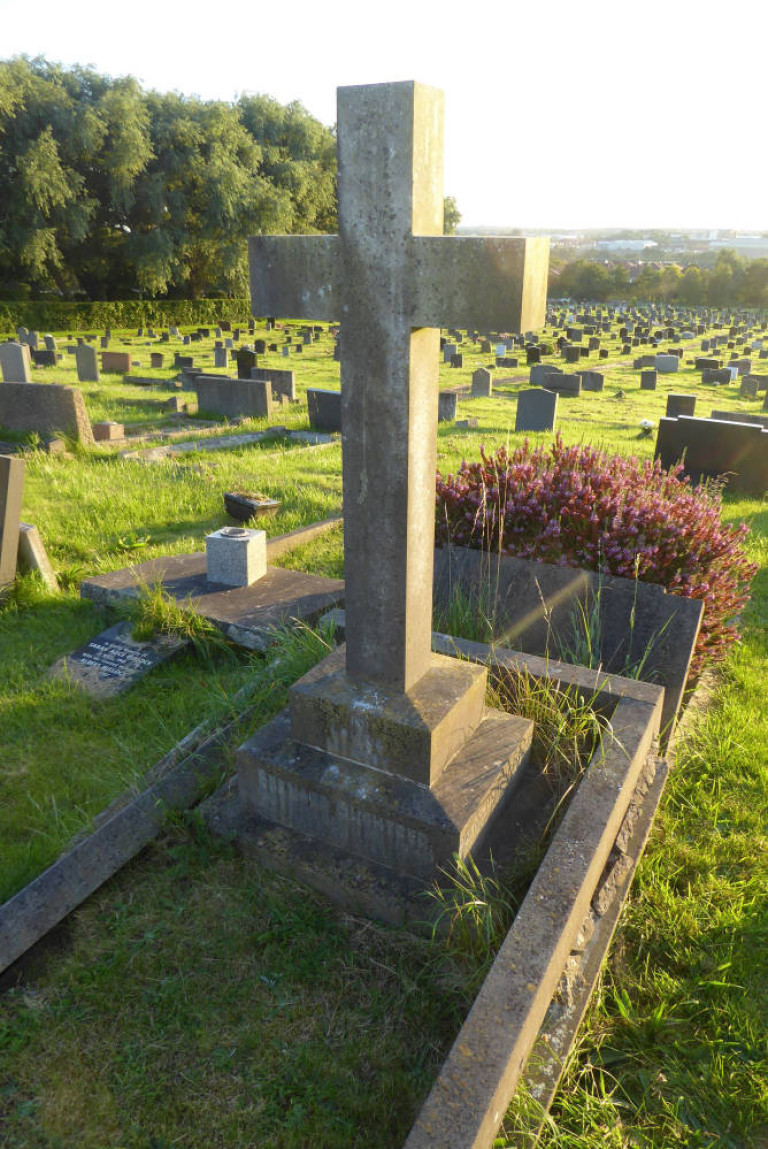
Where is the grave?
His grave is in the so-called ‘Mayor’s Parlour’, up the path from the main entrance, on the right before the North entrance.
Bramwell Longstaffe was the secretary of the Barrow branch of the Independent Labour Party – a constituent part of the Labour Party – during WW1. He was also a conscientious objector, and no doubt subject to the vilification they attracted during the war. This makes it surprising that he served two terms as Mayor of Barrow from 1934-36. He died running for a bus from his home, 18 Beach Crescent, Walney at the young age of 57. At the Magistrates Court, the Presiding Magistrate Mr. CGB Ellison, said as part of his tribute ... ‘who, at considerable suffering, pain and apparently at the sacrifice of all future prospects, has on occasion taken stands which brought him anything but popularity, and brought him also ... considerable suffering, pain and anxiety.’
The headlines of the Barrow News of Saturday 23rd September 1916 read
Barrow News, Saturday 23rd September 1916BARROW SOCIALIST CONVICTED
SENTENCE OF MONTH’S HARD LABOUR
EXTRAORDINARY STATEMENTS
LOCAL FIRM TRADUCED
Bramwell Longstaffe, conscientious objector and secretary of the Barrow branch of the I.L.P., was brought up in custody before the Barrow magistrates on Friday on a charge of attempting to cause disaffection among the civil population, contrary to the provisions of the Defence of the Realm Act. Accused had previously appeared before the court on Monday, and had been remanded, bail having been refused. The magistrates on Friday were Messrs. J. Clarkson (in the chair), G.S. Heath, and E.P. Chapman.
Defendant pleaded “Not guilty”, and was represented by Dr. Eastman, barrister, of Manchester (instructed by Mr. J.F. Hodgson, solicitor, Barrow).
The Chief Constable outlined the case, stating that accused was a painter by trade, and resided at 3, Warwick- street. He stated that Longstaffe approached certain young women, who had come to work at Vickers, and told them not to. He said that they would be treated like pigs, and only receive 12s. a week, and that the firm was a German firm.
Mrs. Catterall, wife of a soldier in the North Lancs. Regiment, whose home is at Wigan, said she was now working in Barrow on munitions. She was in company with a number of others on 15th Sept., having arrived here that day, and when they were looking for lodgings near West View-road and Cragg-street, the prisoner came and spoke to them. He said Vickers were a German firm, and that Miss Pullinger, the manageress, was a human pig. They had been engaged at the Labour Bureau, where they were told that the wages would be £1 a week. Accused said they would only get 12s.
By Dr. Eastman: She did not hear any of the girls complaining.
Did you hear of any woman say that she came from Manchester and left her home and family, and that it was a shame that lodgings had not been found for her?
Witness: Yes, a fat woman. (Laughter).
Did another woman not go from door to door trying to find lodgings? – No.
Witness did not hear accused ask them if they were members of the Women Workers Federation. He said he could give them an address where they could find lodgings. He wrote the name and address in a book. .........
Mrs. Tomlinson, wife of a marine engineer, living at 12 Cragg-street, said she heard prisoner say Vickers were nothing but a German firm, and that they were bleeding them. He also said he had got £25 last week for sending girls back. Witness said, “I asked him what authority he had to say that Vickers were a German firm. I asked him if he could prove it. He said “Yes.” I then said, “A young man like you ought to be at the front.” He replied, “You ought to be, you’d make a good target.” Witness told him she had two sons at the front, and he stated that they should be shot. She went to strike him, but two of the girls got hold of her, and accused ran away.......
Dr. Eastman, on behalf of the accused, said the case had really been brought forward on the evidence of the three women and Mrs. Tomlinson. They would have noticed that the witnesses did not agree exactly in describing the conversation that took place on this occasion. There would not have been any prosecution except that this young man wounded the susceptibilities of Mrs. Tomlinson. His client was well known in Barrow. He (Dr. Eastman) was not there to comment about his views. It was not a criminal offence. Longstaffe was not afraid of expressing his views. A man of this sort did not resort to lies. He had made a full statement to police at the time. Mr. Longstaffe sent two of the women to Mrs. Mills, in Harrison-street, and intended finding the others shelter at the I.L.P. Rooms until they could get lodging. Longstaffe was in his room upstairs, and heard a noise outside. On looking through the window, he saw 30 or 40 women standing in the cold and rain with bags and parcels. His brother then came into the room, and told him what it was. He at once got the key to the Independent Labour Party Rooms in order to let them go in there. He came downstairs, went to the women, and said to them, ‘What’s the matter?’ And then what happened? As soon as they were asked that they all commenced talking and they told him that they had been brought to Barrow and promised lodgings, and they were afraid they were not going to get them. They were being taken from house to house and were getting dissatisfied. One woman was complaining bitterly, and she said that she would let Vickers know that she was not being brought to Barrow in that way when she had a home of her own. The accused did say that they were worse than Germans, bringing women to the town without finding lodgings for them. Was that evidence of attempting to cause dissatisfaction among the civilian population? If cases like that were to come before the Court, he was afraid the magistrates would be kept very busy. ... Accused stood charged with an offence that if found proved made him an enemy to his country. Were they going to stamp a man as an enemy to his country on the hazy recollection of three or four women who talked so quickly that they could not remember what was said. The accused had been five days in gaol, and he asked the Bench, in view of all the circumstances, and his excellent character, to find that no guilt had been proved. They all knew that a man who had Socialistic views was not afraid to speak out, and if he had been guilty of the charge he would have been the first to admit it.
(Bram Longstaffe then gave evidence repeating the above). He concluded: He denied saying Vickers was a German firm, or that the girls would only receive 12s a week, or that they would be treated like dogs. Miss Pullinger he did not know, and he did not use the statement alleged in regard to her.
By the Chief Constable: The statement made by the witnesses for the prosecution were untrue. (This sentence either lacks a question mark, or should be ‘true’ rather than ‘untrue’ I think)
Mrs. Mills, 108 Harrison-street, Barrow, said she found the two girls lodgings, and they were now working at Vickers.
Jenny Atkinson, 167, Rawlinson-street, now working at Vickers, said she was one of the 30 girls who had come from Wigan and Manchester. The accused only said ‘they were worse than Germans for bringing them there and leaving them stranded.’ They thought they were stranded.
By the Chief Constable: Lodgings were found for them by the representative of the firm.
Miss. Brown gave similar evidence. Accused did not tell them not to go to Vickers.
The Bench found the case proved, and sentence accused to one month’s hard labour. Dr. Eastman gave notice of appeal, and pending the trial at Quarter Sessions on 16th October, bail was granted on the accused’s recognisance of £100, and two sureties of £50. On 29th September, Mr. Berry, Chief Constable of Barrow, wrote to the Watch Committee of the Council asking that the Town Clerk ‘be instructed to take the necessary steps to support the conviction at the Quarter Sessions.’
The report of the Appeal in the News of Saturday 21st October repeated much of the above, bit also included the following exchanges:
Barrow News, Saturday 21st October 1916Mr. Wingate Saul (for the respondents): Do you think it a disgrace to be in the Army?
Appellant: No, I honour those who have considered it their duty to go.
- You evidently did not consider it your duty to go
- I must admit I don’t sir.
- Did you think Mrs. Tomlinson had anything to be proud of in having three sons in the Army?
- I don’t think that a fair question.The Chairman: Kindly answer the question.
- I didn’t give it a thought.Mr. Wingate Saul: Give it a thought now, and answer the question. Appellant: Can’t. If they consider it ...
The Chairman: Yes or no; let us have a straight answer. Appellant: In the present condition I should say “Yes”.
Mr. Wingate Saul: What do you mean by the qualification?
- I am a Tolstoyan and a non-resister.
- Do you think Mrs. Tomlinson had anything to be proud of in having three sons in the Army?
- I should say “Yes.”
- Did you think so on 15th September?
- I didn’t give it a thought. I have three or four cousins in the Army.
- You may be ashamed of them. This ‘No Conscription Fellowship’ (Longstaffe was Secretary); does it try to
prevent people joining the Army?
- No; I have not tried to influence anyone, and nor has the Fellowship.The Appeal was dismissed with costs, and the conviction upheld.
The Barrow News 20 September 1919 reported that Bram Longstaffe had been struck from the list of voters after objection from Mr. G. Shyvers (for the Conservative Party). He was still allowed to stand for election as a Councillor, and was duly elected.