Died
15 April 1974
Sources
Military Service Records
Lynne Slavin
Cumbria BMD
Ancestry
Place
Walks
Themes
Private Augustus (Gus) Henry Rodgers
1st/4th King’s Own Royal Lancaster Regiment
Quite rightly, much has been made over the last decade or so, of the young men who enlisted in their thousands in the “Great War”, the “War to end all wars”, and made the “supreme sacrifice”. Many never came back, and are remembered every Armistice Day, now Remembrance Day (11 November) at countless parades and ceremonies; and at tens of thousands of Commonwealth War Grave headstones throughout the country and beyond. Even more are commemorated on family headstones, often when bodies have not been recovered, or remained overseas.

Those who returned to civilian life are often forgotten, yet they were the majority. They are not necessarily on any war memorial, though some villages did record “those who served” as well as “those who fell”. Many had stories to tell, though historically they didn’t share them, perhaps through modesty, or a need to forget the horrors of war. Others were permanently affected. This is one such story, of Augustus (Gus) Rodgers, much of it provided by his granddaughter, Lynne Slavin, who is still in Barrow.
Gus’s granddaughter Lynne Slavin (née Rodgers), July 2023“My grandfather’s terrible experience and a really difficult life that followed was not unlike many sacrifices people had to make and it’s good for young people especially to understand what privations there were.
My grandfather was called Augustus Henry Rodgers, known as Gus. I have few details of his service but St Dunstan’s gave me some. He was blinded by a sniper at La Bassee Canal, near Ypres. where both of the friends with him were killed. He was 18.
I still have the official note he sent to his then fiancée telling her he was ok, then was shot 4 days later. The note was sent on 28th June. My grandfather was born 17 August 1897. He enlisted on 6 March 1917 was wounded on 31 July 1917, and discharged to the care of St Dunstan’s on 17 September 1917 in Regent’s Park, London, and stayed there while they helped him to adjust to life without sight. He was actually married at St Dunstan’s on 23 Oct 1918. (see photo below) I don’t know how my grandmother managed to get there for the wedding. She’d never been outside Barrow before.
Their life was really difficult but they were supported by St Dunstan’s who continued amazing care all his life.
Of course his work was extremely limited My Dad remembers standing next to him in a freezing cold shed in the back yard making baskets. They had to be soaked in cold water before use."
For an account of the fighting endured by the 4th Batt. KORL at the end of July 1917 see John Hutton’s book “Kitchener’s Men” (Pen & Sword 2008) p.47-50.
Cumbria BMD has the following children born to Benjamin and Agnes Rodgers:
Mum’s maiden name Atkinson
Mercy Elizabeth 1888 (died December 1889)
Charlotte Esther 1890
Alice M. 1892
John William 1895
Augustus Henry 1897
Alfred Edward 1899
Beatrice A. 1902
Sidney Stanley 1905 (listed under Ridgers on the Cumbria BMD website)
Martha Matilda 1909 (died 1909 at 15 days – Cemetery records)

A note about St. Dunstan’s
In 1914 St. Dunstan’s Hostel for Blind Soldiers and Sailors was founded by Sir Arthur Pearson, author of Victory Over Blindness. A year later it moved to a property in Regent’s Park. The idea was to provide a hostel where ex-servicemen would go after they had received hospital treatment to ‘learn to be blind’. The legacy of the war meant that in 1921 men were still waiting to be accommodated, with 57 men awaiting admission. By 1929 there were still two thousand men in their care. The intake included 103 colonial ex-servicemen who were trained during their time at St Dunstan’s.
The emphasis of the organisation was training, which often involved varying forms of technology that enabled the men to utilise their skills. This included adapted typewriters and telephones, with standardised assessments to encourage employment. St Dunstan’s often found itself in the papers and, as a more understood form of ‘disability’, attracted public sympathy.
Not all blind people got this kind of treatment – as with disabilities more generally at this time veterans were in a unique position of being seen as particularly deserving of support. Julie Anderson has remarked that ‘Blind people were the most politically active disabled group during the immediate post-war period’. In 1920 there was a march of 250 blind people in support of the passage of the Blind Persons Act, 1920. None of the men from St Dunstan’s were claimed to have been involved.
Numerous pension files detail the experience of men at St. Dunstan’s, including several annual reports. A treasury file also explains more peripheral concerns around convalescence of blind ex-servicemen. In 1918, concerns were raised about the taxation on goods arriving into the country. The goods consisted of 800 braille watches sent from Switzerland for the men of St Dunstan’s given by the National Association of Goldsmiths.
Ancestry tells us:
1901 Census
The 1901 Census has the Rodgers family living at 17 Grosvenor Street, Barrow. Benjamin A. Rodgers (41) is an Ironworks Labourer, born Halesowen, Worcs; wife Agnes H. Rodgers (37) is born Cark, Lancs, and the Barrow-born children are Charlotte E. Rodgers (11); Alice M. Rodgers (9); John W. Rodgers (6); Augustus H. Rodgers (4) and Alfred E. Rodgers (2).
1911 Census
By the 1911 Census the family had moved to 53 Melbourne Street, Barrow. Agnes Hannah Rogers (the enumerator missed the D out throughout) (46) was a Char-woman, born Flookburgh, Lancs; Alice Maud Rogers (18) was single, no occupation recorded, and like all the following, born in Barrow; John William Rogers (16) Apprentice Driller (Shipyard); Augustus Henry Rogers (13) Milk-boy (School); Alfred Edward Rogers (11) Milk-boy (School); Beatrice Alexandra Rogers (8) School girl; and Sidney Stanley Rogers (5) School boy. I am not sure where Benjamin is on the Census, bur according to Barrow Cemetery records he was buried on 23 December 1930, with his wife Agnes buried in the same grave on 11 June 1938. There is no record of a headstone.
From Gus’s military service records:
Attestation papers call him Henry Augustus (sic) Rodgers, a Back Sawyer? He signed originally on 11 December 1915, then again on 7 March 1917, when he was actually called up. He was 5ft 5¾ins. and 113lbs at 18yrs. He was living at 53 Melbourne Street, Barrow and his father was Benjamin Arthur Rodgers.
Gus joined the King’s Own Royal Lancaster Regiment, serving at Home 11 Dec 1915 to 4 June 1917 (in Army Reserve); then in France from 5 June 1917 to 4 August 1917; then Home again 5 August 1917 to 5 October 1917. A note says he suffered G.S.W. (Gun Shot Wound) eyes in France July 1917. A later note says loss of left eye; blinded in right.
King’s Certificate on discharge was sent to 47 Smeaton Street. A further note indicates that he had been a Mill Operative in Steel Rolling Mill of Barrow Hematite Steel Co. Ltd. for 4 yrs 7 months prior to the war.
1939 Register
Living at 41 Smeaton Street were Augustus H. Rodgers (DoB 17 August 1897), Blind ex-Serviceman; Mary A. Rodgers (DoB 27 October 1895) Unpaid Domestic Duties; William R. Rodgers (DoB 8 October 1919) Capstan Lathe Hand?; (next record redacted); George A. Rodgers (DoB 1 February 1927) At School.
Cumbria BMD tells us the missing information. Gus & his wife Mary- but known in the family as Aggie (née Postlethwaite) had three children: William Raymond (1919); Augustus Henry (Jnr) (1922); and George Arthur (1927). By 1939 Augustus Henry Rodgers (Junr) had joined the R.A.F., which may have led to his record being redacted.

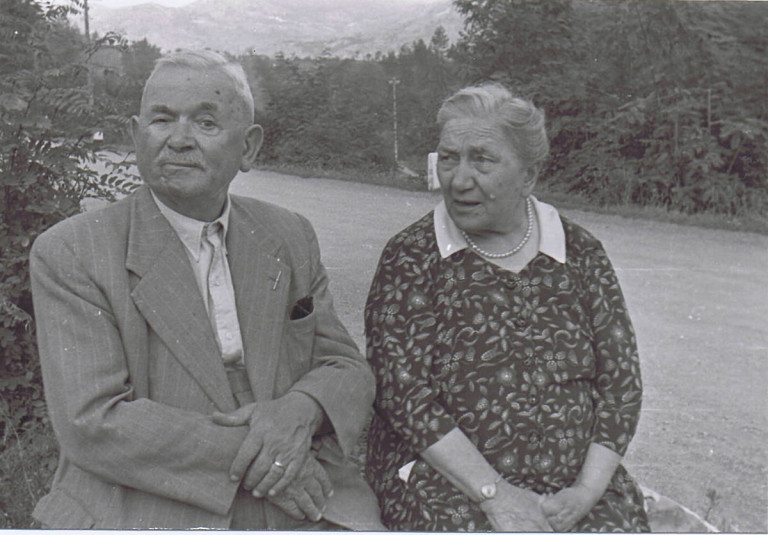
Gus & Mary’s Golden Wedding 1968
Gus died 15 April 1974, and Aggie almost exactly seven years later, on 25 April 1981.