Died
13 April 1940
Born
14 June 1917
Sources
Ancestry
Various websites inc. Wikipedia; Naval History Net; Uboat Net
Place
Walks
Herbert Lawrence Rubery
Cook
Herbert Lawrence Rubery died when the destroyer HMS Eskimo was taking part in the second battle of Narvik. Others who died are listed at naval-history.net Rubery is listed as MPK (Missing Presumed Killed), so perhaps his body was recovered some time later. He was the son of Leonard Francis & Jessie Rubery, born 14th June 1917 in Leytonstone, Essex. His body was brought back to Barrow, and buried on 8th June 1940.
1911 Census
In the 1911 Census, Leonard (24, born Bow) and Jessie (21, born West Ham) Rubery lived at 66 Lansdowne Road, Leytonstone, Essex, along with their 1 yr old daughter, Jessie Frances Rubery. Leonard was an upholsterer, and had been an airman in WW1.
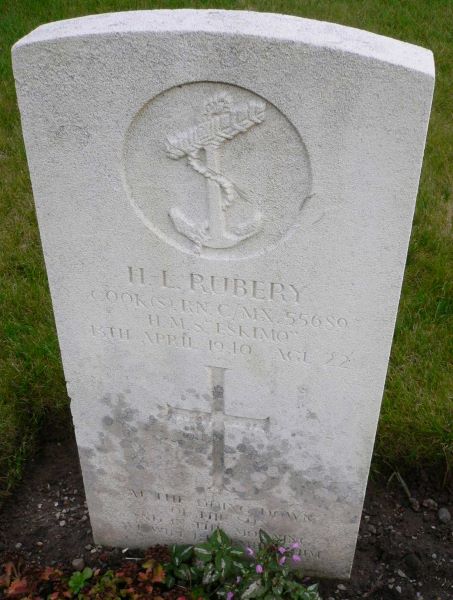
H. L. RUBERY
COOK (S) R.N. C/MX 55689
H.M.S.ESKIMO
13 APRIL 1940 AGE 22
AT THE GOING DOWN
OF THE SUN
AND IN THE MORNING
WE WILL REMEMBER HIM
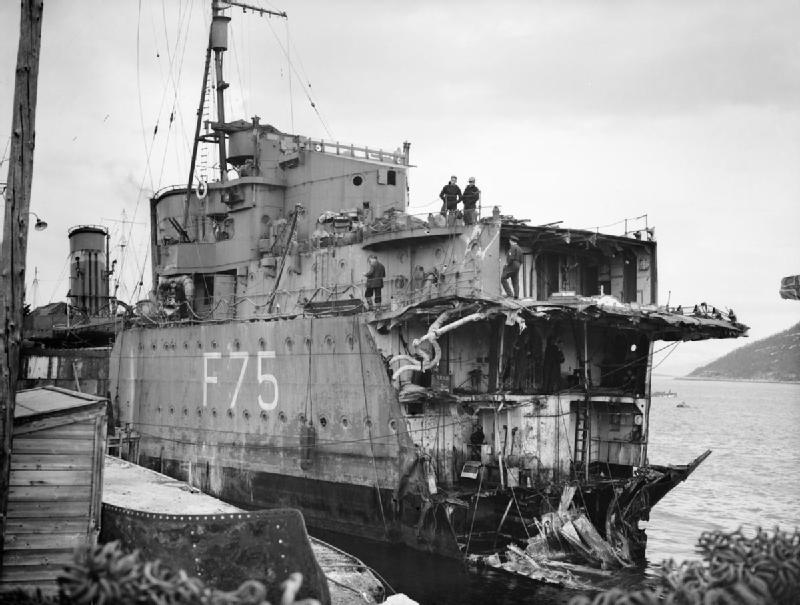
Eskimo after losing her bow during the Second Battle of Narvik. Read More.
HMS Eskimo
HMS Eskimo was a Tribal-class destroyer, laid down by the High Walker Yard of Vickers Armstrong at Newcastle-on-Tyne on 5 August 1936. She was launched on 3 September 1937 and commissioned on 30 December 1938. wikipedia.org
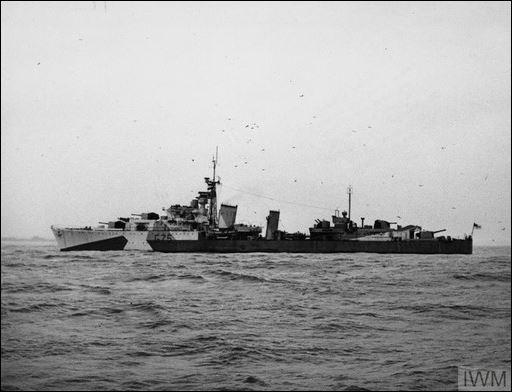
HMS Eskimo in 1941
This is photograph FL 10008 from collections of Imperial War Museums (collection no. 8308-29)
Wikipedia says: Finally, when the German destroyers were low on ammunition, they retreated, except for Hermann Künne, which had not received the order. Hermann Künne was fired upon by the pursuing HMS Eskimo, but she took no hits. Out of ammunition but undamaged, Hermann Künne was scuttled by her crew in Trollvika in the Herjangsfjord. After scuttling the ship, the crew placed demolition depth charges on the ship, attempting to sink her in Trollvika's shallow waters. Eskimo, still in hot pursuit, launched a torpedo which hit Hermann Künne, setting her on fire. Whether the German's own depth charges or the torpedo from Eskimo was the source of the explosion is unclear. Eskimo was in turn ambushed by Georg Thiele and Hans Ludemann, losing her bow but surviving. Read More
During the Second Battle of Narvik, Eskimo had her bows blown off by a torpedo. She limped back to Skilfiord, Norway for temporary repairs. Surviving aerial bomb attacks, she was finally made ready for sea on 31 May 1940. The destroyer proceeded without incident, to the Vickers-Armstrong yard at Newcastle-on-Tyne, England for a rebuild. By September 1940, the work was completed and Eskimo re-joined the 6th Destroyer Flotilla (6th D.F.). Read more: uboat.net