Died
6 July 1904
Sources
Barrow News
Mackereth’s Furness Year Book 1905
1871 Census
Place
Walks
Ulverston 1 point 16
Themes
James Hodgson J.P. C.A.
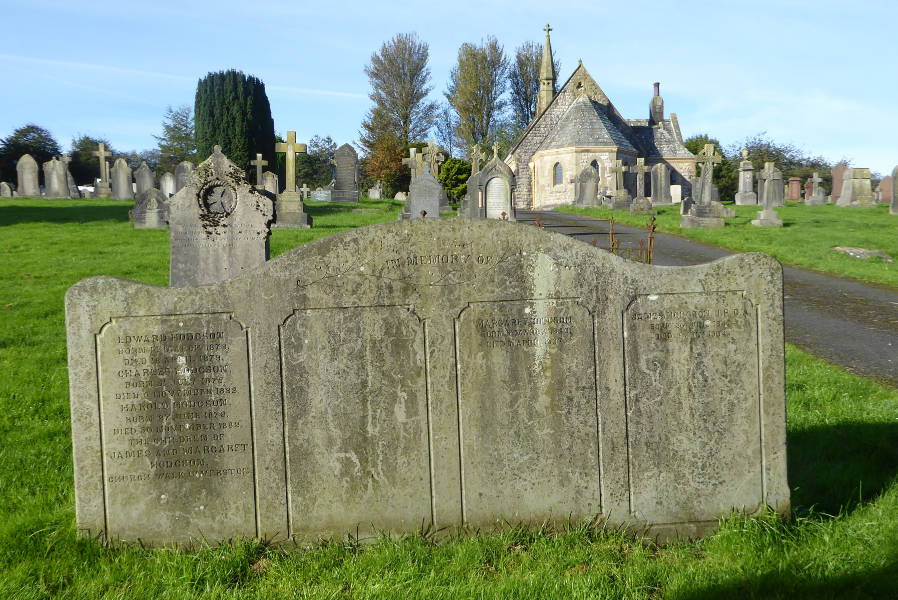
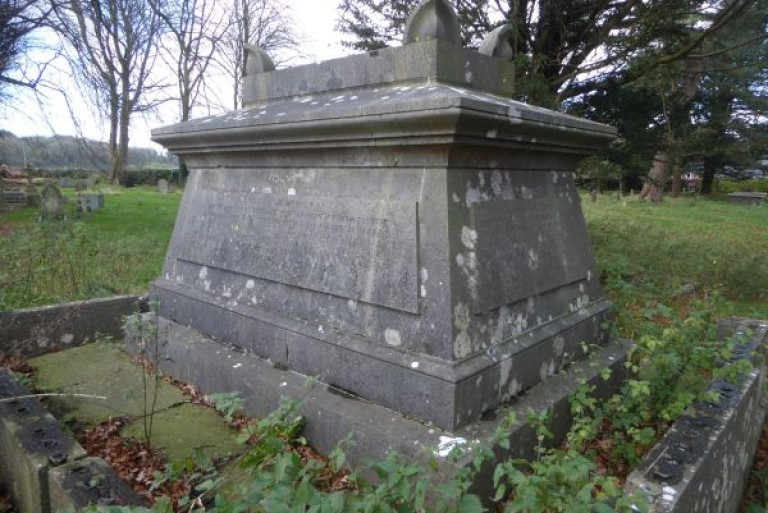
This unusual gravestone is to the Hodgson family: (from left to right; the second section is blank)
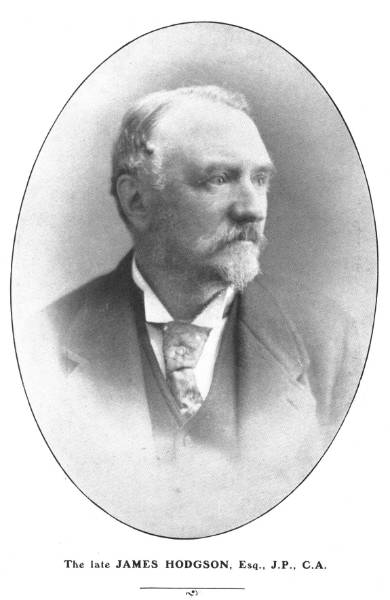
Picture from Mackereth’s Furness Year Book 1905
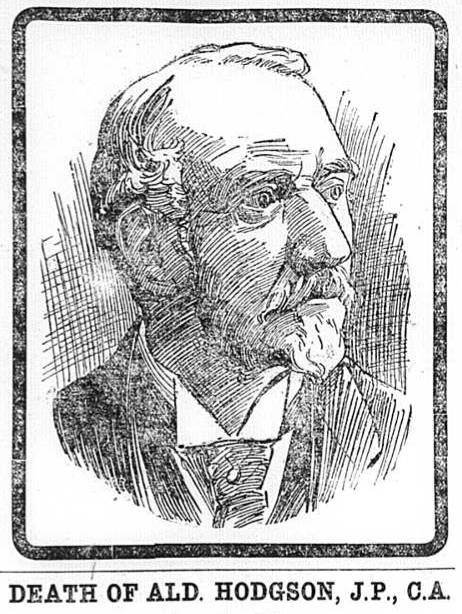
Barrow News 9 July 1904
EDWARD HODGSON
BORN 14 MARCH 1878,
DIED 18 APRIL 1879.
CHARLES HODGSON,
BORN 31 JULY 1875,
DIED 9 NOVEMBER 1882.
HAROLD HODGSON,
BORN 27 JUNE 1879
DIED 30 NOVEMBER 1882,
THE CHILDREN OF
JAMES AND MARGARET HODGSON,
CHURCH WALK, ULVERSTON
MARGARET HODGSON
BORN 5 MARCH 1840,
DIED 7 APRIL 1907.
AMES HODGSON, J.P., C.A. BORN 20 JUNE 1841, DIED 6 JULY 1904.
According to the 1871 Census, James and Margaret were living on Benson St, Ulverston, with their two sons, James (3yrs) and Phillip (2), and two servants, Sarah Sharp (26) and Mary Sharp (21).
James was a Colliery Agent, presumably the C.A. on the gravestone.
By 1881 they were on Church Walk, living with James (13), Phillip (12), Mary (9), Alfred (6), Charles (5), Harold (1), and three servants, Ann Atkinson (24), cook; Margaret Shepherd, (19), Housemaid, and Alice Edwards (21), Kitchen Maid. He is now recorded as a Coal Merchant.
In 1891 their house is identified as ‘Britain Place’, Church Walk, and they have living with them Phillip (22), and Agricultural Student; Alfred (15), Scholar; Margaret (9), Scholar; and three servants: Dinah Askew, (29), Cook & domestic servant; Sarah Atkinson (26), Housemaid, and Agnes Dickinson (19), Kitchenmaid. James is listed as a Colliery Agent again.
As he is in 1901, when the house is spelt ‘Brittain Place’. Only Margaret is left at home with her parents, together with three new servants: Eliza Burns (24) Housemaid; Mary Kirkby (19), Cook, and Anne Smith (15), Kitchenmaid.
In the Introduction to Mackereth’s Furness Year Book 1905, it says “One sad note, alas, it is our mournful duty to record on the death of one of Ulverston’s most esteemed leaders, who detested humbug in every phase, and ever sacrificed self for the cause of his native place, and fought her battles with an energy that inspired admiration. The memory of James Hodgson will remain ever-green in Ulverston and district as one who ungrudgingly devoted his time and talents for its advancement.
In the diary section the entry for 6 July reads: Death of Mr. James Hodgson, J.P., C.A., the man who has done most for Ulverston. I’d never heard of James Hodgson, but his obituary notice is fulsome and glowing.
The Barrow News 9 July 1904 heads its obituary
Barrow News, 9 July 1904DEATH OF ALD. HODGSON
A USEFUL CAREER CLOSED
It is with feelings of much sorrow – feelings which will be shared by all classes of the community not only in Ulverston and throughout the entire district – that we have to announce the death of Mr. James Hodgson, J.P., C.A., which occurred about Wednesday midnight at his residence, Brittain-place, Church Walk, Ulverston. The deceased had been confined to his house with a serious illness for about five months, and the end had been expected for some time. The regret at the loss of a gentleman who has for over thirty years been a conspicuous figure in the public life of the district is, however, none the less keen and profound. Deceased was 63 years of age.
The flags at the Ulverston workhouse, the Police Buildings, and the County Chambers have been hoisted half-mast.
There are no paragraphs in the following section in the original. I have added some breaks to make it easier to read. Note how there is barely a mention of his family, and given his charity and public service work, perhaps he did not spend much time with them.
The late Mr. James Hodgson was the only child of the late Mr. James Kellett Hodgson, of Ulverston, his grandfather being the late Commander Hodgson, R.N. Mr. J. K. Hodgson, who started business in Benson-street about the year 1840, was for many years colliery agent to the Earl of Crawford and Balcarres, afterwards the Wigan Coal and Iron Co., Ltd., manager and secretary of the Ulverston Gas Co., and secretary of the Ulverston Savings Bank. Mr. James Hodgson, on leaving school, entered the office of his father, who then carried on business in Theatre- street. Early in life Mr. Hodgson displayed such strong, shrewd commercial characteristics as soon placed him in the He had the advantage of a splendid training, for there were few better or more exacting men of business than his father – a man of the highest probity, and whose word was his bond. From him his son received and in all his dealings, private and public, invariably acted upon this motto, “Make yourself sure that you are in the right, then go straight ahead to your goal.” As a young man, Mr. Hodgson joined the Ulverston Volunteers on their formation, as a private, and never could be induced to accept a non-commissioned officer’s stripe or a commission. Being a first- class shot, the only badge he wore was that of a marksman. He was proficient in drill, and remained in the ranks until the increasing cares of business necessitated his retirement, he having succeeded his father, who handed over to him the management of the business and the various offices which he had filled.
Mr. Hodgson’s splendid business qualifications, coupled with the very warm and deep feelings which he ever cherished for the welfare and progress of the town of his birth and adoption, soon signalled him out for public service; and we doubt not that had his ambition pointed to a Parliamentary career he would have made his mark in the House of Commons, as he most unquestionably has done in local and county government. He began his public career by taking a particularly active interest in educational matters. After the passing of the Elementary Education Act of 1870, Mr. Hodgson was elected at the head of the poll for the Ulverston and Mansriggs School Board, and it was principally on his initiative that the Rev. Canon Ayre was elected to the chairmanship, a position that he held during the whole existence of that authority. Mr. Hodgson remained a member of the Board for some years, filling the vice-chair and doing excellent service for the ratepayers. He was one of the trustees and a governor of the Old Town Bank Grammar School, and was elected chairman of the governors under the new educational scheme which led to the erection of the Victoria Higher Grade and Technical Schools, and the application of the Tarn Side field as a site for the new building, and of the remaining endowments of the old school for the founding of new scholarships. In the carrying out of the delicate and protracted negotiations with the Charity commissioners, the Education Department, and the County Council, Mr. Hodgson rendered invaluable assistance and advice. In fact up to the last he keenly interested himself in the work of education in all its branches, elementary, secondary, technical and scientific; and on the passing of the new Education Act, which came into force at the beginning of 1903, the great honour was conferred upon him of being the first chairman of the North Lonsdale Education Sub-committee, one of the largest educational bodies of its kind in the Kingdom. He was also one of the representatives for North Lonsdale on the County Education Committee, and while confessing that the Act was not altogether to his liking, he used his best endeavours to get the new educational machinery into proper working order, and to smooth the ruffled feelings of those who were opposed to the change, a work in which he was closely associated with Councillor S. Taylor, J.P., C.C., the vice-chairman, and Mr. F. W. Poole, the clerk. Mr. Hodgson ceased his connection with the committee in March, 1904, tendering his resignation on the grounds of ill-health.
It is also interesting to know that Mr. Hodgson was secretary of the first Sunday School established in Ulverston, the Town Bank Sunday School, and also served the office of superintendent of the school until its dissolution in 1873. For a quarter of a century Mr. Hodgson was very closely identified with the Ulverston Board of Guardians and the Local Board and Urban Council. As to his long association with the first-named body no man had a more perfect knowledge and grasp of poor-law procedures and administration and the other multifarious duties now devolving on Boards of Guardians. For several years he served as vice-chairman of the Board. He was also, for many years, chairman of the Union Assessment Committee, and office he filled with much distinction and tact, his perfect knowledge of finance and complete mastery of intricate details being of the greatest assistance and value. Failing health impelled him, most reluctantly, to relinquish some of his public offices. In March, 1901, he resigned his position on the Board of Guardians, to the keen regret of his colleagues and officials, who as a mark of their great admiration and appreciation presented him with a handsome testimonial. For many years Mr. Hodgson was returned unopposed on the old Local Board, and was its chairman at the time it was merged in the Urban Council, having filled that position in the three successive years 1902-4, and also in 1883-4. He was again elected to the chair in 1900, and was the organiser of the splendid procession to the Parish Church on the occasion of the funeral of Queen Victoria. The great success of the festivities in connection with the Jubilee and Diamond Jubilee of her late Majesty was largely due to his labours, and he also took a prominent part, not only in the “send-off”, but in the reception given on the return of the first Volunteer Active Service Corps to South Africa; in the various rejoicings; and in the King’s Coronation Proclamation. No member of the Council ever more thoroughly mastered the details of the town’s business, and his services on the Gas and Water Committee, the Finance Committee, and the Parliamentary Committee (at each of which he was at one time or another chairman) were particularly valuable. Consequent upon a strong division of opinion on the question of the chairmanship, which Mr. Hodgson maintained should be governed and decided not by the old principle of seniority, but by merit and fitness for the office, he suddenly severed his connection with the Council at a meeting held on April 23rd, 1901. His seat, however, was not declared vacant until the following November, when the Clerk was directed to forward him a letter of thanks for his long and faithful services to the public. But these services did not terminate with his severance from the Urban Council. He retained to the last his connection with the Lancashire County Council, to which he was first elected in 1898 as councillor for the Ulverston Division, on Mr. Myles Kennedy’s elevation to the Aldermanic Bench. In February, 1904, Mr. Hodgson was again returned unopposed, and at the first meeting of the newly constituted Council he was elected as an alderman, the vacancy thus created being filled by the election of Mr. James Walker, of Greenbank.
In the capacity of County Councillor Mr. Hodgson has done yeoman service for Ulverston and North Lonsdale, especially in the conduct of the negotiations between the County Council and the local authorities and the obtaining of substantial grants for the important levelling and widening improvements at High Bridge (between Swarthmoor and Ulverston) and at Cacata and Barrow End (between Ulverston and Greenodd) three steep hills, the removal of which has been greatly appreciated by the immense number of cyclists and others who travel on the main road between Barrow and Lakeside. Similar lasting monuments, largely due to the exertions of Mr. Hodgson, are to be seen in Ulverston – notably the widening of Princes-street; the splendid widening improvement in Dragley Beck (now known by the more dignified name of Victoria-road) and the opening out of the Wytarn Estate for building purposes; and the making of Conishead-road, as a more direct approach from the railway station to South Ulverston, Conishead Priory and Bardsea. Mr. Hodgson was placed on the Commission of the Peace for the County on October 19, 1891, and whilst always striving for equal justice to rich and poor in the administration of the law, he ever leant to mercy’s side. He greatly interested himself in the subject of licensing reform. For about 20 years Mr. Hodgson, who was a staunch Churchman, was a warden of the Ulverston Parish Church, and a most generous contributor to its funds. Until the Home Rule split, Mr. Hodgson was Liberal in politics, and Chairman of the North Lonsdale Liberal Association, and for many years a member of the National Liberal Club, London. He was an effective and formidable platform speaker, and an energetic worker in the cause, taking a most active part in the first electoral fight for North Lonsdale between the late Lord (then Sir Farrer) Herschell and the late Mr. William George Ainslie. Since then he has not actively participated in Imperial politics, but was ever known as a man of highly liberal ideas and wide and generous sympathies.
Among the many other positions filled by Mr. Hodgson may be mentioned the following: - A trustee of the Ulverston Town Lands until they were transferred to the control of the District Council; a director of the North Lonsdale Iron and Steel Company and Messrs. Harrison, Ainslie, and Co.; a member of the Iron and Steel Institute, and of the Barrow Chamber of Commerce; one of the oldest members of the Institute of Gas Engineers; Chairman of the Executive of the North Lonsdale Rose Society; a Vice-President of the North Lonsdale Agricultural Society; hon. sec. of the St. John Ambulance Association; President of the North Lonsdale Chrysanthemum Society; a Vice- President of the Ulverston Cricket Club; honorary fellow of the Morecambe Lodge of Oddfellows, of which his late father was a former secretary; a Vice-President of the Ulverston Lecture Association and of the Ulverston Angling Association; a trustee of the old Ulverston Library; trustee of the Ulverston Temperance Building Society; trustee of the Neville Hall Charity; trustee of the Barrow Sailors’ Home; trustee of the Rattan-row School Church; a trustee of the Ulverston Cottage Hospital; in fact, he was a most liberal supporter of every deserving local institution, and with a heart ever open and responsive to distress or misfortune, the cause of charity or philanthropy never appealed to him in vain. It has been largely through Mr. Hodgson’s instrumentality that the erection and fitting up of the pavilion for the “light cure” treatment of cancerous affections and lupus in connection with the Ulverston Cottage Hospital has been practically accomplished.
Mr. Hodgson, who married the second daughter of the late Mr. Philip Hartley, cotton manufacturer, of the Ellers and Low Mill, Ulverston, has left a widow, three sons, and two daughters.
The funeral will take place to-day (Saturday), the 9th inst., at 3 p.m., at the Ulverston Cemetery. The first portion of the burial service will, however, be taken at the Parish Church, the cortege leaving Brittain Place, at 2.30 p.m.
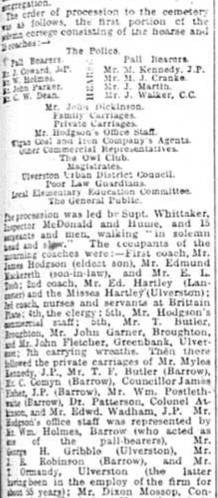
There is a long account of the funeral in the Barrow News 16 July 1904, beginning:
Barrow News, 16 July 1904THE LATE ALDERMAN JAMES HODGSON, J.P.
IMPRESSIVE FUNERAL
Amid many manifestations of sincere sorrow and sympathy, the mortal remains of the late Mr. James Hodgson, J.P., C.A., of Brittain Place, Church Walk, Ulverston, were reverently laid to rest in the family vault at the Ulverston Cemetery on Saturday last. The flags at the Railway Station, the Police Station, the Workhouse, the Parish Church, the Victoria Higher Grade School, the Liberal and Conservative Clubs, Stone Cross, and other public buildings, and private residences, were hung at half-mast, and along the route to the cemetery blinds were down, shutters put up, and business temporarily suspended., as the last mark of respect to the memory of one who had laboured so long and faithfully for the good of the community.
It goes on to list the mourners and wreaths, and describe the service. The extract (left) highlights the order of the funeral procession. Unusually in my research among the Victorian and Edwardian funerals in Ulverston, Mr.Hodgson does not appear to have been a Freemason. I have yet to find out what ‘The Owl Club’ was.