Died
21 April 1821
Born
c1790
Sources
Ancestry
Lancashire Online Parish Clerk
Various websites including Wikipedia and "After the Conflict: Cumbria War Memorials"
Place
Walks
Themes
Thomas Gardner
Drill sergeant of the Furness Cuirassiers
An interesting slate monument on the south wall of Urswick Church, east of the church door. The first ‘s’ of both double-letters look like ‘f’s, in the nineteenth century tradition.
I feared that I would have little luck finding out much regarding Thomas Gardner as an individual, although he probably had an interesting life.
The Life Guards were one of very few mounted regiments. Thomas may well have seen service in the Peninsular (sic) War (1807 – 1814) in Spain and Portugal, and possibly at Waterloo (1815), when Britain was fighting Napoleon.
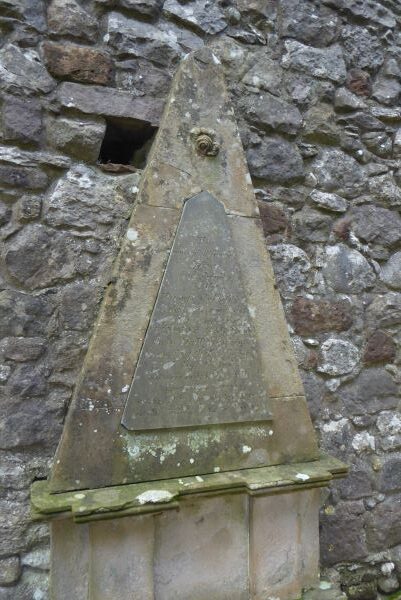
The
non-commissioned
Officers
and Privates
of the
Furness Cuirassiers
erected this monument
to the memory of
THOMAS GARDNER
their Drill Sergeant
formerly of the first Regiment
of Life Guards
who was killed by a fall
from his Horse
on the 21st Day of April 1821

A Cuirass is a piece of armour consisting of breastplate and backplate fastened together. (online dictionary)
Richard A Warren writes on his blog in November 2016: Apologies for my recent neglect of this blog, but here’s an uncommon button with the rose of Lancashire, inscribed “Furness Curassiers[sic]”, from a yeomanry troop that went in for a bit of post-war glamour. Neighbouring Cheshire may have boasted the Adlington Lancers among its yeomanry of the ‘twenties, but Lancashire went in for a proper piece of armour. The late R J Smith’s 1983 Ogilby Trust booklet on the Duke of Lancaster’s Own Yeomanry narrates the formation of Captain Thomas Braddyll’s Furness Troop in 1819, noting that it was also known as the Furness Cuirassiers, and continues:
“There has been considerable doubt expressed as to whether the Furness Troop ever wore cuirasses, and it must be stated that no positive evidence has yet come to light, but it will be seen that available evidence tends to prove that the Troop were Cuirassiers in fact as well as in name. Major J E Willan of Silverdale wrote in the Yeomanry Record of October 1898 saying many years ago a Troop of Yeomanry raised in the Furness district wore the cuirass, and bright steel helmets with an enormous bearskin crest projecting in front … He had talked with old men who could remember seeing the Yeomanry crossing the Sands, going to and from Lancaster with their armour flashing in the sun.”
It’s a rather wonderful image. No attributed cuirass seems to have survived, but helmets of the Cuirassiers are known. In 1999 Bosley’s offered a complete example, which seems to have been that described in Crown Imperial of 1982 as quoted by Smith. It is of the 1812 to 1818 Heavy Dragoon pattern, with a blackened metal skull, gilt furniture and a black horsehair mane and short plume. The original front plate carries an oval plaque inscribed “Furness Yeomanry”, concealing the title of the original unit. (Smith describes the sides of the skull as decorated with metal leaves, but there is no sign of this in this photo, and this may be a reference in error to the laurel leaves ornamenting the edges of the front plate.) The example here is owned by Stuart Bates, and the image used with his kind permission.
Smith describes two other dilapidated examples, one now lost and one with a skull and peak of blackened leather. Evidently Captain Braddyll acquired a mixed lot of these redundant helmets on their retirement from regular service in 1818.
In 1828 the Lancashire independent troops, the Cuirassiers included, were amalgamated as the Lancashire regiment, the dress of the Furness troop was “assimilated” with that of Wigan, and the breast and backplates of the Cuirassiers flickered only in the sunlight of memory.
A Wikipedia entry has: Napoleonic Wars
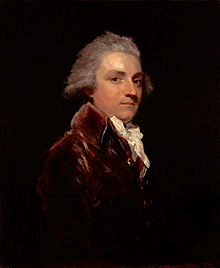
Wilson Gale-Braddyll by Sir Joshua Reynolds. (Left)
The Peace of Amiens was short-lived, and the militia was called out again: the 3rd Royal Lancashire Militia being embodied on 4 April 1803 under the command of Col Wilson Gale-Braddyll of Conishead Priory. From about 1804 the regiment's 10 companies included a rifle company. During the French Wars the militia were employed anywhere in the country for coast defence, manning garrisons, guarding prisoners of war, and for internal security, while the Regular Army regarded them as a source of trained men if they could be persuaded to transfer. The 3rd RLM was successively stationed at Exeter, Bristol, Gosport, Alton, Chichester and Dover. The regiment was granted the subtitle The Prince Regent's Own in 1813 (Col Gale-Braddyll was an associate of the Prince Regent).
The 3rd RLM volunteered for service in Ireland in 1813. Although most of the militia was disembodied after the Treaty of Fontainebleau in April 1814, the 3rd RLM was still in Ireland when Napoleon escaped from Elba and returned to power in France in 1815. The three regiments of Lancashire Militia, which happened to be stationed together at Dublin, were allowed to recruit back to full strength by ballot and 'by beat of drum'. They also provided drafts of around 1000 volunteers to the regular regiments being sent to Belgium. There is a story that many of the Guardsmen at the Battle of Waterloo were still wearing their Militia uniforms. The militia continued to do duty after the Battle of Waterloo while much of the Regular Army was with the Army of Occupation, and the 3rd RLM did not return from Ireland to be disembodied until January 1816.
An Act of 1817 allowed the annual training of the Militia to be dispensed with. So although officers continued to be commissioned into the regiment and the ballot was regularly held, the selected men were rarely mustered for drill. The 3rd RLM's rifle company was disbanded in 1829. In 1831 King William IV bestowed on the three Lancashire Militia Regiments the additional title The Duke of Lancaster's Own. (replacing the title 'Prince Regent's Own' carried by the 3rd RLM).
The wonderful website: After the Conflict: Cumbria War Memorials has:
After the French Revolutionary wars and the defeat of Napoleon the armed forces were disbanded. Many of the veterans, particularly officers, subsequently raised units of volunteers. One such was the Furness Troop of Yeomanry known as The Furness Cuirassiers. They were raised at Ulverston on 22nd September 1819 under the command of Captain Thomas Richard G. Braddyll, formerly Captain and Lieut. Colonel in the Coldstream Guards. On 15th May 1828 the troop amalgamated with other local volunteer units to become the Lancashire Yeomanry Cavalry.
Given his age and the date of his death it is reasonable to assume that he may have fought in the Peninsula or at Waterloo.
A correspondent to the above website says: Private Thomas Gardner WAS at Waterloo. He was born in Ulberton, (sic) Lancs, enlisted in 1808 and was discharged in 1818 aged 29.
The Lancashire Online Parish Clerk has Thomas Gardner being buried on 12th April 1821, but whether this is (a) the same Thomas Gardner, or (b) whether this date or the one on the monument is wrong I cannot say.
Wellington’s Men Remembered: Volume 1 A Register of Memorials (Bromley & Bromley) 2012 quotes the Urswick stone, with the additional information .. “Pte 1809 Served in the Peninsula and at Waterloo. At Waterloo his horse fell on him and damaged his lungs. As a result of this fall and poor health which he encountered in the Peninsula he was discharged 23 Dec 1818. Served for 11 years and 60 days.”
This is reinforced by an entry on Ancestry for the Royal Hospital, Chelsea, Regimental Registers of Pensioners for January 1819, which has Thos. Gardner, age 29; who I think was discharged on 01 June 1820. His entry reads: served 9+ years in India; 2 Waterloo; Spilling of Blood from the Lungs by a fall from his Horse on the Chest at Waterloo and broken health from illness; 6ft 1in; a Labourer; brown (hair?); grey (eyes?); fair (complexion?).