Lieut. James Thurstin Wright
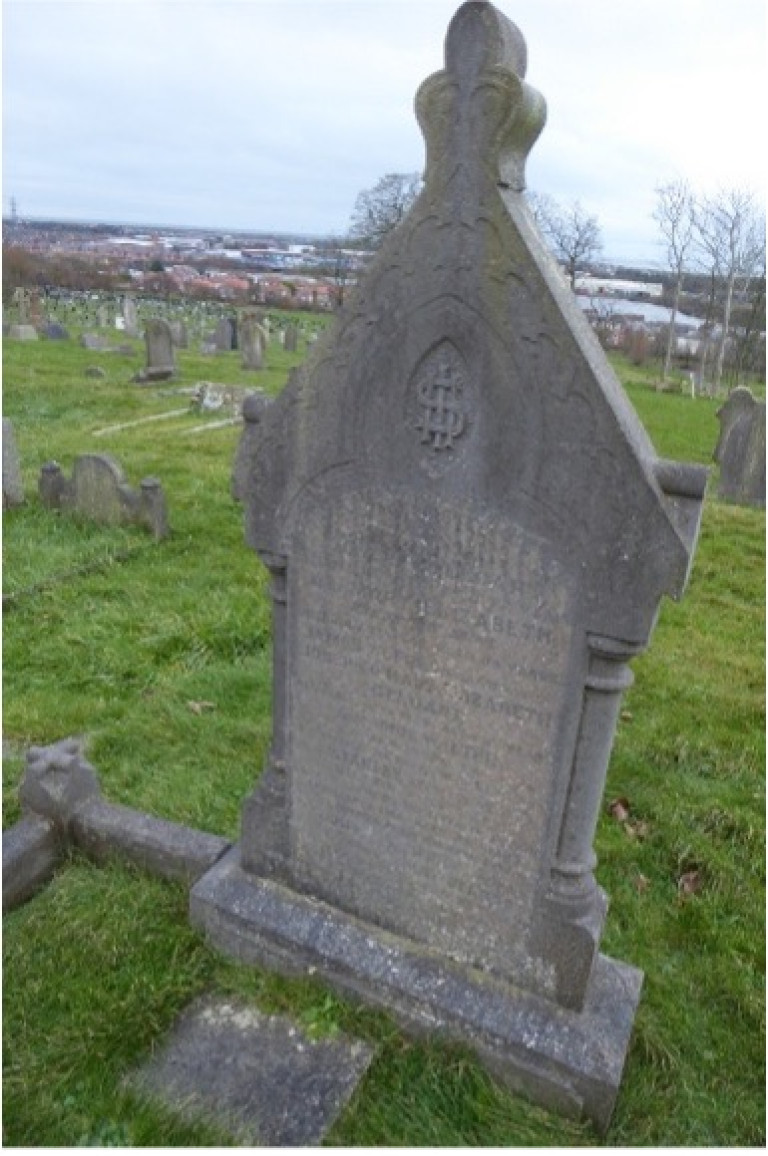
Lieut. Wright’s grave also commemorates his brother Basset.
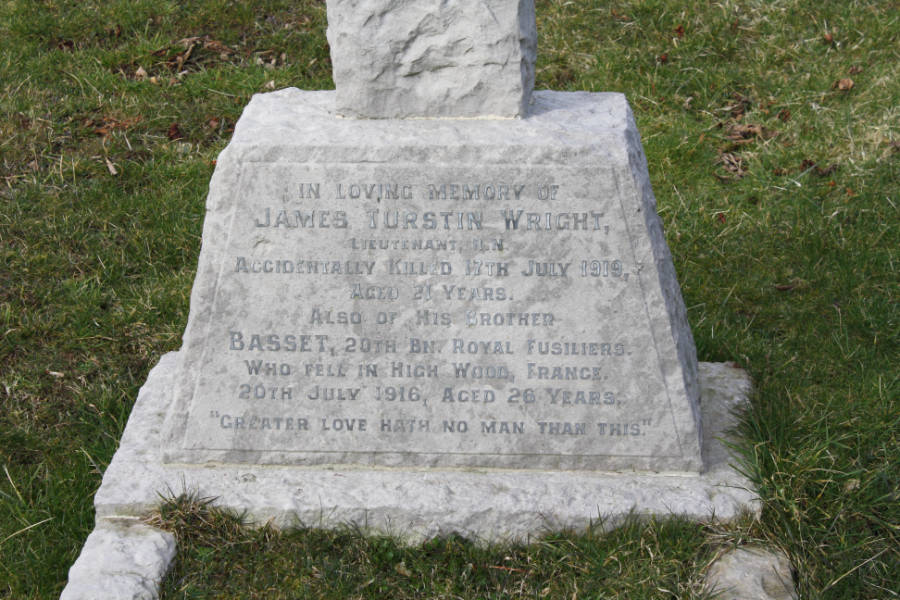
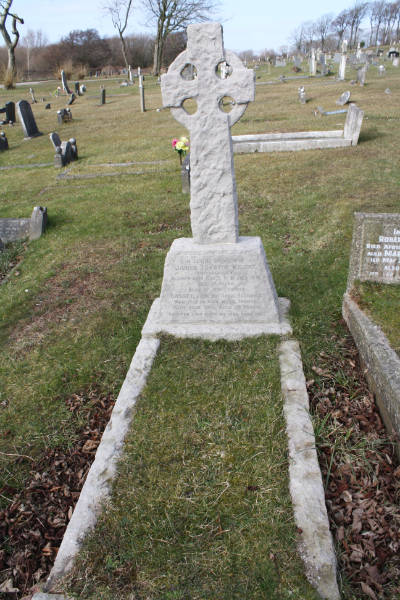
Where is the grave?
From the crematorium car park, take the path down the hill to the left. Ignoring two paths to the left, carry on down the hill. The Wright grave is near the bottom on the right.
During WW1 Barrow was leading developments in two new forms of war-machine: submarines and airships. The Airship Heritage Trust website has the following:
Airship Heritage Trust websiteVickers had disbanded its airship department after the failure of the Government to keep it supplied with work following the Mayfly project. A new department was therefore constituted in April 1913. They reassembled its original design team including H. B. Pratt and the young Barnes Wallis. Design work started on the No. 9 in April 1913. Work proceeded slowly at first as specifications were required to follow the Zeppelin lines.
As the existing shed had been over water, the idea of constructional sites was changed and a new nearby location was sourced. A second constructional shed was later commissioned on the site of what is now the private airfield of Walney Airport.
Lieut. Wright was the commander of the airship station, and about to leave the Navy, when he was killed in a motorcycle accident at the airship station. The North Western Daily Mail of Friday 18 July 1919 reported:
North Western Daily Mail, Friday 18 July 1919Walney Accident
AIRSHIP STATION OFFICER KILLED
Lieut. J. T. Wright R.N.
The officer commanding the Barrow airship station, Lieut. James Thurston Wright, R.N., was the victim of a fatal motor-cycle accident at Walney last evening.
Lieut. Wright was riding a motor-cycle along the private road leading to the Walney airship shed. A number of sheep appear to have strayed into the road, but while the noise of the approaching motor and the sounding of the horn dispersed the animals, it is said that the unfortunate officer lost control of his cycle, and he fell heavily to the ground.
He remained motionless, just as he had fallen, and when a fellow-officer went to his assistance he found that he was unconscious, and had him removed to the officers’ mess. Dr. Booth was summoned, but Lieut. Wright was beyond medical aid, and he died about half an hour after the accident.
The deceased officer, whose home was at 2, Grove-court, Belsize-grove, London, N.W., had had an eventful career. As a youth he entered Osborne College to train as a naval cadet, and his first appointment was to the Barrow-built H.M.S. Euryalis.
During the war he was in charge of a party at W Beach at Gallipoli, and he was among those who achieved fame on the steamship River Clyde which was beached for the purpose of effecting a landing on the peninsula. Afterwards he was sent to a monitor for service up the Tigris, and while on this enterprise he contracted a sight affection (sic) known as sun blindness. This resulted in his being invalided to England for twelve months, but not wishing to remain inactive, he offered himself and was accepted for service by the Royal Air Force.
He was at first posted to Inchinnan, Scotland, where Messrs. Beardmore were constructing airships, and then about twelve months ago he came to Barrow with the rank of first lieutenant. Eventually he was appointed commander of the Barrow airship station in succession to Lieut.-Colonel Harries.
Among the officers and men of the station Lieut. Wright was very popular, and in Barrow he had a wide circle of close friends. Probably the saddest feature of the fatality is the fact that next week he would finally have been invalided out of the service. He was due to leave Barrow next Wednesday, and the officers of the station had arranged a little farewell gathering for him to-night. This, of course, has been abandoned.
The funeral will take place, with full naval and military honours, on Tuesday afternoon at the Barrow Cemetery.
An inquiry into Lieut. Wright’s death will be held by Mr. F. W. Poole (coroner) in the officers’ mess at the airship station to-morrow morning.
On Monday 21 July 1919 the NWDM reported:
North Western Daily Mail, Monday 21 July 1919THE WALNEY FATALITY
INQUEST AND VERDICT ON LIEUT. WRIGHT
‘HE WAS RIDING VERY FAST’
‘This is a case in which I can only find that this man was accidentally killed.’ In these words the Furness Coroner (Mr. F. W. Poole), at the officers’ mess, at the Walney Airship Station, on Saturday, concluded an inquiry relative to the death of Lieut. James Thurston Wright, R. N., commanding officer of the station, who died as a result of a motor-cycle accident.
Capt. Little, R.A.F., identified the deceased, who, he said, held the rank of captain in the Air Force, and had had a long experience as a motor-cyclist.
Richard Bainbridge, gateman at the main entrance to the airship station, said that shortly after 4 o’clock on Thursday evening, the deceased entered the gate on a motor-cycle, and having reached the end of the private road he turned back and rode towards the gatehouse. When he had reached a point about 30 yards distant from the gatehouse, six sheep wandered into the road. ‘He seemed to clear the sheep, witness went on, ‘He just missed them anyway, and when he was passing the last one he seemed to give a great shout as though he had lost all control of the machine. The cycle seemed to zig zag, first to one side and then to the other; and when it had gone three or four yards past the gatehouse he fell off the machine, and it dragged him along about 15 yards. When I got to him he was lying with his foot underneath the cycle, and he was unconscious. He died half an hour later.
The Coroner: What speed was he going at? – Witness: He was going at the speed that they generally go at.
That tells me nothing; how fast? – He was riding fast, very fast at the time.
Then they generally ride fast. It is a nice piece of road? – Well, you see, where there is nothing in the road there is nothing to deter them.
The Coroner then delivered his verdict.
The CWGC identifies him as a Captain, and as a member of the Royal Naval Air Service (RNAS). There is also confusion about the spelling of his second name: the grave says Thurstin, CWGC & the newspaper Thurston.
Private Basset Wright served with the 20th Battn. Royal Fusiliers, died on 20 July 1916 aged 26, and is commemorated on the Thiepval Memorial. He was the son of Elizabeth Wright, of 122, Clarence Gate Gardens, Dorset Square, London, and the late James Wright. Educated at Marlborough College and at Oriel College, Oxford. It is perhaps surprising that he was a private rather than an officer. (CWGC)