John Backhouse
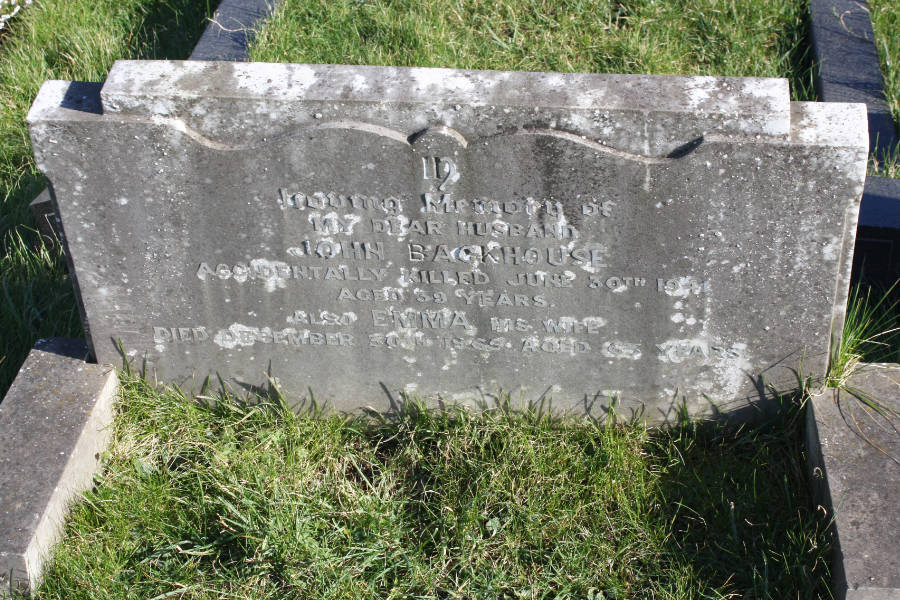
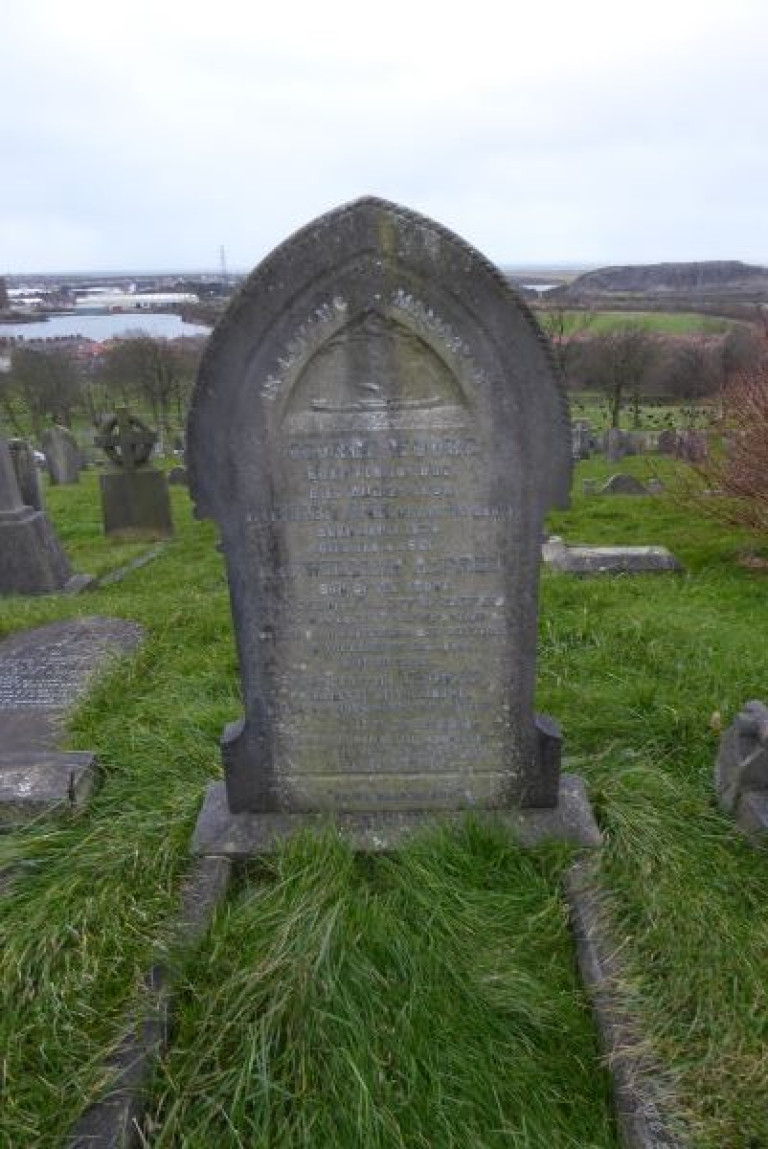
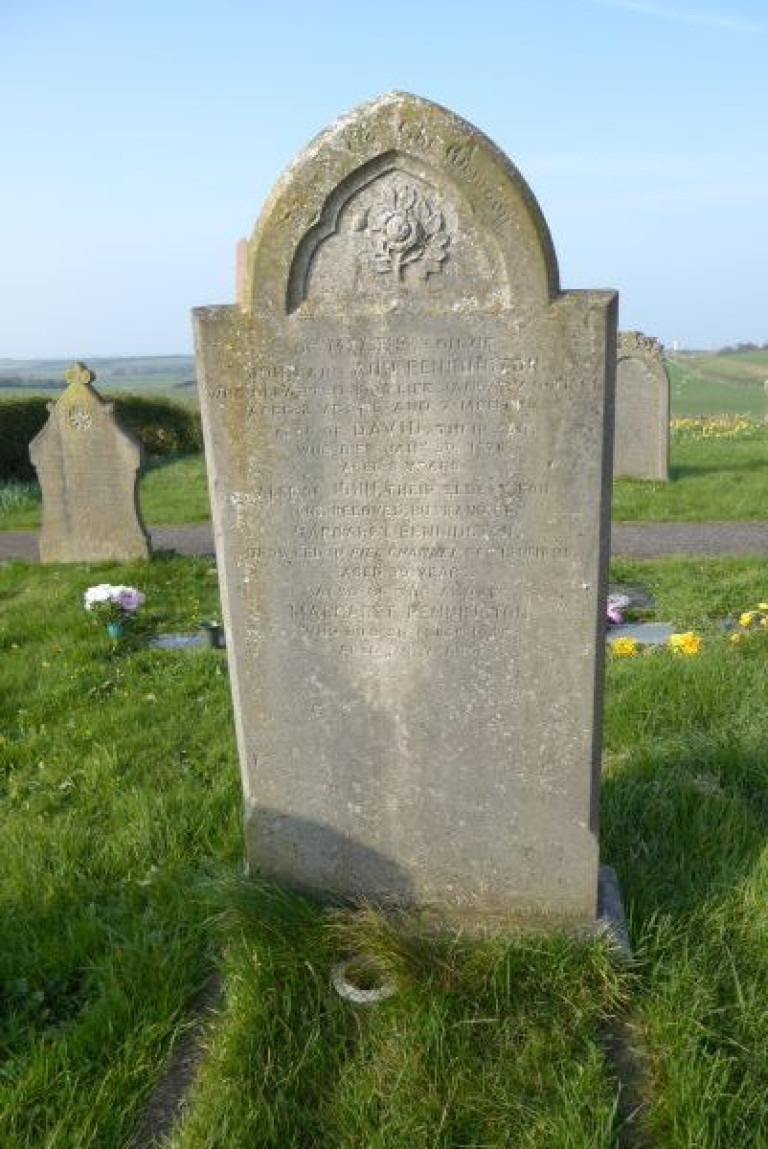
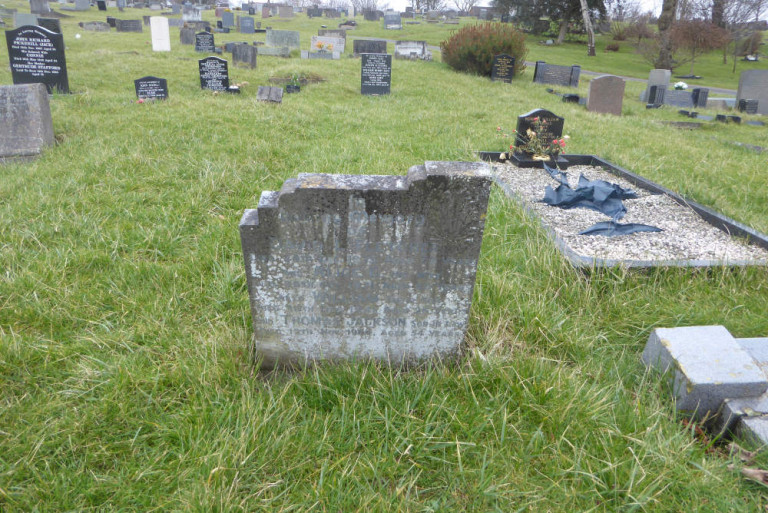
In Loving Memory of MY DEAR HUSBAND JOHN BACKHOUSE ACCIDENTALLY KILLED JUNE 30TH 1941 AGED 39 YEARS
ALSO EMMA HIS WIFE DIED DECEMBER 30TH 1965 AGED 39 YEARS
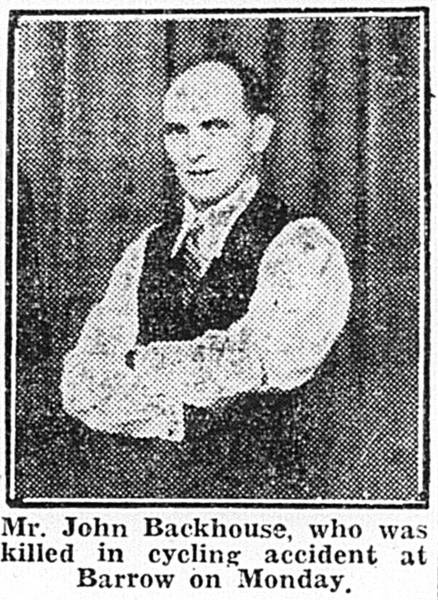
Barrow News, 5 July 1941BARROW MAN’S TRAGIC END
THROWN FROM CYCLE UNDER LORRY
CORONER’S VERDICT
A verdict of “Accidental Death” was returned by the Deputy Coroner (Mr. John Poole) at an inquest held on Wednesday at the Barrow Police Buildings on John Backhouse, 194, Schneider Road, who was killed on Monday whilst riding his cycle along North- road.
The relatives of the deceased were represented by Mr. W.A. Chislett, the L.M. and S. Railway Co. by Mr. H. Tomlinson, and the police by the Deputy Chief Constable, Chief Inspector R. Clarkson.
Evidence of identification was given by Harry Cooksey, of 192, Schneider-road, Barrow, a charge hand boilermaker employed at Vickers-Armstrongs, Ltd. He was 39 years of age.
On Monday at about 12.10p.m. deceased and witness were riding their cycles along North-road from the direction of Bridge-road towards Hindpool-road, at the usual cycle speed. As they were travelling down the incline to pass underneath North-road Bridge, he saw a horse-drawn lorry under the bridge proceeding in the same direction as themselves. It was on its proper side of the road. Witness was travelling about a cycle length behind deceased. They had to pass the lorry and moved over to the off side of the road, there being some six feet of clearance between the lorry and the off side of the road.
APPEARED TO SKID
When deceased had got just about behind the off side front wheel of the lorry he appeared to skid. The road was rough there with some cobbles and a dip. Witness imagined that deceased’s front wheel went into the dip.
Deceased came off his machine and fell to the ground underneath the lorry just behind the front wheel. The rear off side wheel passed over his chest. Dr. Liddle arrived on the scene and pronounced life extinct.
In answer to Mr. Chislett, witness said the gutter at the side of the road would prevent a bicycle front wheel from turning either right or left, and would be enough to throw the cyclist. He himself had fallen off his cycle in the same way.
Henry Elliot, of 3, Foundry-street, Barrow, employed as a carter by the L. M. and S. Railway Co., said at the time and date in question he was driving a horse-drawn lorry along North-road towards Hindpool-road. The lorry was loaded, the weight of the load being 1 ton 12 cwts., and of the lorry 16 cwts. Passing beneath the railway bridge he would be about one foot away from the kerb, on the left-hand side. He heard a scream, and pulling up he saw decesed (sic) lying on the ground. The lorry was set so that no bumps could be felt, and it was fitted with pneumatic tyres.
SCENE OF MISHAP
Acting Police-Sergt. Francis Sargent said on Monday at 12.30 p.m. he took measurements at the scene of the mishap. The width of the North-road underneath the bridge was 15ft. 10in. The same road on the Hindpool-road side of the bridge opened out to a width of 27ft. The lorry had an overall width of 7ft. 1in., and the distance between the front and rear axles of the lorry was 5ft.
He examined the surface of the road beneath the bridge, and found it comprised of cobble stones. The road was perfectly dry. On examining the bicycle he found that the rear brake was efficient but the front brake was not, which ruled out any suggestion that deceased was thrown from his cycle by applying his front brake.
GUTTER WOULD THROW CYCLIST
The gutter to which witness Cooksey referred was a kind of water channel. It was about 10 to 12 inches wide and was at the side of the road near the wall. Cyclists coming down the road towards Hindpool-road would be quite likely to get into it. The gutter was such that if a cyclist did get his front wheel into it, it might throw him in attempting to get out. The whole of the road’s surface was in bad condition. He understood that the Railway Company was responsible for the road.
Recording his verdict, the Coroner said it seemed reasonable to suppose that deceased did in fact get into the gutter and was thrown from his cycle. That was the only possible conclusion at which he could arrive.
Mr. Tomlinson expressed the Railway Company’s sympathy with the relatives of deceased.