John Henry Carter

IN
MEMORY OF
J. H. CARTER
DIED SEPT 5TH 1926
AGED 53 YEARS
BAND TEACHER AND ADJUDICATOR
ERECTED BY PUBLIC SUBSCRIPTION OCT. 19TH 1931
Where is the grave?
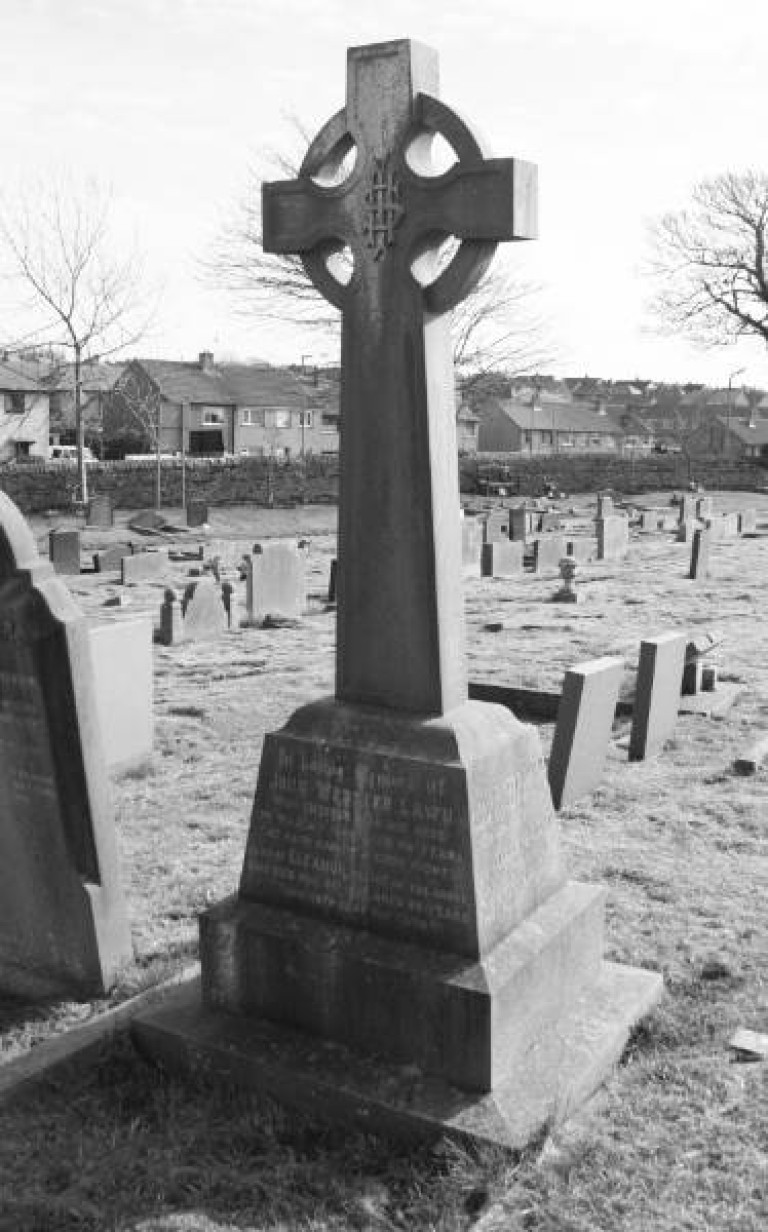
Another sitting alone just north of the South Chapel.
Obviously a well-respected contributor to Dalton life, worthy of a stone paid-for by public subscription. The Barrow News 11 Sept 1926 had a whole column devoted to his life and his funeral, plus a eulogy in a comment section.
Barrow News, 11 Sept 1926LOSS TO MUSIC
DEATH OF MR. J. H. CARTER, DALTON
HIS WORK FOR BRASS BANDSMr. John Henry Carter, of 4, Glenfield-road, Dalton, died on Sunday, following an operation, in the North Lonsdale Hospital, where he had been removed only that morning. He was aged 53, and his passing will be mourned not alone in Dalton, but in many parts of the country where his musical ability made him known and respected in some of the highest circles of his calling.
Mr. Carter was born in Roose, and was the eldest of a family of seven, his parents being of Cornish stock. His father was a miner, and worked at Stank before emigrating as one of the early pioneers of gold mining to Africa, where he died. Upon his son devolved much of the duty of looking after the mother and family, a charge faithfully kept till it closed some seven and a half months ago with the death of Mrs. Carter.
The young John showed an aptitude for music from the earliest and studied under the late Mon. Lexhime, of Barrow, the cornet being his instrument. From the age of 14, he had been working at Stank, but on being invited to become bandmaster of Dalton Band, some thirty years ago, he took up music as his livelihood, and soon after came to live at Dalton, residing at the Weint House, recently demolished for road widening. He had at one time the shop next door as a piano and music store. In addition to conducting the Dalton Band, he acted as a trainer to a great number of other bands in different parts, his proteges in Durham, South Wales and Cornwall having gained particular prominence as a result of his tuition. His services as a judge at contests were in constant demand from the earliest, and he attained the ‘blue ribbon’ of such work, when appointed to judge the supreme test, the championship at the Crystal Palace contest. He had been so honoured, two or three times, and also judged the subsidiary class. He likewise judged at the Newcastle “Big” contest, and Morecambe, and was at Orpington only last Saturday, judging 29 bands.
As a composer and “arranger” of brass band pieces, he achieved equal note, and was the musical advisor to the national journal devoted to those interests.
He wrote dozens of marches, waltzs, dance and other compositions for bands, and his arrangements have been played all over the country, as well as at national contests, and were many times broadcast. The Dalton Band frequently performed his compositions, and only this season had re-engaged his services as trainer and conductor. He had charge of their entry in the recent Barrow championship, when they gained a second, and was to have conducted them at the Bentham contest on Saturday. Under his direction they have won at one time or another some 50 prizes, including at Briarfield, Morecambe, Whitehaven and Workington.
There follows a long description of the funeral, with between two and three thousand mourners: ... Eight band secretaries and representatives led the procession: Messrs. Robert Smith (secretary), Mr. T. H. Kneebone (Late secretary), J. Edmondson and Alec McPhee (committee), Dalton Town Band; J. T. Wright (treasurer) and T. Whitall (secretary), Steel Works Band; H. C. F. Lace, Shipyard Band; G. A. Cain, Askam Town Band. They were followed by the massed bands of nearly 60 players .....
The Comment section of the News of the same date reported:
Barrow News, 11 Sept 1926MR. JOHN CARTER
Music knows no frontiers, and while those who knew Mr. Carter personally alike (sic) as a lovable personality and as a master of his craft, will miss him greatly, there are other living far beyond this district who knew him for his genius alone, and they will feel his loss just the same. Personally unknown to them, he was known to thousands as the writer of inspiring band music; as the impartial and masterly critic of the country’s greatest bands at national contests; as the teacher and leader of many a rising band that attained note under his tuition. His judgement was unquestioned by the greatest authorities of his art, and his advice and guidance was sought by all who wished to rise in it. Dalton Town Band may be counted as one of the most fortunate of bands in having him at hand all his time, and their many achievements of the past may be largely traced to his influence. At the time of his death, he was training what was really a new Town Band up to its old traditions, and with its promising mingling of ripe and of developing talent, great things had been expected. His death is an irreparable loss to the town, but that thought must not be allowed to overshadow the remembrance of what Dalton has profited by his life here. Nor must it make us forget that great a musician as he was, he was no less a man whose kindly nature made all his acquaintances his friends.
I found reference to his career from an earlier date: - Barrow News Saturday 9th January 1909 contained the following –
Barrow News, 9th January 1909A FURNESS BANDMASTER
“The Musical Mail and Advertiser” for January contains an admirable photograph of Mr. John H. Carter, the conductor of the Dalton Town Band and the Barrow Shipyard Prize Band, with a brief sketch of his musical career. We extract the following:
“It was in 1873 that the gentleman first saw the light. His birthplace was near Helston, Cornwall (This is likely to be correct. No John Henry Carter is recorded at the relevant date on the Cumbria BMD website), and it was here, at the tender age of six years, that Mr. Carter commenced his musical career by appearing at a class of tonic so-fa students. Thus early did the composer of the one and only ‘John Bull’ give evidence of more than average musical ability. Three years later the cornet took our friend’s fancy and, encouraged by his father, also a cornet player of ability, the young pupil proved himself a capable executant. We next find him at the bandstand of the Church Army Band, Barrow-in-Furness, to which place his family had moved, and there he remained until 1889, when a new band, the Stank Mines, was formed, with Mr. Carter as solo cornet, and Mr. D. Bennets as conductor. It was with this band that he attended his first contest. Subsequently Barrow Borough and Barrow Iron and Steelworks Bands benefited by his services, and with these combinations he gained considerable contesting experience. Afterwards he became a member of Mons. Lexhime’s celebrated orchestra, playing solo cornet in it for several years with marked success.
From the age of sixteen ‘J.H.’ has spent most of his spare time in the study of harmony, and under good masters he worked his way forward in the various branches of the art, studying assiduously from four to eight hours each day. The natural outcomes of such diligence soon became manifest, and the public received several compositions from his pen. One of his first was the song, ‘The Blind Flower Girl’, the music of which originated in Mr. Carter’s mind while following his daily work as a miner. To-day his compositions are known the world over, such pieces as “Powerful”, “Hurricane”, “The Lion”, “Viceroy”, “Canadian”, “University”, “Veterans”, “Mikasa”, “Federation”, and “John Bull” marches being in the repertoire of every up-to-date band. The popular arrangement of “Il Trovatore” and “Ten minutes with Burns” (‘M.M.’ Journal) are also among Mr. Carter’s works.
Mr. Carter’s experience as a conductor dates from 1895, when he took charge of the Roose Band. Two years later he was wooed and won by the Dalton Town Band, where he is presently located. The progress of the Dalton Band can be traced from Mr. Carter’s engagement, for from a decidedly ‘brassy’ brass band, he quickly moulded the fine-toned combination which Daltonians now delight to hear. It is noteworthy that less than a year after taking it over, Mr. Carter brought the Dalton band into the prize list at Whitehaven. Since then, more than fifty prizes have fallen their way, of which more than twenty are firsts. ........ (contd)
See here for a picture of the Band in 1900, including Mr. Carter.