Died
2 November 1993
Born
1 November 1913
Sources
Place
Walks
Denny Dennis
In his time, Denny Dennis was truly famous.
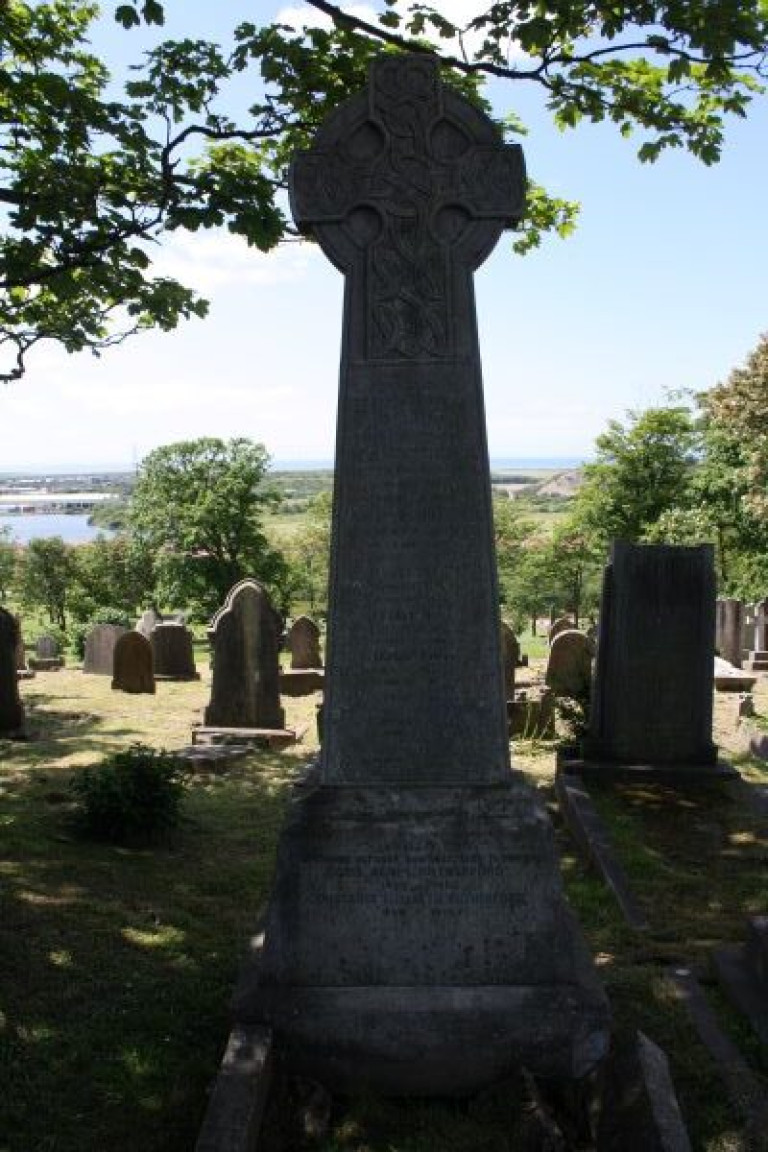
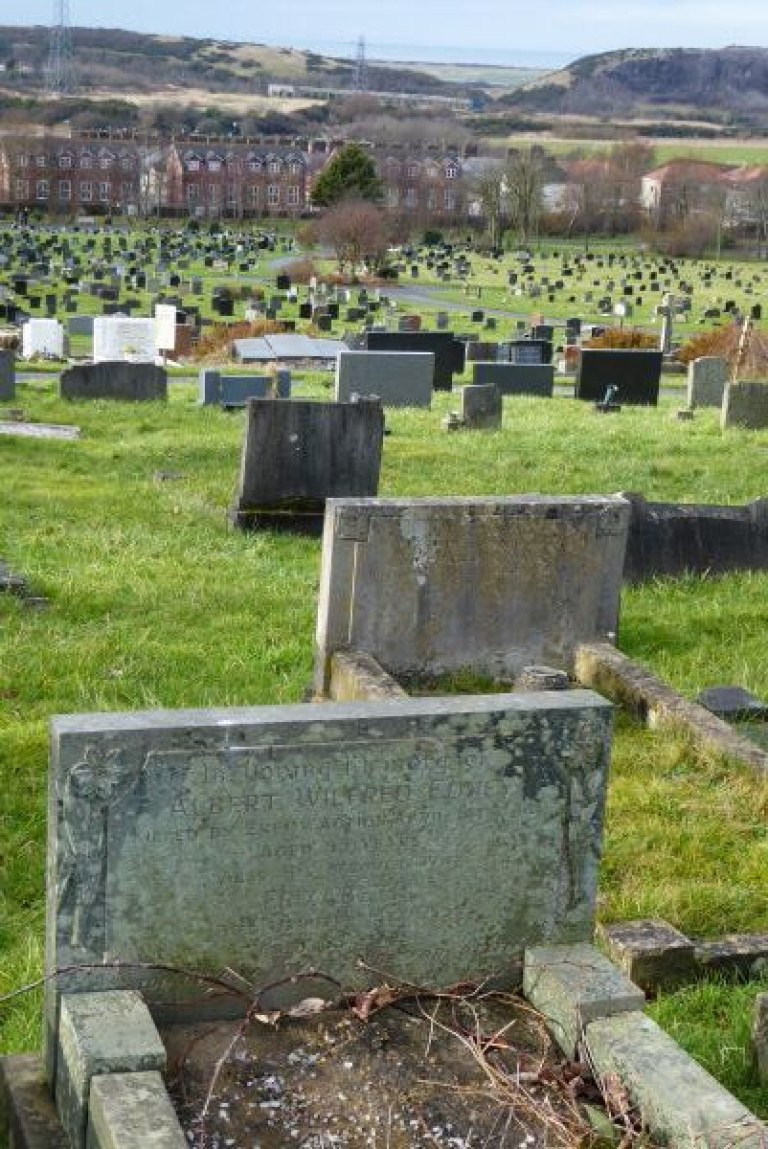
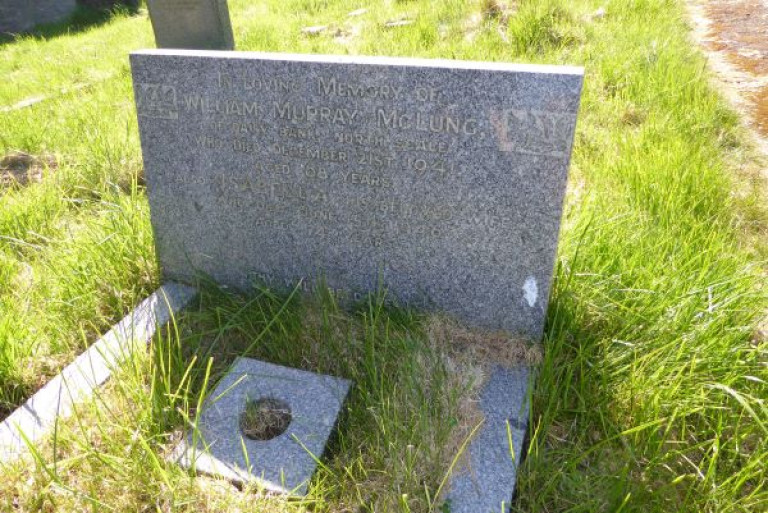
Denny’s stone is in the cremation section of the old graveyard, near the southern hedge.

Treasured Memories Of
DENNY DENNIS
Who sang a thousand love songs
BELOVED COMPANION OF BERYL
Renowned and Respected
Friend of Many
Died 2nd November 1993
Aged 80 Years
“THE MUSIC STOPPED”

A publicity bill from the Palace Theatre, Huddersfield, 1950
Wikipedia has an entry for Denny Dennis which includes the following: “Denny Dennis (1 November 1913 in Derby – 2 November 1993 in Barrow-in-Furness) was a British romantic vocalist during the 1930s to the 1950s, when British dance bands were at the peak of their popularity. He was a band singer, a solo recording star and a broadcaster.
Born Ronald Dennis Pountain, he had a job on the railways as a teenager. He was spotted by Percy Mathison Brooks, the editor of the Melody Maker, at a regional dance band contest in 1932.”
There is also a very full, and interesting, website from which the photographs are taken (courtesy of the site owner)

A publicity photograph of Denny Dennis from 1948, when he was appearing with Tommy Dorsey
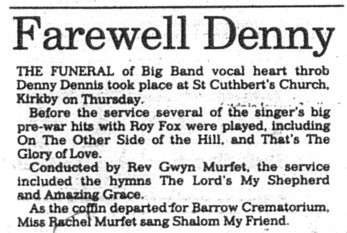
A report from the North-West Evening Mail of Denny's funeral 6 November 1993

A publicity shot from the mid-1930s
The North-West Evening Mail 3 November 1993 reported:
Danceband legend suffered heart attack
Forties singing star Denny dies aged 80
BY TERRY HORNE
Forties big band singing idol Denny Dennis, from Kirkby-in-Furness, died yesterday in hospital just a day after his 80th birthday.
Three weeks ago Denny travelled to London’s Royal Lancaster Hotel to receive a prestigious gold award from the British Association of Singers, Composers and Authors for his contribution to music in his lifetime.
Among other showbusiness stars to be honoured with BASCA gold awards with Denny on the same day were Norman Wisdom, Roy Castle, Elaine Page and Russ Conway.
FIGHTER
However, shortly after his return to his Kirkby home, Denny was taken into Furness General Hospital suffering from a heart attack.
His good friend and landlady, Mrs. Beryl Showers, spent hours at his hospital bedside. She described Denny as “a hell of a fighter.”
Writer Mike Carey from Derby, who wrote Denny’s biography last year called I’ll Sing You a Thousand Love Songs, had also been visiting him in hospital.
AMERICA
During a 50-year showbusiness career, Denny sang with all the top British bands and even followed in the footsteps of Frank Sinatra, singing with the Tommy Dorsey Orchestra in America.
Originally from Derby, Denny had lived in Kirkby for the past 11 years.
He last sang for his adoring fans around ten years ago when he appeared at the Royal Festival Hall on London’s South Bank.
My correspondent who runs the Denny Dennis tribute website believes that his last appearance was in Derby in 1992.
An appreciation in the Derby Telegraph 2 July 2018 by Nicola Rippon read:
Crooner Denny needed no Bing Crosby comparison
In November 1993, Denny Dennis, famous Derby-born crooner of the 1930s and 1940s, passed away at his home in Kirby(sic)-in-Furness, Cumbria.
Although Denny had been out of the limelight for many years, his achievements, music and recordings had been enjoying something of a revival thanks to a biography written by former Derby Telegraph Sports Reporter Mike Carey and published in 1992.
The second son of a carpenter and patternmaker, Denny was born Ronald Dennis Pountain on November 1, 1913, and was raised in houses in West Avenue and Howard Street (Derby).
He began his working life as an assistant projectionist at Cosmo Cinema on Upper Boundary Road before starting an apprenticeship at the Carriage and Wagon works.
Both Ronald and his elder brother, Eric, were musically inclined. Eric - as Barry Gray – would be first to join a band and would himself enjoy a successful career as a singer in London in the 1930s. Sadly, Eric was killed during wartime service in the Merchant Navy. In Derby, both men were part of the New Mayfair Dance Band. Young Ronald spent hours listening to his collection of 78s to study the vocal techniques of his favourite artists, both male and female.
Ronald was spotted when the band entered a Melody Maker competition in Derby, and was given an audition with the famous band leader Roy Fox, who suggested that Ronald seek professional vocal training and come back in a few months’ time.
After taking Fox’s advice, he found work in London with Jack Jackson, whose band was filling in for the BBC Dance Orchestra. When he and Fox crossed paths once more Fox was impressed and, according to the Derby Telegraph, was “so astonished at the change that he offered him an immediate contract” and suggested that he change his name to the catchier Denny Dennis.
By this point the paper declared: “Mr Pountain is regarded as one of the finest vocalists to be heard singing with a dance band.”
From that point, his career had gone from strength to strength, but Denny did become frustrated when he was called “the British Bing Crosby”. Certainly, his vocal style had some similarities with Crosby, but Denny Dennis’s career was successful enough – appearing and collaborating with countless internationally regarded dance bands – to deserve consideration in its own right.
While with Fox, Denny sang nightly at the Kit-Kat club and the Café de Paris and, in 1935, appeared in the film Radio Pirates. From 1936 his brother joined him in the band.
After the Second World War, during which he served in the RAF entertaining the troops, Denny was offered jobs by both Benny Goodman and Tommy Dorsey. He chose Dorsey, following in the footsteps of Frank Sinatra.
Once in New York, where his solo recording of the The Bluest Kind of Blues was already an enormous hit, he was taken from interview to interview before embarking on a seemingly endless tour of the country with the band. Dorsey declared that he was “one of the nicest guys and greatest singers I’ve ever had the pleasure of working with.”
But, after only one year, Denny returned home where he carried on recording and broadcasting for several years.
Eventually, like most successful entertainers, Denny Dennis succumbed to changing fashions. He drifted from one agent to the next, finding it increasingly difficult to find work, particularly of the sort to which he had become accustomed.
Financial pressures meant he was unable to pick and choose jobs, and at one point he even agreed to impersonate Bing Crosby.
He eventually retired to Cumbria, but he was not forgotten, and made occasional reappearances over the next decades.
In 1982 he came out of retirement to participate in a tribute to Roy Fox at the Royal Albert Hall. The following year he took part in a tribute to bandleader Sid Phillips.
In 1992, no less than Frankie Laine gave his own tribute to Denny, saying: “Denny Dennis is a fine singer of impeccable taste. If you can make a living making people happy, and leave behind a recorded legacy for future generations in the process, then I think you’re entitled to look back with a sense of accomplishment.”
Nobody could argue that Derby’s Denny Dennis had done anything less.