Died
19th October 1914
Sources
Sankey Family Photographic Collection
Barrow Herald and Furness Advertiser
Soulby’s Ulverston Advertiser and General Intelligencer
Cumbria BMD
Ancestry
National Probate Calendar
Barrow News
Place
Walks
Themes
John Hair

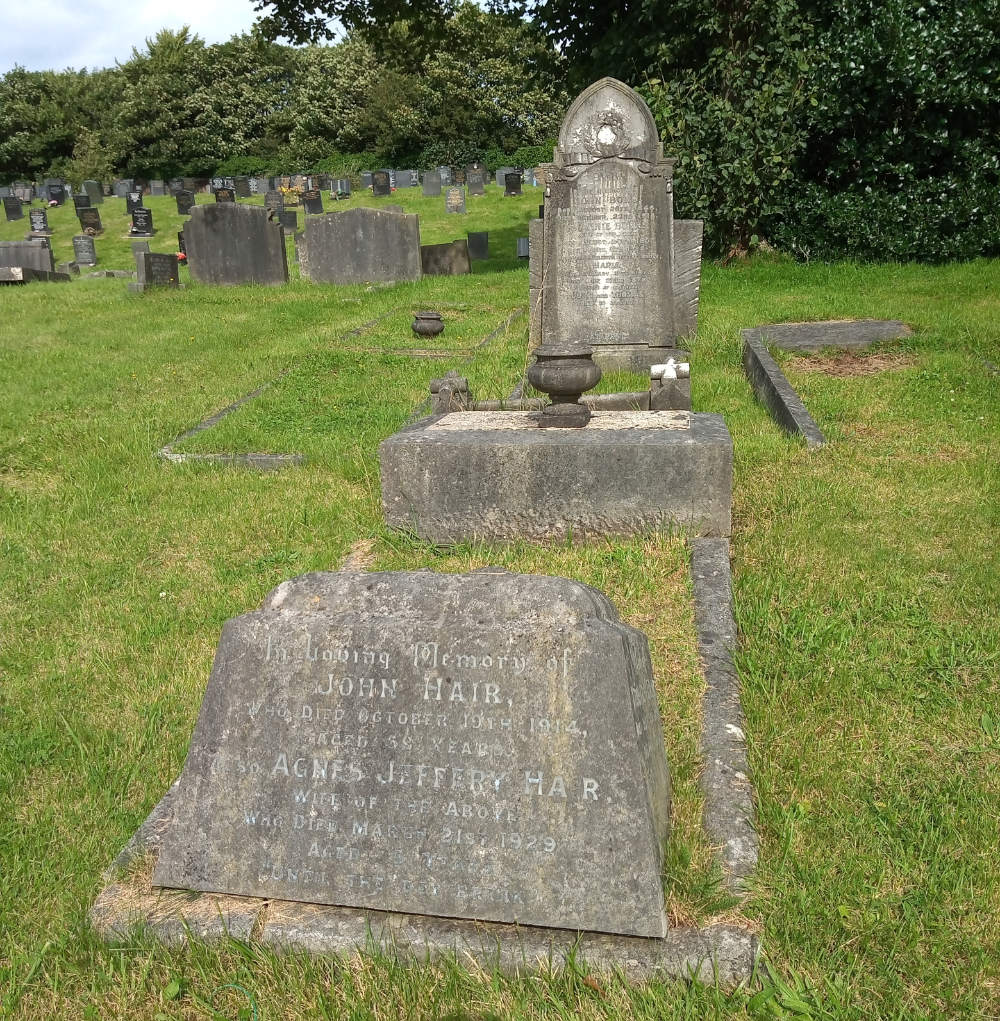
In Loving Memory of
JOHN HAIR
WHO DIED OCTOBER 19TH 1914,
AGED 59 YEARS
ALSO AGNES JEFFERY HAIR,
WIFE OF THE ABOVE
WHO DIED MARCH 21ST, 1929
AGED 75 YEARS
“UNTIL THE DAY BREAK”
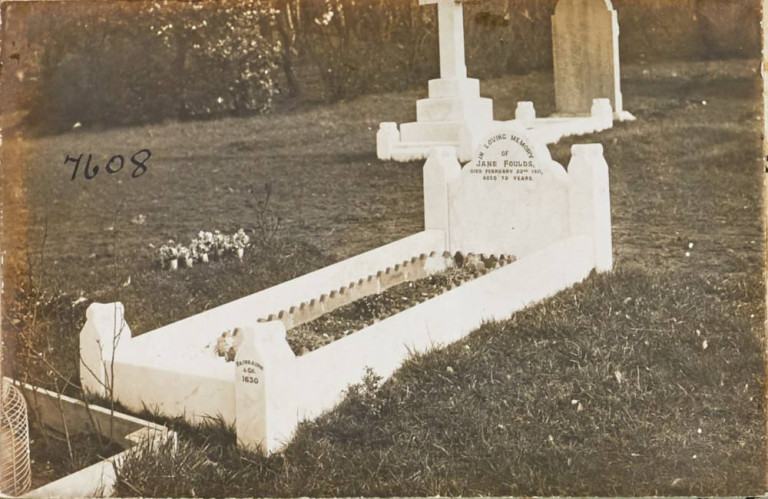
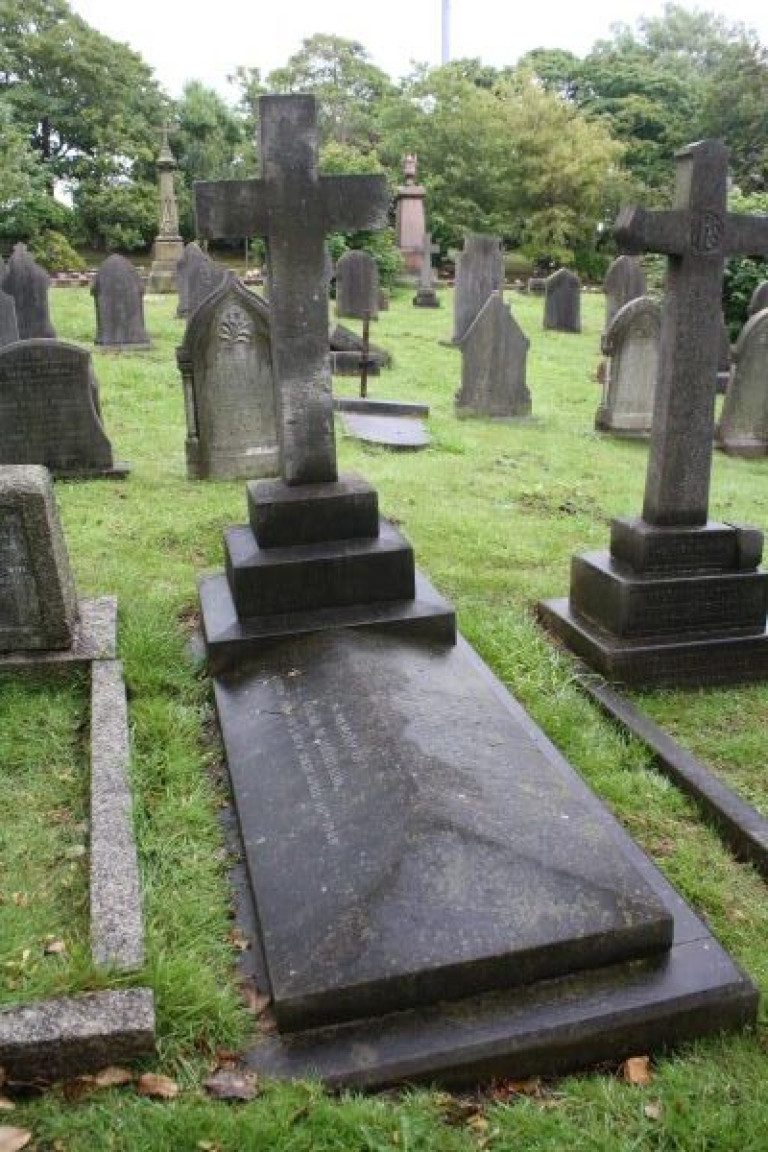
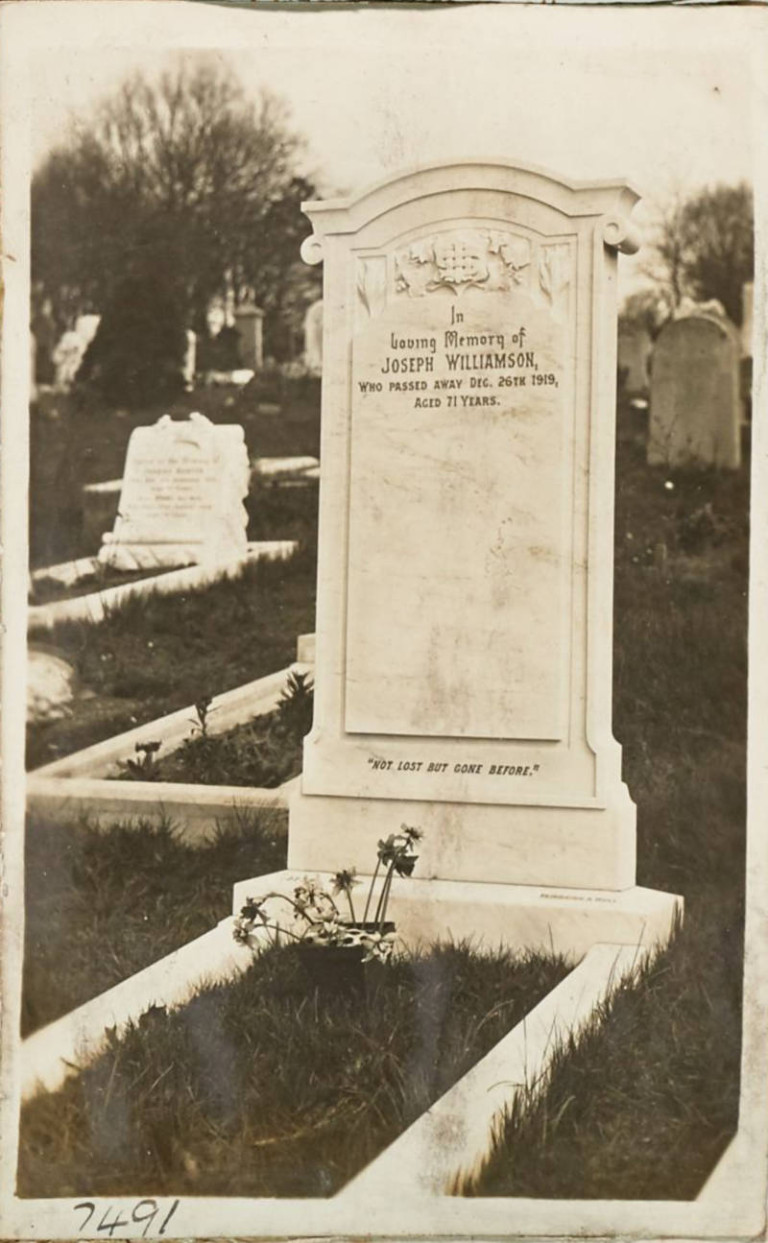
The contrast between the old Sankey photo, and the 2023 version, is considerable. The written plinth has been added to, and moved to the front; the large cross has been removed, and John Burns’ grave to the rear is now completely visible. Sankey’s picture also includes two glass covers for the floral tributes. His wife’s name has obviously been added later.
On the right side is:
Also of
THOMAS HAIR
DIED MAY 3RD 1890
AGED 3 YEARS
In Thomas Hair’s Death notice, in the Barrow Herald and Furness Advertiser 10 May 1890, John Hair is described as an engine fitter.
1891 Census
John Hair was born in Ayrshire, but had moved down to Barrow by the 1891 Census. He was living at 24 School Street, Barrow; was 36 and an engineer, born in Scotland. The rest of the household comprised wife Agnes Hair (36); Daughter Annie Hair (13); son John Hair (12), and daughters Lizzie Hair (8) and Agnes Hair (1), all born in Scotland. They also had a Domestic Servant, Matilda Dalbridge (18), born Shropshire.
1911 Census
The extent of John Hair’s success is reflected in the 1911 Census, where the family is living at 5, The Promenade, Walney. John Hair (56) is Assistant Manager, Engineering Dept., Shipbuilding Yard, born Saltcoats, Ayrshire; and still living with him are wife Agnes, born Greenock, Renfrewshire; daughter Agnes Hair (21) Single, no occupation recorded, born Saltcoats, Ayrshire, and son Thomas Hair (18) Apprentice Engineer Fitter, born Barrow. Mary Higgins (42) Single, born Glasgow, Lanarkshire, is listed as a Visitor.
Soulby’s Ulverston Advertiser and General Intelligencer 29 June 1905 mentions John Hair as the Commodore for the annual Vickerstown and North Scale regatta and land sports.
The same newspaper on 9 January 1908 reports on a complimentary dinner st the Furness Abbey Hotel for the Russian cruiser Rurik, built in Barrow. John Hair is an invited guest, enjoying the menu of “Caviar, hors d’ouvres, crème Lamballe, supreme de soles, Imperiale, Couchees a la Montglass, sele de pre Sale al la Broche, chux de Bruxelles, choux fleurs, ponnes chateau, sorbet au Kirsch, dinronueau roti aux Saucisses, salade de saison, gateau hoka, petite fours, pailles Parmesan, dessert, café”. This is accurately copied. I suspect that there are a lot of accents missing, and possibly spelling mistakes. Good to see that brussels sprouts and cauliflowers are on the menu, but I wonder what “salade de saison” meant in January in Barrow.
The account of the launch of H.I.J.M.S. Kongo, a Japanese battle-cruiser built at Barrow, in the Barrow Herald and Furness Advertiser 25 May 1912, has Mr. and Mrs. John Hair among the list of invited guests.
The National Probate Calendar (Index of Wills and Administrations) 1915 has:
HAIR John of 5 Promenade Vickerstown Barrow-in-Furness Lancashire marine engineer died 19 October 1914 Administration Lancaster 11 March to Agnes Hair widow. Effects 2209 9s 4d.
1939 Register
Following some of the family further, in the 1939 Register Agnes H. Hair (DoB 14 Sept 1889) is living at 41 Lord Roberts Street, Walney. She is an engine tracer, and an A.R.P. (Air Raid Precaution warden). Her family believe that she rose to the position of Head Tracer. She shares the house with Alice J. Park (DoB 4 June 1889), a General Clerk and A.R.P. warden. This generation of women were often left single due to losses in WW1 and the flu which followed it.
Agnes Higgins Hair died at Solway Drive, Walney on 23 January 1976.
Her elder sister Elizabeth Logan Hair married William James Cornwell, a Civil Engineer, born Dudley, Worcs. And in the 1911 Census they were living at 5 Douglas Street, Vickerstown. James was 31; Elizabeth 28. She was living at 2 Snaefell-view, Barrow-in-Furness, when she died at North Lonsdale Hospital on 5 June 1955.
In 1912 the youngest son Thomas married Mabel Richardson in Barrow. In the 1939 Register they were living at “Barnsyde”, North Scale, Walney. Thomas Hair (DoB 14 June 1892) [NB the Royal Naval Reserve records have his DoB as 17 June 1892] is an engine fitter; Mabel Hair (DoB 19 Sept. 1890) is occupied on Unpaid Domestic Duties; and John Hair (DoB 22 August 1913) is a Pattern Maker.
Thomas Hair’s descendants are still in Barrow, and have contributed to this record.
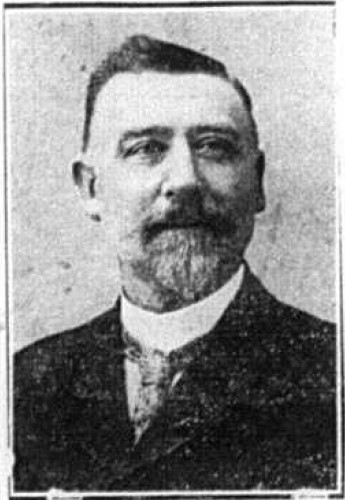
The Barrow News 24 October 1914 (from where his picture is copied) carried a long account of Mr Hair’s funeral:
Barrow News, 24 October 1914LATE MR. JOHN HAIR
IMPRESSIVE FUNERAL
A profound tribute of respect was paid to the memory of the late Mr. J. Hair, of 5, Promenade, Walney, undermanager at Messrs. Vickers, Ltd., on Wednesday afternoon, when the deceased gentleman’s mortal remains were interred in the borough cemetery. The cortege first proceeded to the Trinity Presbyterian Church, where the Rev. W. Hay, M.A., B.D., conducted the first portion of the burial service. Official life at the Shipyard was very fully represented amongst the mourners, whilst it was a fact of touching significance that among the large congregation in the church were not a few workmen from the bench, and one who appeared in his boiler suit. After leaving the church the funeral provided an imposing procession. There were wreaths and floral tokens in great profusion, coming from a great variety of sources, and including private sympathies and many whom the departed gentleman knew in an official capacity. Immediately behind the hearse was a long following of Shipyard officials, and there were also representatives of Vickers, Limited, in several of the long line of mourning coaches. Among the latter were: Mr. McKechnie, Manager? (later Sir James McKechnie, Managing Director), Mr. A. Miller, secretary, and Mr. J. C. Ferguson, assistant secretary; Mr. J. C. Goudielock, marine manager; and Mr. J. Haddow, foreign corresponding department.
Amongst those present were: Mr. William Leslie, doc’s? department; Mr. I. Kiloh, building department; Mr. William Pratt, fitters department; Mr. S. Gibson, engine machine shop; Mr. P. McLachlan, Mr. J. Fraser, copper shop; Mr. J. Fallows, submarine department; Mr. J. J. Bromley, staff; Mr. J. Webster, patternmaking department; Mr. J. Brown, boilermaking department; P. S. Burch, Mr. C. Hannah, engineering side; Mr. J. Urie, dock boilermaking department; Mr. Wm. Wane, dock?; Mr. J. Nash, joinery department; Mr. Werr? Caulking department; Mr. Killiner, head foreman boiler shop; Mr. Brown, foreman dock boilermaking department; Mr. J. Ferguson, foreman rigger; Mr. Brown, ordnance department; Mr. Angus, drawing office; Mr. J. Lewis, gun-mounting department; Mr. Charles Kelly, Shipyard foreman; Mr. W. Kershaw, engineering department; Mr. J. Morton, foreman plater; Mr. J. Shaw, commercial staff; Mr. T. Ross, Mr. I. Richardson, and Mr. D. Craig, dock department; and Mr. D. McHarg, moulding loft. (NB where the name or word is difficult to read I have added a question mark – RMW)
Also present were: Councillor T. Johnstone; Mr. J. Kelly, I.O.M.S.P. (Isle of Man Steam Packet) Company, and Mr. G. Kay.
The bearers included Mr. C. Alexander, gas shop; Mr. J. Ferguson, dock-rigging department; Mr. R. Cruikshank, and Mr. McCartney, engine shop.
The undertaking arrangements were in the hands of Messrs. W. Ormandy & Sons.
------------------------------------------
TRIBUTE BY A FRIEND
“John Hair has passed away.” This mournful intelligence passed from numberless lips on Monday last and caused gloom and sorrow among friends and acquaintances. The same words on reaching the utmost bounds of the seven seas will not fail to discover responsive hearts, who will share our sorrow and will be equally shocked by the tragic unexpectedness of the sad news.
“The world knows nothing of its greatest men.” was a truism peculiarly exemplified in the case of the late Mr. Hair. There was no dossier of his career in the newspaper office pigeon-holes, for he had not dazzled before a gaping public in the focus of the limelight. Yet humanity has lost a great man, engineering has been deprived of one of its arch-craftsmen and leaders, sport mourns the end of a devotee of the gun and the rod, our town is short of one of its best citizens, and hundreds of people are bereft of a friend.
A characteristic Scot, tempered by travel and residence far from his native shore, yet possessing all those finer but distinctive fibres of rationality? which are the Scotsman’s universal passport, Mr. Hair was beloved by his compatriots and esteemed by all. Born in Ayrshire some 65 (sic) years ago, and apprenticed to the engineering trade, the lure of marine engineering soon attracted him to the Second City of the Empire, whose great shipyards were then in the thick of development of the art of steam propulsion of ships. The study of his profession he pursued with an assiduity which quickly brought reward and recognition, but which made no impression on his strong attribute of modesty. The early eighties found him trading as chief engineer of one or other of the great liners, circling the globe three or four times a year ripening his experience of mechanics and of men, and laying the foundations of friendships which only death severed.
When he gave up the sea and took a position ashore, it is no figure of speech to say he was at once the doyen of his profession. It would be difficult to find a superintending marine engineer amongst all our great shipping lines who has not passed through Mr. Hair’s hands, and has not had a brotherly intimacy with him. Always helping others and displaying a complete disinterestedness in self, he engrafted himself into the hearts of superior and subordinate alike.
When the Naval Construction and Armaments Co., Ltd., took charge of the ebbing fortune of the Barrow Shipbuilding Co., Ltd., in 1887, it soon became evident to the new proprietors that a sprinkling of fresh blood was one of the necessaries of success, so in 1888 Mr. Hair, whose career had been carefully watched by the then Managing Director of the Works, (the late Mr. A. D. Bryce Douglass), was appointed to Barrow. The choice was a happy one. The engineering success of Barrow built ships in these 25 years may be claimed by many. To the late Mr. Hair is due a large quota. Always on the workshop floor before the six o’clock buzzer gave the signal to commence work, no detail of construction or administration escaped his experienced and watchful eye. The assembling of a mass of machinery such as goes to make up a 70,000 horse power engine, and running such an engine not only successfully, but to give greater success than the engines produced by others, is no small feat even for a great firm like Messrs. Vickers, but the great firm is only the embodiment of men of genius and experience. Such a man was John Hair, and these were the tasks he set himself to accomplish and did. In the din of a boiler or engine shop or in the roar of an engine room he preserved that imperturbable calm which inspired men. He did not spare himself. He set no man a task which he himself could not accomplish, so that the personnel of an engine room where he presided was without slackers or redundants. His example compelled good service, and he did not hesitate to speak plainly at times of the “gold sleeve link” type of engineers.
Though in national politics Mr. Hair was a Liberal, his instincts were Conservative (sic). The advent of the turbine he received suspiciously, and stood for the reciprocating engine long after the merits of the turbine had been amply demonstrated, yet it is fair to say he eventually capitulated to the rotor engine.
Though widely travelled and an extensive reader, keeping himself abreast of the times in mechanical ingenuity and political activity and otherwise, Mr. Hair shunned public life as a poison. His leisure was devoted to yachting, fishing and shooting, and to all these three branches of sport he developed an incomparable efficiency, garnering as he went a host of friends of the gun, the rod, and the line.
And now this devoted husband, father and friend is no more. His ashes were committed to mother earth on the anniversary of the day that Nelson hoisted his famous signal – “England expects that every man will do his duty.” The stun we got when Mr. Hair died, the grief since visible on all hands, the lump I feel in my throat as I write is more than evidence to me that John Hair did his duty, and that a great and good man has crossed the bar.
This tribute is included in full because of the language used: of its time, somewhat hagiographic, and very masculine. There is hardly a mention of his family of wife and five or six (if we include the Thomas who died in 1890) children.
No-one is certain why Edward Sankey took photographs of graves in the period 1910-1920ff. Were they advertising the skills of his friend William Hull, or later Hull and Fairbairn? Were they to be made into postcards that the bereaved family could send to members who were not able to attend the funeral?
The historic photograph is from the Sankey Family Photographic Collection, courtesy of Cumbria Archives.