Died
Oliver: 1869
Agnes: 1844
Sources
UK Naval Officer and Rating Service Records 1802 – 1919
Baines Directory for 1824-5
Gore’s Directory of Liverpool 1821
Pigot’s 1822 Directory
Ulverston Mirror
The Diary of William Fisher of Barrow 1811-1859
Ulverston Canal: Its ships, Ship Builders and Seamen 2020
Barrow Herald
Hull Packet and Weekly Commercial, 10th April 1827
Cumbria BMD
Ancestry
Place
Themes
Oliver and Agnes Haydock
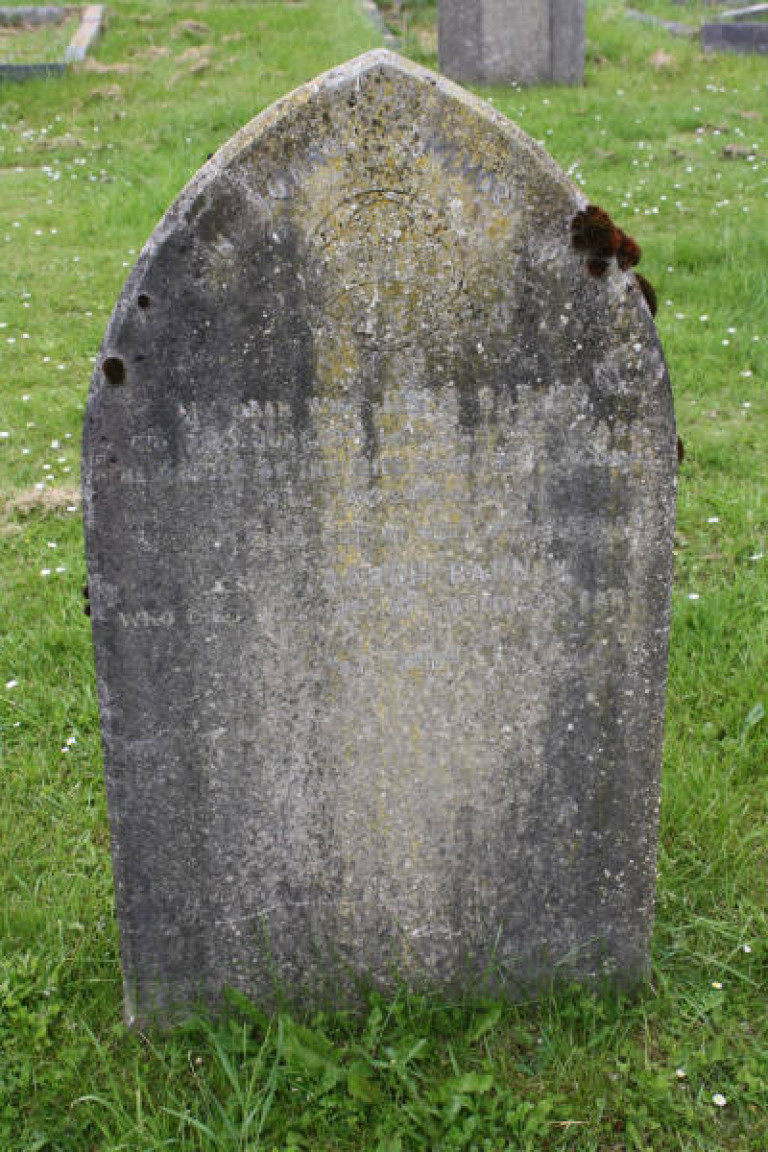
I was looking at graves in St Mary’s at Egton-cum-Newland (Greenodd) for a correspondent in Australia, when I came across this gravestone. Strictly speaking, this is Agnes’s, since Oliver is buried in Dalton Cemetery, but it’s a good story. I came across the significant document on Ancestry, which led to another Australian correspondent married to one of Oliver & Agnes’ kinfolk.
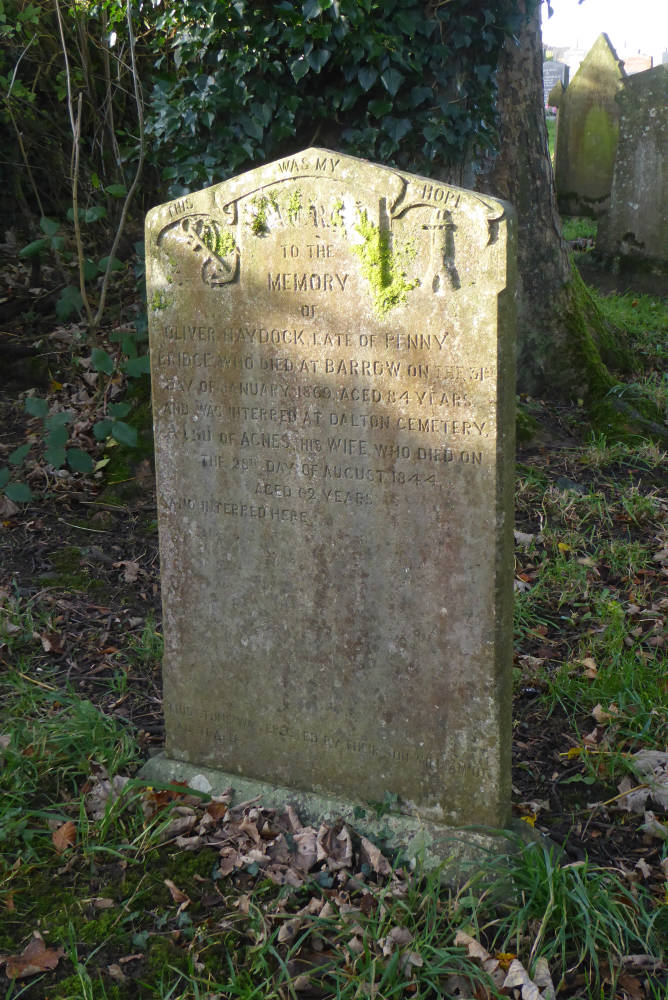
THIS WAS MY HOPE
SACRED
TO THE
MEMORY
OF
OLIVER HAYDOCK, LATE OF PENNY
BRIDGE, WHO DIED AT BARROW ON THE 31ST
DAY OF JANUARY 1869, AGED 84 YEARS,
AND WAS INTERRED AT DALTON CEMETERY.
ALSO OF AGNES, HIS WIFE, WHO DIED ON
THE 28TH DAY OF AUGUST 1844
AGED 62 YEARS,
AND INTERRED HERE.
THIS STONE WAS ERECTED BY THEIR SON WILLIAM OF
AUSTRALIA
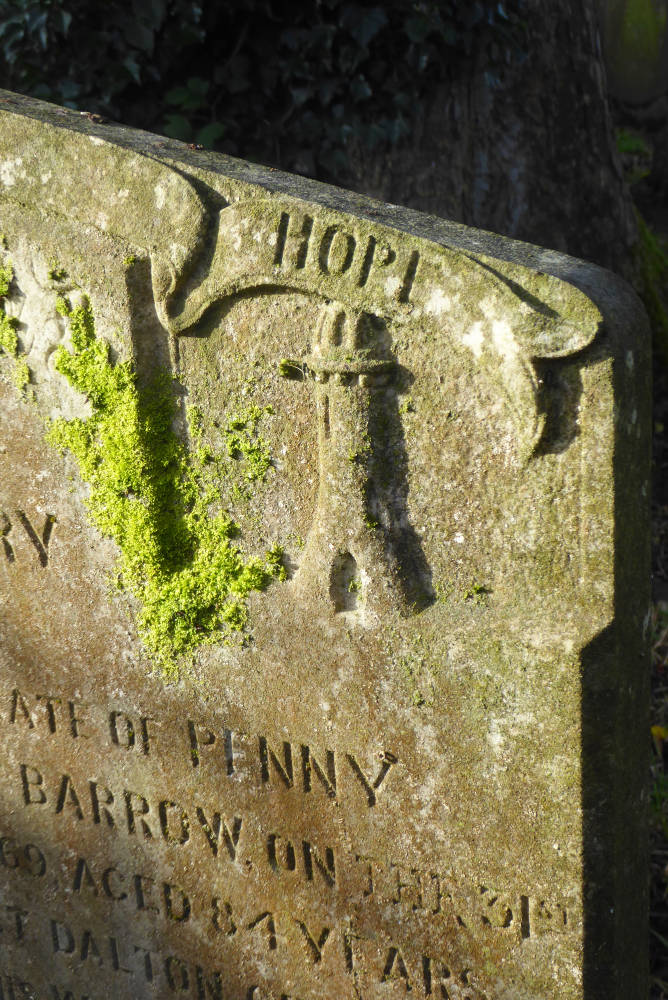
There is an anchor on the top left of the stone, a Christian symbol as well as the sign of a mariner. Top right is this lighthouse.
From Ancestry, there is an Oliverum Haydock baptised at St Peter, Lancaster on 18 February 1786.
Oliver Haddock (sic) married Agnes Pratt 17 May 1808 in Ulverston.
UK Naval Officer and Rating Service Records 1802 – 1919
The UK Naval Officer and Rating Service Records 1802 – 1919 has Oliver Haydock (age 23) serving on the Dryad from 22 March 1811 to 12 March 1814; and then 13 March 1814 to 19 April 1815 on the Charron. According to this document, he was discharged on 1st August 1816.
Baines Directory for 1824-5
The Baines Directory for 1824-5 has Oliver Haydock trading as a coaster from Ulverston to Liverpool. So too does Gore’s Directory of Liverpool 1821, and Pigot’s 1822 Directory. All list the Commerce as his ship.
1861 Census
The 1861 Census lists an O. Haydock living in the Workhouse at Milnthorpe. He is likely to be this Oliver: he is 73; a pauper, with mariner listed as his occupation. My Australian correspondent thinks that he went to live with a daughter in Barrow after this, which would explain why he is buried in Dalton Cemetery. (His death being before the Cemetery in Barrow opened).
In the Ulverston Mirror, early February 1869, (sourced from a public document on Ancestry), appeared the following letter from someone who knew Oliver Haydock:
SIR, - Having seen in your last week’s obituary the death of Oliver Haydock, I beg to send you a sketch of his life, which was written from his dictation some years ago, when we were endeavouring to get him into Greenwich Hospital: -
Oliver was born in Lancaster, on the 25th of February 1788, and in 1802, at the age of fourteen, was bound apprentice to Captain Allen, of Lindale-in-Cartmel, to the Ulverston coasting trade. When on board the Neptune, 500 tons, West Indiaman, of Lancaster, he was pressed at sea into H. M. sloop of war Argus. From her he was drafted into the Druid frigate, Capt. Philip B. V. Brooke (the same captain who commanded the Shannon in the celebrated engagement with the American Frigate, Cheaspeake (sic)). The Druid was stationed with the blockading squadron of Rochfort. Whilst engaged in the boats at night Oliver was taken prisoner, and confined two years in a French prison. He escaped with others, and crossed to England in an open boat, and begged his way to Liverpool, where he met a coasting captain who took him to Ulverston. Soon after he again entered the navy, as a volunteer on board the sloop of war the Carron, and went to America, and was at the engagement against the fort of Mobile, on the river Mississippi. He was also in an engagement at sea when the frigate Clorenda surrendered to the Carron. He ranked as captain of the foretop, and after as a gunner’s mate, and was paid off at Portsmouth on the 1st August 1815. He then went as master of his own galleott, the Commerce, which was blown up at Piel, on the 20th March 1827, which caused his ruin, having all his hard earned saving invested in the vessel. He again went to sea until 1843, when he joined the Windermere Steam Yacht Company, and retired to live with his daughter at Barrow, in 1861. The wreck of the Commerce was saved, and sold, all except the mizzen mast, which Oliver used to say was blown into the moon! His eldest son, William Haydock, I believe, is still living at Sydney, New South Wales – at least, I corresponded with him a few years ago.
I am, sir, your obedient servant,
DANIEL H. BELLASIS,
BOWNESS.
Other researchers have found and published the following:
The End of the Commerce
Commerce was a 72 ton galliot built in Ulverston in 1815. The 64 shares were spread between 21 owners. They included Michael Knott of Thurstonville, John Machell esq of Penny Bridge, George Beecham, steward, a painter, a solicitor, farmers, yeomen, a tallow chandler, a blockmaker, merchants, a butcher and a widow. The architect, George Webster held two shares as executor to John Harrison and her master, Oliver Haydock had two shares.
The entries in the shipping registers end with this note:
“On the 22nd March 1827 at Pile of Foudray this vessel was blown up with gunpowder. Found about 200 yds from the place where the accident happened, the certificate of registry was delivered on 27th inst”
The Shipwreck Index gives these details:
“Ulverston, 24th March...Master Haddock, from hence to Liverpool, caught fire yesterday at Pill Foudray Harbour, near Rampside, and having 200 barrels of gunpowder on board, blew up, and was totally destroyed with the whole of her cargo. The explosion was felt as far away as Lancaster and Preston.”
A more detailed account comes from the Hull Packet and Weekly Commercial, 10th April 1827:
DREADFUL EXPLOSION
The Commerce, dogger from Lancaster to Liverpool with cottons and general articles and 400 half barrels of gunpowder when off Piel Castle, about 3pm on Friday week was discovered to be on fire, among the cottons, near to the gunpowder. From the situation of the fire, all attempts to overcome it being instantly seen to be fruitless, the boat was lowered, and the ship being scuttled, and the water admitted through the lower tier, the crew departed, being then about six miles from the shore: A strong southerly breeze prevailing, the ship warped round, and losing the direction of the helm, sailed before the wind for about two minutes. In a few seconds after she seemed lifted by her knees out of water, and blew up with a most terrific explosion. The boat was almost lifted out of the water and but for the circumstance of the ship being to windward, they must have perished. They made for shore, which was lined by hundreds who witnessed the accident, many of whom were seriously bruised from being dashed in the ground by the force of the concussion produced by the explosion. The vessel was blown almost to atoms, scarcely a vestige of her timbers or cargo being recovered. An anchor and part of a chain were blown over another vessel, to the distance of 200 Yds. About 20 or 30 vessels were lying not far distant, all of whom escaped without damage except one, which had her boat’s bottom broken by the falling timber. Happily no lives were lost, but the damage done to the houses at Piel Castle, Backborough and the immediate vicinity of the coast was very great; several are said to have been blown down. So dreadful was the concussion and the effects so extensive, that for a distance of 100 miles, it was supposed to be an earthquake. At Lancaster, 40 miles from the place, the windows clattered and the houses and furniture shook so much, that a number of persons reeled out onto the streets, and some made for the plains outside of the town. The windows of Brougham Hall, the residence of Mr Brougham, were shattered by it. Considerable damage was done at Kendal and Lowther Castle, at Milnthorpe, Bolton on the Sands, Poulton, etc, etc.
© History of Lindal & Marton. This article was researched and written by Peter Sandbach of Dalton, and published in May 2010.
A further account is given in The Diary of William Fisher of Barrow 1811-1859 Rollinson & Harrison (eds) University of Lancaster Occasional Paper 15. (1986) where the entry for 23 March 1827 reads (spelling as in the publication above) A vessel 70 tons burthen Called the Commers Oliver Haddock Master belonging to Ulverston with 200 Barels of Gun powder on Board 10 tons weight bound for Liverpool, laying near Ramside by some means the vessel got on fire which soon got to the powder went of with dreadful Explosion the hands had time to get away from her the report was felt very forsebly in Lancaster Garstang and Preston (p36).
According to Jennifer Snell’s Ulverston Canal: Its ships, Ship Builders and Seamen 2020, quoting the report in the Lancaster Gazette, everyone considered it to be an earthquake until the Ulverston-over-Sands stage coach arrived at Lancaster and revealed the truth. She suggests that the cottons came from Backbarrow Mill, and the gunpowder from Lowwood Gunpowder Works. (p36/7)
A local account was published on the death of Captain Haydock, in the Barrow Herald 6 February 1869:
DEATH OF VETERAN SEA CAPTAIN
We have this week to record the death of Captain Oliver Haydock, who may be fitly called the father of our Barrow captains. He died in Barrow on Saturday last, in the 84th year of his age, and, during his lengthened (sic) career in connection with the sea he must have experienced many dangers and witnessed many remarkable events. Sixty years ago he sailed as a master from the Barrow and Ulverston ports, and was connected with the Windermere Steam Packet Company from its formation. When he served his time as an apprentice, vessels used to lay up at Penny Bridge, near Mr. Machell’s house. During the war between France and England he was taken prisoner, and spent a few years in a French prison, from which, we understand, he with a few companions, escaped and made his way back to England, after a very venturesome voyage across the Channel in an open boat. A most remarkable escape he had will perhaps be remembered by our older readers. He was on board his galliot, near Foula Island, and an explosion took place, which blew the vessel to atoms, and sent him up in the air to a great height. He, however, escaped with no great serious injuries. A curious fact connected with the event may not be without interest, and worth repeating. Although within such a short distance of Rampside, the effects of the explosion were scarcely felt there, while at Lancaster many windows were shattered. At the time the assizes were being held and the sitting judge was in the act of sentencing a man for murder. So severe was the concussion and so plainly felt in court, that some alarm was felt, and a pause took place in the proceedings.