Died
2 February 1921
Sources
Barrow News
CWGC
gubu-world.blogspot.co.uk
North Western Daily Mail
irishgenealogyqueries
naval-history.net
policerollofhonour.org.uk
seanmaceoin.ie
raycityhistory
armin-grewe.com
Place
Walks
Dalton 1 point 26
Francis Worthington Craven
Died in an IRA ambush

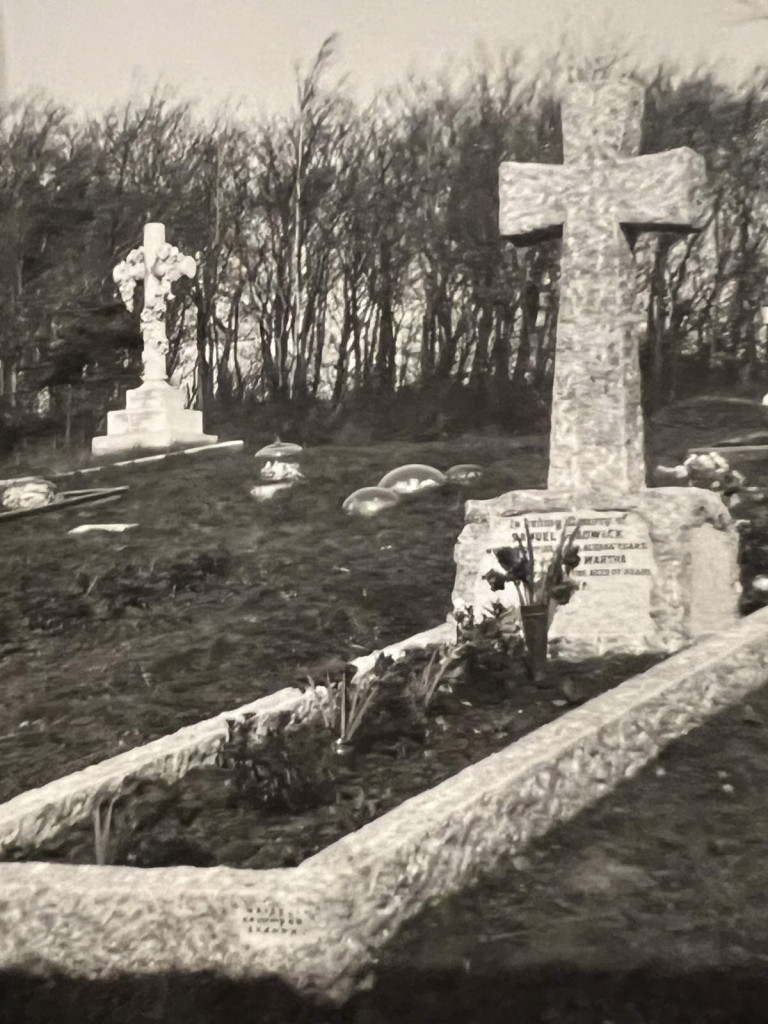
The grave in Dalton Cemetery
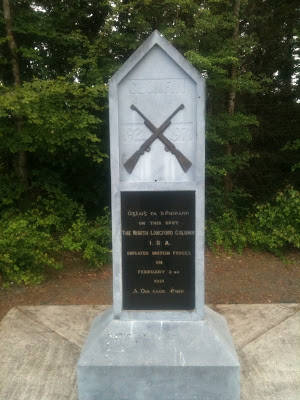
Picture of the memorial. [Source by Ted Leddy]
Dalton Cemetery contains the grave (due east of the North Chapel) of a genuine hero, Francis Worthington Craven, brother of Commander C. W. Craven, a Director of Vickers, Ltd., who lived at Dowdales, Dalton-in-Furness. His heroic act took place towards the end of WW1, but he died in an IRA ambush in 1921, along with several others on his force, the Auxiliary Division of the Royal Irish Constabulary. Mentioned on the grave is his brother, Lance Corporal John Hollinger Craven, who died in Canada of wounds received while serving in the Canadian Army during WW1. He is buried in Vancouver (Mountain View) Cemetery. CWGC says that he was the son of Ada Elizabeth Craven, of 36, Brazenose St., Manchester, and the late Jonas Craven.
On the copy of the North Western Daily Mail of Thursday 3 February 1921 on microfilm in the Barrow Records Office is scrawled ‘He won’t be wanting another blood money job.’
The North Western Daily Mail of Monday 7 February 1921 records:
North Western Daily Mail, 7 February 1921THE LATE LIEUT.-COMMANDER CRAVEN, R.N.
The funeral took place at Dalton, on Saturday afternoon, of Lieut.-Commander District Inspector Francis Worthington Craven, D.S.O., a retired officer of the Royal Navy, and an officer in the Auxiliary Division of the Royal Irish Constabulary. The deceased, who was 32 years of age, was a younger brother of Commander C. W. Craven, R.N., O.B.E., of Dowdales, Dalton, one of the directors of Messrs. Vickers, Ltd., Barrow. (As Sir Charles Craven, he became Managing Director in 1923.)
The deceased officer had a distinguished career in the Navy, from which service he retired only a few months ago. He joined the R.I.C. Auxiliary a few weeks ago. He was the holder of the 1914 Star, and in addition to the D.S.O., he received the United States Distinguished Service Medal and Navy Cross.
District Inspector Craven met his death on Wednesday night last week, in a Sinn Féin ambush at Longford, Ireland, there being only two survivors of his party. The body was removed from Dublin to Dalton in charge of two cadet officers, Lieut. J. S. W. Smith and Lieut. W. F. P. Williamson, the two survivors of the ambush. (There follows an account of the service at Dalton Parish Church).
The coffin was borne from the church by representatives of the Dalton Discharged Sailors and Soldiers, a detachment of whom headed the funeral procession to the cemetery. On the coffin, which was covered with the Union Jack, reposed the dead officer’s naval cocked hat and sword. .... Following the coffin, on foot, were Commander C. W. Craven and Captain W. C. Craven, brothers of the deceased. The other family mourners were: Mrs. Parker More(?), Colwyn Bay (sister) , and Mrs. C. W. Craven (sister-in-law). Amongst those present were Captain J. Fisher, Drumard, Barrow; Mr. G. H. Banister, C. B. E. director of Messrs. Vickers, Ltd; Mr. W. Gordon, O. B. E. (chief designer, of Vickers); Col. W. F. A. Wadham, J. P.; Mr. Mason (Barrow Steel Co.); Mr. L. Speakman (Furness Railway), Councillors T. M. Kay, J.P., and J. Backhouse (Dalton), Police Inspector Walton (Dalton). The streets of the town were lined by a crowd of sympathetic spectators as the cortege passed through. The remains were interred in the circular plot immediately in front of the cemetery church. (There follows a list of wreaths)
Internet sources say: According to his Royal Naval Service record Francis W Craven was born on the 29th Feb 1889 in Manchester. His address at the time of joining was given as Carlton Lodge, Dudley Rd, Whalley Range, Manchester; where he lived with his mother. He joined his first ship in May 1903 and served throughout the war with a very good record. Between 1914 and 1917 he served on the super-dreadnought HMS Queen Elizabeth, flagship for the naval operations in the Dardanelles campaign.
By 1918 he was commanding HMS Mounsey, an M-Class Destroyer. In October 1918 HMS Mounsey was off the Western Isles when she was called to the aid of HMS Otranto, an armed merchant cruiser used as a troopship and ferrying American soldiers to the Front. Otranto had collided in rough seas with an escort ship, struck rocks, and was sinking fast. 351 American troops were lost, together with 80 British crew; however Craven, in command of HMS Mounsey, managed to rescue almost 350 Americans and landed them at Belfast.
For his seamanship and gallantry during the rescue operations Craven was awarded the Distinguished Service Order, the American Distinguished Service Medal and the American Navy Cross (second only in importance to the Medal of Honour).
He retired from the Navy in April 1920. It is not clear whether this was due to the general demobilisation following the War, or whether the fact that a receiving order in bankruptcy was made against him around this time. In any event the bankruptcy order was annulled shortly after and by December 1920 Craven had joined the Auxiliary Division RIC. He was posted to 'M' Company in Longford.
On the 2nd February 1921 two lorries of Auxiliaries were travelling at speed on the road between Granard and Ballinalee. At a place called Clonfin, an ambush had been prepared by Sean MacEoin's Longford Flying Column. A mine was exploded under the first lorry, wounding and disabling all within it. The second lorry, which had been travelling too close behind, then ran into the ambush and its occupants were engaged by the IRA attackers and quickly subjugated. Only when their ammunition was exhausted did the Auxiliaries surrender.
Although other members of the Flying Column wanted to kill the remaining Auxiliaries out of hand, MacEoin gave orders that the wounded were to be seen to; his actions were noted by the survivors and several were later to pay tribute to him.
Francis Craven had initially wounded in the leg, he was bandaging it when a further bullet struck him in the neck. Also killed at the scene was Cadet John Houghton, aged 26. He had previously served as a Lieutenant in the Royal Sussex Regt and the Sussex Constabulary. He had been married 2 months.
Two more of the wounded were to die in hospital on the 4th February. They were Cadets George Bush and Harold Clayton. Bush was 24 and from Hertfordshire. Clayton was 25 and had served with the Royal Field Artillery, being awarded the DCM. He was commissioned as an officer in the Duke of Wellington's Regiment. Clayton left a pregnant wife and one child. He was buried on 10th February 1921 at his home in Tynemouth.
The other Auxiliaries seriously wounded in the ambush were Cadets Chesterton, Greenfield, Lambert, Lee, Moyles, Richardson, Taylor and Weeble. Cadet T J Wilford was the lone survivor of the party of 18; he managed to escape and went for assistance. [Source]
The following is from ‘Many were Held by the Sea: the Tragic Sinking of HMS Otranto’ R. Neil Scott Rowman & Littlefield 2012:
Lieut. Francis Worthington Craven, R.N. In recognition of his services when H.M.S. "Otranto" was wrecked on the 6th October, 1918. H.M.S. "Otranto" was damaged in collision with the s.s. "Kashmir" whilst carrying a large number of American troops. Lieutenant Craven displayed magnificent courage and seamanship in placing H.M.S. "Mounsey" alongside H.M.S. "Otranto" in spite of the fact that the conditions of wind, weather and sea were exceptionally severe. After going alongside and embarking a certain number of men, it was reported that the "Mounsey" had sustained considerable damage, and .that there was a large quantity of water in the engine room. Lieutenant Craven, therefore, left the "Otranto," but on finding the damage was not so serious as had been reported, he again went alongside, though he had previously experienced great difficulty in getting away. His action resulted in the saving of over 600 lives which would otherwise have certainly been lost. His performance was a remarkable one, and in personal courage, coolness and seamanship ranks in the very highest order. [Source]
One of the most striking images from his service in the war is the discussion he had on the road at Clonfin with Francis Worthington-Craven, the commander of the Auxiliaries. Craven, a decorated naval officer, was mortally wounded in the fighting and in his dying minutes, he and MacEoin had a frank exchange. In reply to being described as a murderer, MacEoin said that he and his men were acting on the proper authority and were fighting for independence, which was their right to do. In the end, Craven accepted the validity of that argument, wished MacEoin well and asked him to be kind to his men.
In his speech at his trial for the murder of D. I. McGrath, on 14 June 1921, MacEoin again justified his actions, and stated that he had behaved at all times ‘in accordance with the usages of war’. Significantly, three of the Auxiliaries who had been at Clonfin - Maddocks, Smith and Wilford - gave evidence in his favour. However, MacEoin was convicted and sentenced to death. [Source - This contains a video describing the ambush]. MacEoin was not executed following the intervention of Michael Collins.
Dist Insp Francis Worthington Craven DSO DSC DSM, 32
T/Cadet John A. Houghton, 25
Died 2 February 1921
T/Cadet George Bush, 22
T/Cadet Harold Clayton DCM, 24
Died 4 February 1921
Fatally injured in a gun and bomb attack on their patrol by the IRA
[Source]
Both have accounts of the Mounsey rescue and the fatal ambush. [Source 1 and Source 2]
There is a memorial to the dead of HMS Otranto on Islay. [Source]