Died
6th January 1898
Sources
Barrow News
Cumbria BMD
Ancestry
Baldwin Lodge of Freemasons
Cambridge Alumni
Place
Walks
Themes
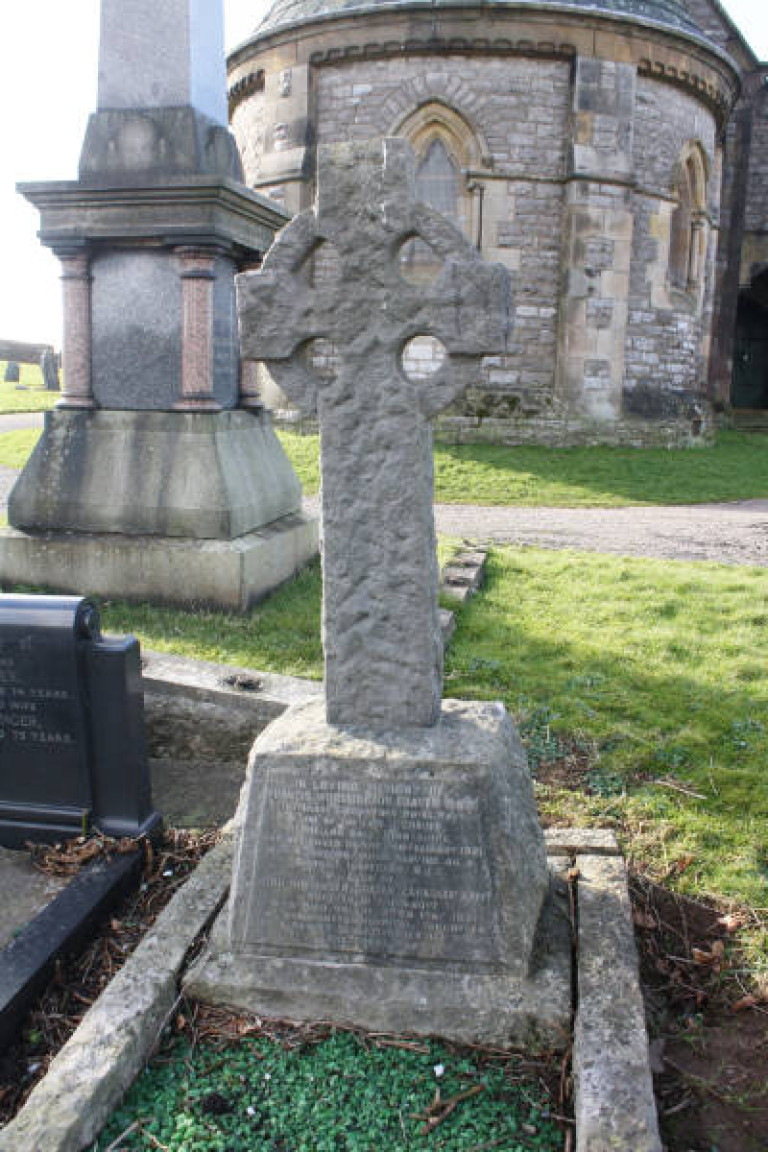
Rev James Morrison Morgan
Vicar of Dalton
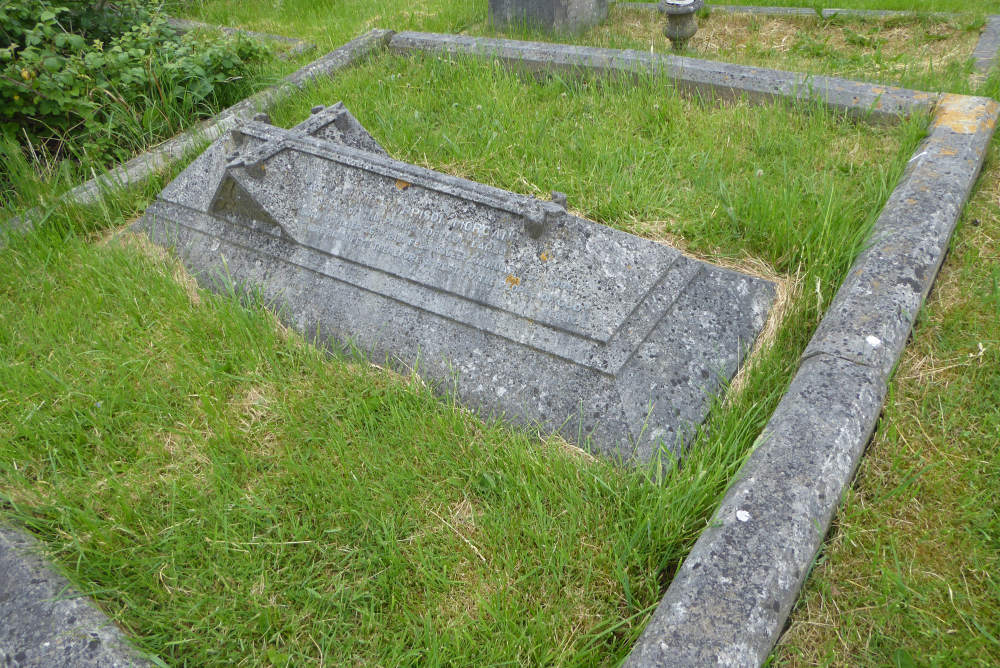
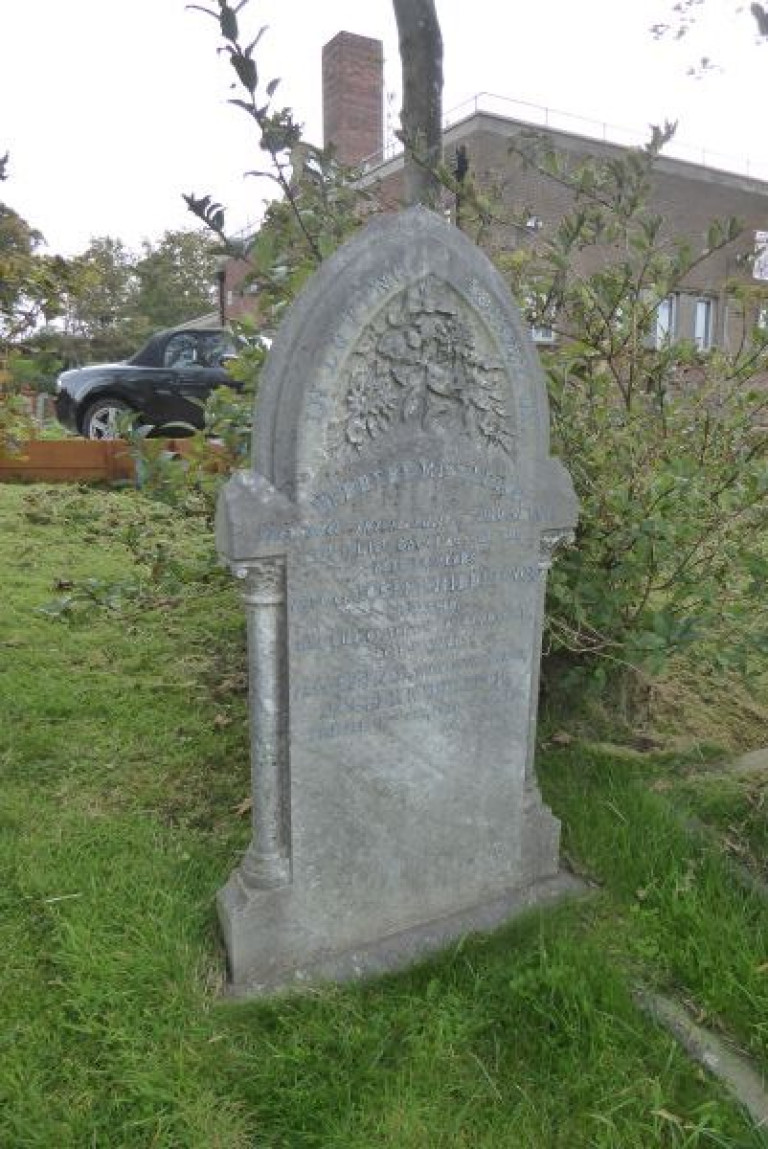
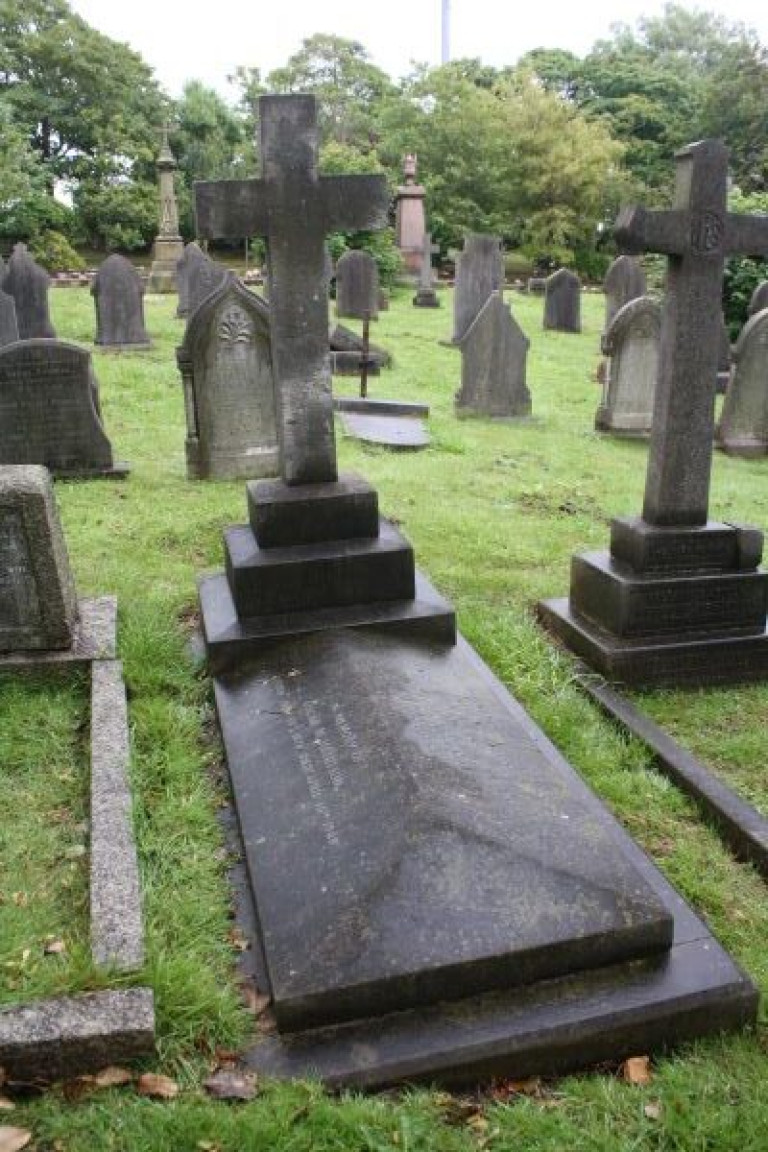
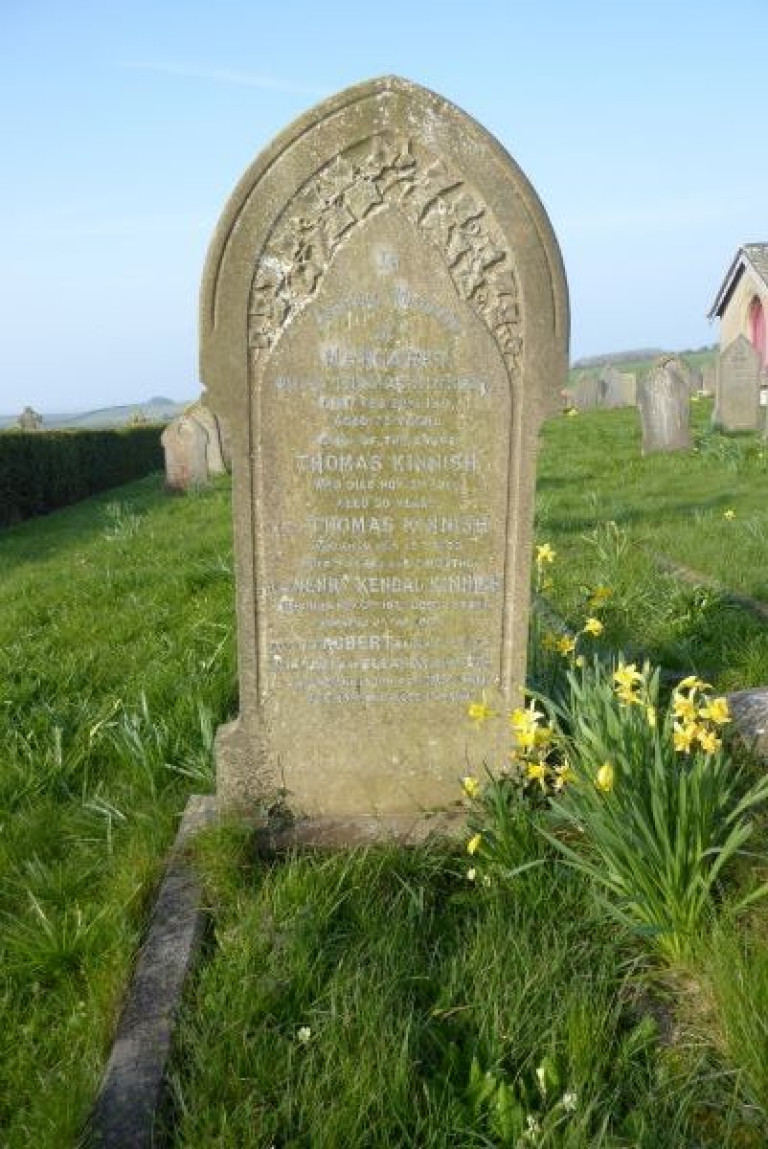
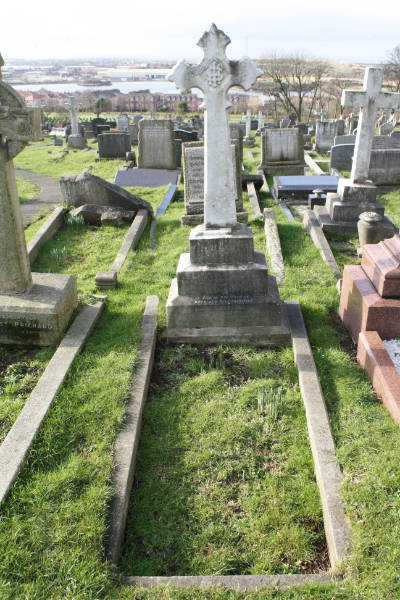
ALSO OF JAMES MORRISON MORGAN
VICAR OF THIS PARISH FOR 49 YEARS
BORN OCTOBER 26TH 1819, FELL ASLEEP JANUARY 6TH 1898
HERE REMAINETH, THEREFORE AT REST FOR THE PEOPLE OF GOD
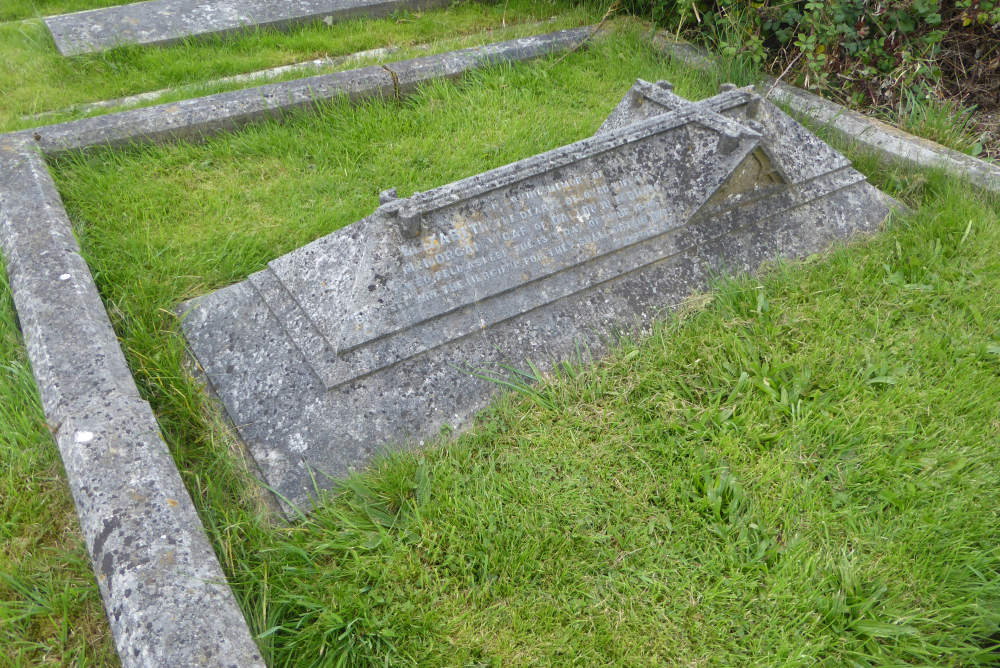
IN LOVING MEMORY OF
ELIZABETH THE DEARLY BELOVED WIFE OF
J. M. MORGAN, VICAR OF DALTON-IN-FURNESS WHO
WHO FELL ASLEEP THE 13TH DAY OF JUNE 1889.
BLESSED ARE THE MERCIFUL FOR THEY SHALL OBTAIN MERCY
In Loving Memory of
The Revd James Morrison Morgan, Rural Dean
Vicar of this Parish for forty-nine years
Born on the 26th day of October 1819. Died on the
Feast of the Epiphany, 6th day of January 1898
“In Cælo Quies”
Means: There is rest in heaven.
This Plaque is in St Mary’s Church, Dalton
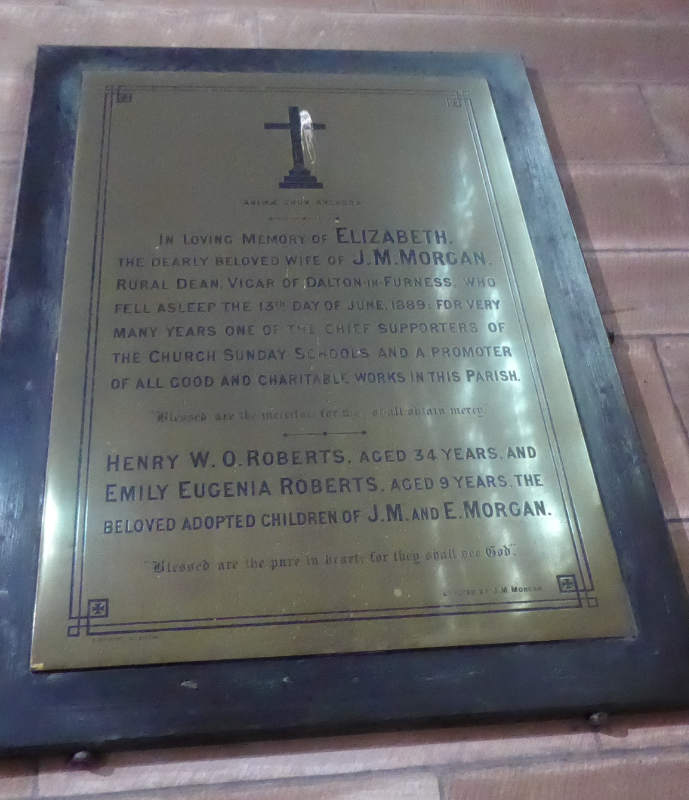
IN LOVING MEMORY OF ELIZABETH
THE DEARLY BELOVED WIFE OF J. M. MORGAN
RURAL DEAN, VICAR OF DALTON-IN-FURNESS WHO
FELL ASLEEP THE 13TH DAY OF JUNE 1889. FOR VERY
MANY YEARS ONE OF THE CHIEF SUPPORTERS OF
THE CHURCH SUNDAY SCHOOLS AND A PROMOTER
OF ALL GOOD AND CHARITABLE WORKS IN THIS PARISH
Blessed are the merciful for they shall obtain mercy
HENRY W. O. ROBERTS, AGED 34 YEARS, AND
EMILY EUGENIA ROBERTS, AGED 9 YEARS, THE
BELOVED ADOPTED CHILDREN OF J.M. AND E. MORGAN
Blessed are the pure in heart, for they shall see God.
ERECTED BY J.M.MORGAN
This Plaque is in St Mary’s Church, Dalton
Barrow News 8 January 1898:
DEATH OF THE VICAR OF DALTON
FIFTY YEARS A VICAR
It is with deep regret that we chronicle the death of the Rev. James Morrison Morgan, Vicar and Rural Dean of Dalton-in-Furness, which event occurred at the Vicarage this (Thursday) afternoon, at an advanced age. In May last the Vicar was very unwell, and for some time resided at Lakeside, returning in time for the Diamond Jubilee festivities, the last sermon he was destined to preach in the Parish Church – where he has delivered hundreds of discourses – being that in commemoration of the Queen’s sixty years’ reign – a sermon memorable to those who had the pleasure of hearing it. In the beginning of July he suffered from an acute attack of diarrhoea, but he recovered somewhat and again, went to Lakeside, where he remained until the second week in October. In that month he took part in the annual installation for Worshipful Master of Freemasons, of which he was the Chaplain for many years, and held the post of W.M. in the Diamond Jubilee year. He attended the banquet in the evening. About the middle of October, he began to fail in health, and since that time he gradually grew worse, and was confined to his room. Dr. Cross paid great attention to his patient, but the Vicar gradually sank, and passed away on Thursday about 12 o’clock. The rev. gentleman who was born at Tivoli, County Cork, Ireland, about the year 1819, and was trained for the ministry at St. Bees College, Cumberland, was ordained curate of Dalton in 1846, under the Rev. J. T. Kirkbank, M.A., vicar. On the death of the latter gentleman, Mr. Morgan was appointed vicar, the patronage at that time being (sic) resting with the Chancellor of the Duchy of Lancaster. The population at that time was 4,683, which included Barrow. From that time to this the rev. gentleman was identified with every civil and religious movement. When the development of iron ore industry began to attract a population to Barrow – the place previously being a mere village – the vicar took steps for the religious welfare of the community, and in connection with an influential committee funds were raised for the building of St. George’s Church, Barrow. From the parish attached to St. George, the subsequent parishes of Barrow were formed after 1861. There was still left in the ancient parish of Dalton-in-Furness, the district of Newbarns and Hawcoat, where a church was erected, and a parish established, and in more recent times a church was erected, and a parish set apart for Lindal-in-Furness. This reduced the parish to its present size, which contains a population of 9,000. In the year 1872 the deceased provided for the increased population by erecting an iron church at the east end of the town, the charge of which is allocated to one of the curates licensed to the Parish Church. In 1874 the Bishop of Carlisle appointed the vicar Rural Dean, which office he held up to the time of his death. In 1872 the presentation of the benefice was transferred to the Bishop from the Chancellor of the Duchy of Lancaster. It is of the annual value of £350 and parsonage. Probably the chief work of his life might be said to consist in the re-building of the ancient Parish Church at Dalton, in 1881-5, which is one of Messrs. Paley and Austin’s best efforts. The total amount was about £15,000, and was defrayed by handsome donations from the then Dukes of Devonshire and Buccleuch, the late Sir James Ramsden, Mr. J. Fell, Mr. E. Wadham, and other well known personages. The work of the late vicar in the educational movement is specially well known within the memory of nearly every inhabitant. Up to 1862 the control of the Free Schools was under the sidesmen, on the four and twenty of the parish of which body the vicar was chairman. His career in educational matters was one of great usefulness, and he seemed to take delight in the progress made. In the year mentioned, a new scheme was established and trustees appointed, under whose supervision – with the vicar as chairman – the present commodious National Schools were erected on the site of the old Free School. Mr. Morgan was also chairman of the Ireleth School managers, up to the time the Lindal and Marton School was transferred to the School Board existing in Dalton. Owing to the large increase in the population, and the consequent inadequate commodation (sic) in the National Schools, a School Board for the district was established, by order of the Education Department in 1876, the first building being erected in July of that year, the vicar being its first chairman. He remained a member of the Board continuously up to 1894, and occupied the position of chairman up to 1891, with the exception of one year, when Mr. Crossley was chosen. Although a member for the Board three years longer, the Rev. J. G. Anderson filled the post of chairman. The late vicar was also connected with the now defunct Burial Board. The Parish Churchyard having been closed for interments, in pursuance of an Order in Council, the Burial Board, consisting of nine members, was formed in 1860, and the vicar held the post of chairman uninterruptedly until the Dalton Urban Council secured the powers vested in them by the adoption of the Parish Council Act, and took over the whole of the duties. Up to the year 1875, the inhabitants of Barrow had the right of burial at the Dalton Cemetery, but in pursuance of the Barrow-in-Furness Corporation Act upon payment of £2,700 to the Board, all rights and interests of the parishioners of inhabitants of Barrow – except private rights of burial – ceased, and the Corporation agreed to pay, in addition to the sum above mentioned, an annuity of £75 to the then vicar of Dalton in respect of burial fees. Of course this payment will now cease. Mr. Morgan took great interest in the Dalton charities, the chief of which is the Billincoat Trust, of which body he was chairman until his death. He was also closely associated with the Atkinson charity, and as chairman of the 24 sidesmen he was connected with George Banks Ashburner’s charity. It may be interesting to note that in only one other parish in England does such as body as the “Four and Twenty” exist. From old records still extant, it would appear that the sidesmen or Four and Twenty of the parish of Dalton, formerly not only controlled and virtually acted as Trustees of the Free School, Dalton, but also transacted or managed the whole of the parochial business, arranging and settling on the poor “pentioners” (sic) of the parish the weekly allowance or “pentions” periodically granted to them, and along with the churchwardens practically exercising the exclusive power of annually electing churchwardens of the parish, and the control of the Parish Church may therefore be said to rest almost entirely with the sidesmen to the exclusion of the parishioners generally, and even the major portion of the congregation. In all parishes except Dalton, and another where this custom still exists, the churchwardens are elected in public vestry meetings. For many years the vicar was an ardent Freemason of the Baldwin Lodge, which meets at the Dalton Castle, and for some time acted as chaplin. (sic) In a thousand and one ways the late vicar demonstrated his interest in town affairs, and was always of a genial and kindly disposition. No one knows the extent of his benevolence. From the commencement of the Dalton Ambulance Centre he was the President, and presided at the annual gatherings. He was a former President of the Dalton Horticultural Society. The livings of Lindal and Ireleth were in the gift of Mr. Morgan. The vicar was a commissioner for oaths, and could prove wills and grant affidavits by virtue of being vicar previous to the passing of the Court of Probate Act, 1857. He was the only privileged surrogate in the Diocese of Carlisle. There are very few clergy in the country who possess the right at the present time. He performed the duties up to a few months before his death. He also acted as chaplin (sic) at the rent audits of the tenantry on the Holker and Furness Estates of the late Duke of Devonshire, and now of Mr. Victor Cavendish, M.P. He was absent at the last rent dinner held at Holker, the reason being indisposition. The vicar married the widow of the late Rev. William Spence, his predecessor in the curacy of Dalton. Mrs. Morgan died on June 13th, 1889, and since that time the vicar’s household affairs have been managed by his niece, Mrs. Bainsfather (sic) (née Miss C. Roberts). There is a handsome brass tablet in the Parish Church to Mrs. Morgan’s memory. The Rev. Canon Morgan, rector of Larne, is the only near relative of the late vicar of Dalton. On Thursday evening the bells of the Parish Church rang a muffled peal. The flag on the Castle is flying half mast as a token of respect and esteem. Mr. T. C. Hoskins has forwarded us a splendid block photo of the Rev. J. M. Morgan, R.D., “In memoriam” copies are remarkably cheap. The interment is fixed to take place in the family vault at the Dalton Cemetery, to-day (Saturday). There will be a service in the Parish Church at 1.30 p.m. To-morrow (Sunday) morning, the St. Margaret’s Church will be closed, but here will be a funeral service in the Parish Church.
As yet (January 2020) I have not found which other Parish had a similar system of sidesmen. It seems to have been widespread at one time: I have found references to Cartmel, Dent, and Braintree in Essex. (RMW)
A lengthy account of the funeral covered two columns of the Barrow News 15 January 1898, part of which is reproduced here:
THE LATE VICAR OF DALTON
Amid many sorrowful manifestations on the part of the parishioners, the mortal remains of the venerable Vicar and Rural Dean of Dalton-in-Furness, the Rev. J.M. Morgan, a biographical account of whom has already been published in our columns, were laid to rest on Saturday afternoon, in the Dalton Cemetery, in the grave in which his wife was interred on June 13th 1889 (sic – this was the date on which she died). As a last mark of respect to the memory of one who had been intimately identified with the religious, educational, and social life of the parish for just half a century, most of the tradesmen closed their places of business, the blinds of every dwelling en route to the Cemetery were drawn, and the parishioners, young and old, male and female, dressed in deep mourning, apparently all turned out to follow the remains of their late vicar to their last earthly resting place. The bells of the Parish Church rang muffled peals, and the pulpit, lectern, and Vicar’s stall were all draped in black; whilst the church was well-filled with sorrowing friends some time before the hour fixed for the solemn obsequies, viz. 1.30 p.m. The clergy, having robed in the Castle, proceeded to the Vicarage, where a procession was formed, headed by the surpliced choirs of the Parish Church and St. Margaret’s, the singing being led by Mr. Bayliff, headmaster at the National Schools. The clergy of Dalton and adjoining parishes followed, those being present being the Ven. Archdeacon Phillips, the Rev. Canon Ayre, R.D., of Ulverston; the Rev. F. Byard, curate of the Parish Church, the Rev. R. Hindle, St. Margaret’s, Dalton; The Rev. F. Pascoe, St. John’s, Barrow; the Rev. L.O. Lewis, Vicar of Lindal; the Rev. S. A. Adams, vicar of Rampside; the Rev. R. B. Billinge, Vicar of Urswick; the Revs. A. J. Roberts and F. T. Weller, Vicar and Curate of Ireleth; the Rev. E. H. Dykes, Vicar of St James’, Barrow; the Rev. C. Thornton-Duesbery, Vicar of St. Mark’s, Barrow; the Rev. W. Berry, Vicar of Newbarns; the Rev. C. de Boinville, Curate of St. George’s, Barrow; and the Rev. Nigel Buchanan, Vicar of Walney. Then came the coffin, which was of polished oak, with brass fittings, ….
……
On being re-formed in the churchyard, the procession was headed by an excellent master of the Masonic brethren, followed by the members of the two choirs and the clergy; the coffin, borne this time by Messrs. Jospeh Fisher, Frank Fisher, Jas. Wright, Wm. Hohnes (?), Robert Atkinson, and Thos. Cooper, and many hundreds of the parishioners bringing up the rear. The chief mourners were the Rev. Canon Morgan, Rector of Larne, brother of the deceased; Mrs. Bairnsfather (niece of the deceased) and Commander Bairnsfather, Royal Navy, and the following who left the Vicarage: Mr. and Miss Wadham (Millwood), Miss Byard, Mr. F. J. Ramsden, Mr. and Mrs. W. Butler, Cavendish Park, Barrow; Margaret, Maggie, Isabella, and Johnny, past and present servants (who don’t appear to qualify for family names! – RMW).
There follows a long list of mourners, especially Masons, councillors and officials, and those unable to attend. Then there is the account of the following day’s service. The Rev. S. A. Adams, B.A., vicar of Rampside, who preached at the service, included the following:
It is apparent to you all here tonight that this is no ordinary occasion on which I address you. During the last week the Vicar of Dalton has been called away to his rest, and it is only right that a public tribute of respect such as this should be offered in his memory. There are many things which tend to make his death affecting to me. Fifteen years ago, I came here as curate of this parish. For nearly 11 years, during which time I held the curacy, and since, I received very, very many acts of kindness at his hands, and I cannot forget his great kindness, when I bade you goodbye in my ministerial career, for it was his gift which conferred upon me my living. But there were closer ties which knit us together. I cannot but recollect on this occasion that I, 14 years ago, read these sacred words of committal to the earth over the remains of Henry Roberts, his nephew, and adopted son; nine years ago over the remains of his beloved wife, and now at the close of his more than 50 years (sic) connection as Vicar of Dalton, it has been my lot to read them over him.
The eulogy continues at length.
1891 Census
From Ancestry we learn that at the 1891 Census James Morrison Morgan (71), Head, Vicar of Dalton, is living at Vicarage, Market Place, Dalton with Charlotte Emily Roberts (25), grand-niece, born London; Hannah Leece, (27), domestic servant, born Bootle, Cumberland; Elizabeth Eleanor Postlethwaite (20), housemaid, born Lowood, Cartmel, Lancs.; and there is a visitor staying, Emily Reid Ross (34), born Preston, Lancs. Charlotte Roberts married George Bairnsfather on 3rd February 1892 in Dalton.
1881 Census
In the 1881 Census, living at the Vicarage, Dalton, were James M. Morgan (60), Vicar of Dalton and Rural Dean, born Ireland; Elizabeth Morgan (59), born Manchester; Henry W. O. Roberts (31), nephew, unmarried, occup. Gentleman, born Woodside, Cheshire; Elizabeth W. Riley (30), domestic cook, born Rusland; and Mary E. Atkinson (26), housemaid, born Leece.
Henry Roberts died in the first quarter of 1884.
1871, 1861 and 1851 Census'
I found James & Elizabeth in the 1871 Census, the 1861 Census, in both of which they had the same 2 servants, Ellen Ashburner and Margaret Heys, and in the 1851 Census.
James Morrison Morgan married Elizabeth Spence in the third quarter of 1849 on the Wirral.
The list of Cambridge Alumni for Rev. James Morrison Morgan has him as sizar (an undergraduate who receives some form of assistance such as meals, lower fees or lodging during his or her period of study, in some cases in return for doing a defined job) at ST JOHN'S, Apr. 17, 1847; a ‘Ten-year man.’ S. of James (and Maria). Born. in the parish of St Nicholas, Cork, Ireland. Bapt. Nov. 1, 1819. At St Bees Theological College. Vicar of Dalton-in-Furness, Lancs., 1849-97. Domestic Chaplain to the Earl of Cork and Orrery. Disappears from Crockford, 1898.
James Morrison Morgan is an early member of the new Baldwin Lodge of Freemasons, Dalton, being admitted on 12 July 1872.
In the National Probate Calendar (Index of Wills and Administrations) 1898 we can read MORGAN THE REVEREND James Morrison of the vicarage Dalton-in-Furness Lancashire clerk died 6 January 1898 Probate LANCASTER 4 March to Charlotte Emily Bairnsfather (wife of George Edward Beckwith Bairnsfather) the said George Edward Beckwith Bairnsfather commander in the Royal Navy and reverend Samuel Atkinson Adams clerk Effects £2575 4s 10d.
In the Baptismal Records for All Saints, Wigan 1856, we find Emily Eugenia Roberts, the other adopted child, being baptised on 23th April. She had been born on 3rd April. Parents were John Roberts, a Commissioning Agent, and his wife Alice.
1861 Census
By the 1861 Census the Roberts family are at Camberwell, Surrey, where they live at 7, Chatham Place East, off Avenue Road. The household is: John (46), Head, Engineering Agent, born Liverpool, Lancs; Alice (42), born Manchester, Lancs; Elizabeth S. (17), daughter, born Birkenhead, Cheshire; Henry W. O. (12), son, born Birkenhead, Cheshire; Charles S. (10), son, born Birkenhead, Cheshire; Emily E. (5), daughter, born Wigan.