Died
5 May 1902
Aged 32
Born
5 Nov 1869
Sources
North Western Daily Mail
Barrow News
Ancestry
Submariners' Association Research, Barrow
Place
Walks
Themes
Stoker John Henry Curtis
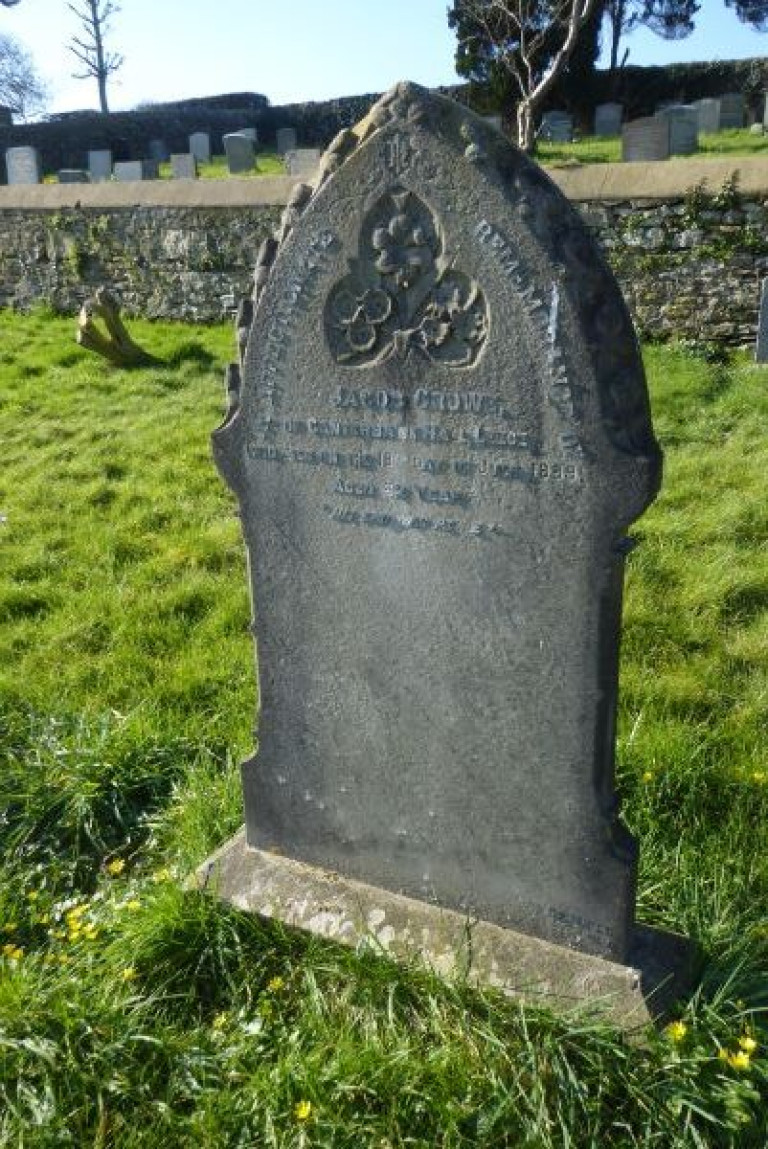
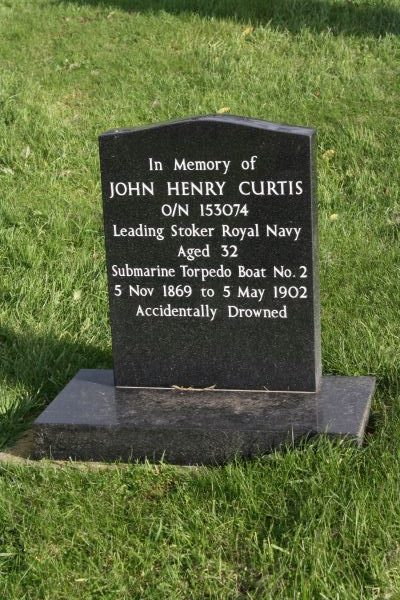
This is a modern headstone to someone who may have been the first naval casualty who actually served on a submarine, at a time of great secrecy. I was asked to research this story by a correspondent through the website, but found that the work had already been done by Barrie Downer (and colleagues) of the Submariners’ Association, Barrow. Much of what follows is their work, reproduced here with permission.
The North-Western Daily Mail 5 May 1902 carried the following report:
DROWNING ACCIDENT AT BARROW
NAVAL STOKER DROWNED
The Barrow police have received information of the discovery of the body of a naval stoker named John Henry Curtis, which was found in Devonshire Dock this morning. The deceased, who was a Leading Stoker (2nd class) belonged to H.M. gunboat Hazard, and temporarily serving on No. 2 torpedo boat, went ashore on leave at 6 p.m. on Sunday. He was seen by E. Talind, stoker, at 10.15 p.m. in the town near Duke-street, and was then, it is stated, under the influence of liquor. He was reported missing at 6.30 a.m. this morning. His cap was found in the water near the torpedo-boat, and on draging (sic) the dock the body was found about 11 a.m. There was a slight cut over the left eye.
Leading Stoker 2nd Class John Curtis was born in St. Colomb in Cornwall on 5th Nov 1869. He was the eldest son of Joseph and Elizabeth Ann Curtis. Joseph, (described as an Engineer) and Elizabeth were married in St. Colomb in September 1868. Henry was one of a large family of possibly eleven children of whom five (three boys and two girls) were the children of Joseph and Elizabeth, with the remainder being born after Elizabeth’s death in 1877. In the 1881 Census the Family were recorded as living at 19, Fore Street, St Colomb Major, Cornwall, and were sufficiently well off enough to employ a domestic servant.
Prior to joining the Royal Navy John Curtis worked as an Engine Driver.
He joined the Royal Navy as a Stoker 2nd Class on 10th Jan 1890 at HMS Indus (the Engineering Training Establishment) at Devonport. He served as follows:
HMS Aurora from 16th Dec 1890; advanced to Stoker 1st Class on 1st Nov 1901.
HMS Narcissus from 4th May 1892 for two years.
7,350-ton Twin Screw Protected Cruiser HMS Endymion from 26th May 1894 for three days.
HMS Vivid II at Devonport on 29th May 1894. Vivid II is a shore establishment for the Stokers and Engine Room Artificers School.
7,700-ton Twin Screw Protected Cruiser HMS Crescent from 11th Sep 1894.
HMS Lizard from 1st Jan 1895 for over three years.
HMS Vivid II from 15th May 1898.
9,420-ton Twin Screw Armoured Battleship HMS Colossus (Captain Samuel A Johnson, Royal Navy) from 28th Oct 1898 – the Coastguard Ship at Holyhead - where he served for just less than a year.
HMS Vivid II from 6th Oct 1899.
On 20th Aug 1901 the 1,070-ton Twin Screw Torpedo Gun Boat HMS Hazard (Captain Reginald Bacon, RN) was commissioned for ‘Special Service’ as a support ship for the new Submarine Service. John Curtis was drafted to HMS Hazard on the same date and on 11th Nov 1901 he was advanced to Leading Stoker 2nd Class. He was allocated to HM Submarine Torpedo Boat No. 2 (Holland 2). [This was the second submarine built for the British Navy]. On 5th May 1902 HMS Hazard was alongside in the Devonshire Dock at Barrow in Furness when John Curtis was found drowned in the Dock. It was suggested that he returned on board HMS HAZARD by the wrong gangway and slipped and fell into the Dock. The Coroner’s Court verdict was that he was accidentally drowned. John Curtis was buried in a Private Grave (sponsored by HMS Hazard) in the Thorncliffe Cemetery, on 7th May 1902.
The following letter from Lieutenant Forster Delafield Arnold-Forster, RN, of HMS HAZARD, refers to the accident and reads as follows:
Barrow-in-Furness
May 14th 1902My dear Father,
I have had my hands very full this last 10 days and had no time to write before.
I arrived here from home that Sunday evening, having caught the train at Shipley all right. I had to see the Captain (Bacon) over the side at 6.30 the next morning and receive orders from him about the trials and things in connection with the submarines he wanted done during his absence. During breakfast I was told a Leading Stoker was missing and his cap found floating near the torpedo boat. It looked as though he must have fallen overboard so I started dragging at once and found his body at 11.00 and sent it to the mortuary. The next three days were perfectly awful what with arranging about the inquest and funeral and running trials with No.2 in between whiles. We buried him eventually on Wednesday with Naval Honours after a lot of telegraphing with his relations who first wanted him sent to Plymouth, not realising that it would cost them £23. We got a gun carriage from Vickers and the Volunteer band and a number of volunteers attended.
Admiral May was here on Saturday and we took him diving in the dock in No.1 and fired a torpedo from No.2 submerged but not under way. Evans and I had a very good bicycle ride on Sunday along the left banks of the Coniston to Fore How which we found shut up. We started at 2.00 and got there at 5.00 and had tea in the kitchen and rode back by Bowness, getting Dinner at Lakeside. On Monday we took the torpedo boat and No.1 into the lock and went out at 2 am Tuesday morning and had some good submerged running in Morecambe Bay. We ran about 18 feet deep occasionally going to 20 to just cover the periscope. I worked the diving wheel and Evans steered. I have trained one of the torpedo coxswains to take the diving wheel which frees me now to a great extent, as up to now nobody else has done it.
Sueter came tonight. He will live on shore on compensation till I go, I don’t know when that will be. I have been training Evans and Moreton and all the submarine crews pretty thoroughly at submerging the boat and working all the pumping, flooding and floating arrangements, so that Sueter will find them fairly efficient.
It will be very nice if this gets done for the review and all the etcetera’s.
I will remain your affectionate son
Del
Lieutenant Arnold-Forster was nephew to the parliamentary and financial secretary to the Admiralty, H. Oakeley Arnold-Forster. Lt. Arnold-Forster had joined the Navy in 1891, and served in Antigua, Grenada and Copenhagen. He was initially sceptical about submarines, but became converted. He rose to the rank of rear-admiral in 1927, and died in 1958.
The first submarines were built under conditions of great secrecy. When Arnold-Forster arrived at the shipyard, it is alleged that he couldn’t find anyone to confirm that a submarine was being built. Eventually he found it being constructed in a shed labelled “Yacht under construction.” Sea Devils: Pioneer Submariners John Swinfield (The History Press) 2014 (p95). The news cutting quoted earlier refers to a “torpedo-boat”, rather than a submarine.
Note: The Headstone for John Curtis was funded by, and erected by, the Barrow in Furness Submariners’ Association – and was organised by Terry Spurling and Barrie Downer.
The John Curtis information was researched by Peter Schofield and Barrie Downer.
The grave is owned by the Borough, there are a number of people in the same grave therefore a headstone is not permitted.
Ancestry
On Ancestry the Army and Navy Birth, Marriage and Death Records states: Cause of death: Drowning – found drowned – on night leave.
One thing not mentioned by Lt. Arnold-Forster in his letter is that John Curtis was the third Stoker from HMS Hazard to have died in Barrow in Furness in 1902. The first was Acting Chief Stoker Richard Wright O/N 147506 (Dev) who also had joined HMS Hazard on 20th August 1901. He was born in Saltash in Cornwall on 15th Mar 1870. He is reported to have died on 2nd Jan 1902 from apoplexy. He was returned home to his family in Saltash for burial.
The second to die was Stoker 2nd Class Alfred Elliott Holland O/N 297095 (Dev). He was another Cornishman and he died from pneumonia in the Sailors’ Home in Barrow on 9th Jan 1902 and was buried in a public grave in the Thorncliffe Cemetery. Why Curtis was buried in a Private Grave and Holland was buried in a Public Grave in the same Cemetery is not known. Neither grave was marked at the time of burial.
Alfred Elliott Holland O/N 297095 (Dev)
Stoker 1st Class Alfred Holland was born in Saltash in Cornwall on 20th April 1883. Prior to joining the Royal Navy he was employed as a waterman. He joined the Royal Navy as a Stoker 2nd Class at HMS VIVID II at Devonport on 25th April 1901 signing on for a twelve-year Continuous Service engagement commencing on the same date. He was drafted to the Submarine Tender HMS Hazard on 20th August 1901.
The Barrow News Saturday, 11th January 1902
Naval Funeral at Barrow
An unusual event and that of a solemn character took place at Barrow on Friday morning when the remains of a British sailor belonging to HM Gunboat Hazard were laid to rest at the Borough cemetery. Within the short time of a week two deaths have occurred on this boat. The first being that of the head (chief) stoker who we understand died somewhat suddenly last week. A few days ago another sailor died named Alfred Holland, also one of the stokers, was seized with a serious illness and despite the attention of Dr. Stewart he passed away at the Sailors Home and Mission on Wednesday, pneumonia and pleurisy being the certified cause of death. The deceased was extremely popular on his ship and during the short time he had been in the town he had also made many friends. When the funeral took place yesterday there was a very large crowd assembled in the vicinity of the Sailors Home notwithstanding a downpour of rain. The crew of Hazard under the command of Lt Arnold Foster were marched out of the shipyard drawing a gun carriage for the conveyance of the coffin and were drawn up in Michaelson Road along with several members of Volunteers under Sergeant Instructor Tyrell and a number of civilians including the port missionary Mr. Fern, the Superintendent of the home Mr Paterson (sic - actually James Peterson) and others. The blue jackets were called to the present and the coffin was borne out on the carriage and covered with the Union Jack and several magnificent floral tributes sent by the officers of the Hazard crew, the Sailors Home and Mission, deceased friends in the town and others. After the order reverse arms had been given the mournful procession moved off to the strain of the Dead Man’s March in Saul played by the Volunteer Band, the carriage being drawn by the bluecoats from the Hazard. En-route to the cemetery many sympathetic spectators stopped to watch the procession pass by. At the cemetery the committal portion of the burial service was read by Archdeacon Boutflower and after the coffin had been lowered the crew fired three volleys over the resting place of their departed comrade. The deceased, who was only nineteen years old, belonged to Saltash, Cornwall. He had no less than four brothers serving in the British Navy.
The funeral arrangements were carried out by Henry Swarbrick, undertaker.
The Sailors’ Home and Mission in Michaelson Road no longer exists. In 1904 The Sailors’ Home and Mission moved to new premises in Ramsden Dock Road on Barrow Island. This building was later the home of the Barrow Branch of the Royal Naval Association and is currently active as the Navy Club (2019).