Robert Davies & James Newby
Died in a mining rescue at Roanhead Mines
23 March 2015
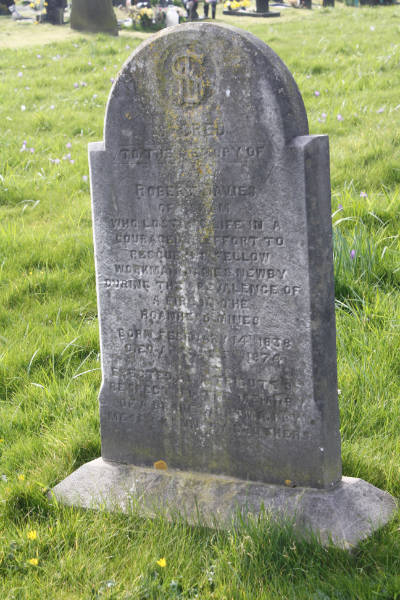
SACRED
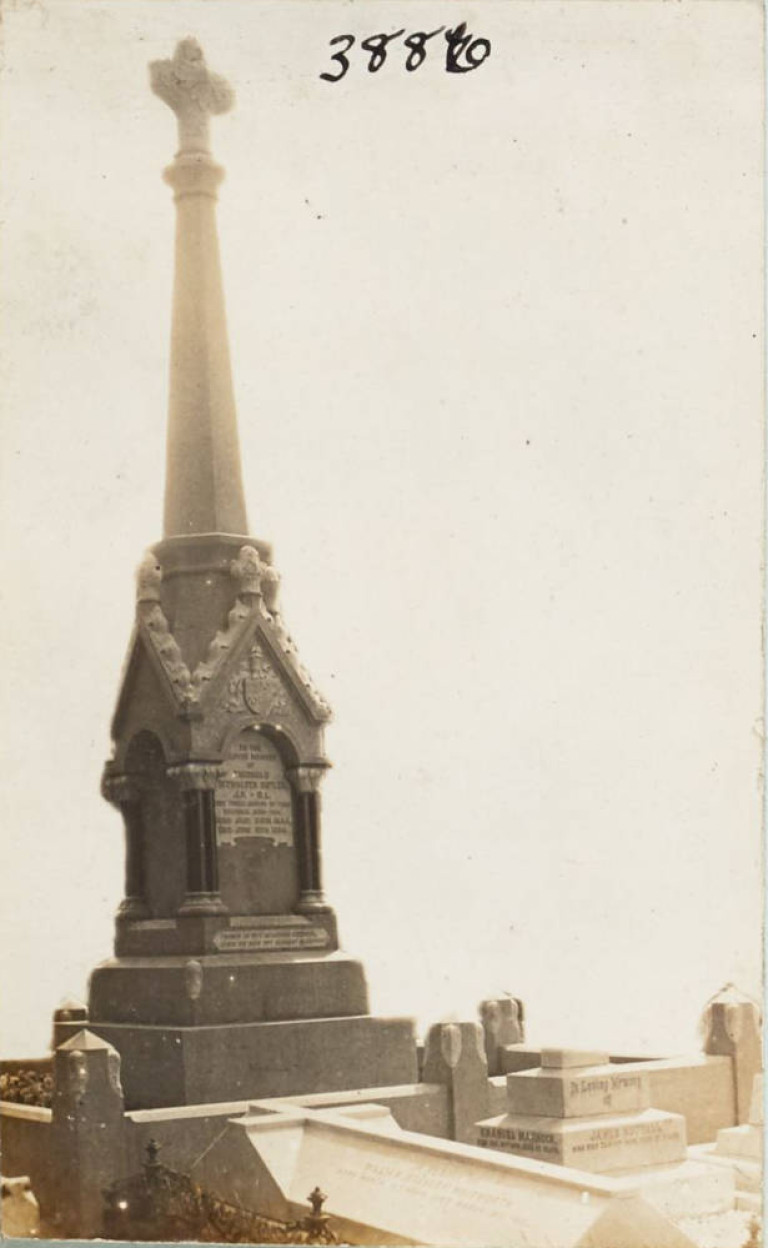
TO THE MEMORY OF ROBERT DAVIES
OF ASKAM
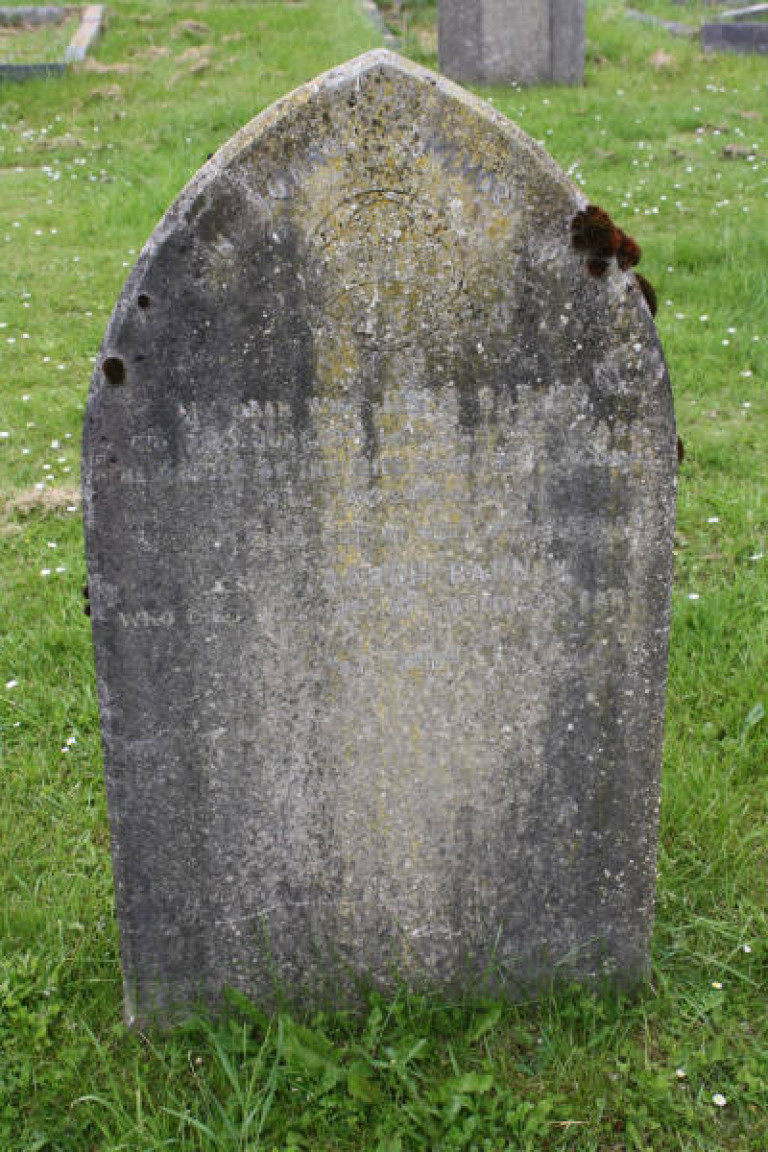
WHO LOST HIS LIFE IN A COURAGEOUS EFFORT TO RESCUE FELLOW WORKMAN JAMES NEWBY DURING THE PREVALENCE OF A FIRE IN THE ROANHEAD MINES BORN FEBRUARY 14TH 1838 DIED AUGUST 25TH 1874 ERECTED AS A TRIBUTE OF RESPECT TO THE MEMORY OF A BRAVE WORKMAN MESSRS. KENNEDY BROTHERS
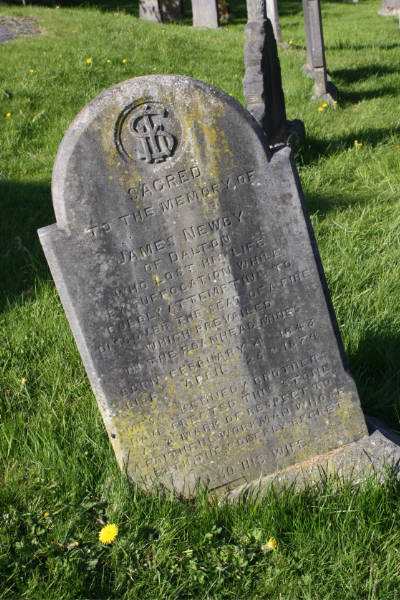
Sacred to the memory of James Newby Of Dalton Who lost his life By suffocation While boldly attempting to find the seat of a fire which prevailed in the Roanhead Mines Messrs Kennedy Brothers have erected this stone as a mark of respect to a faithful workman whose
Where are the graves?
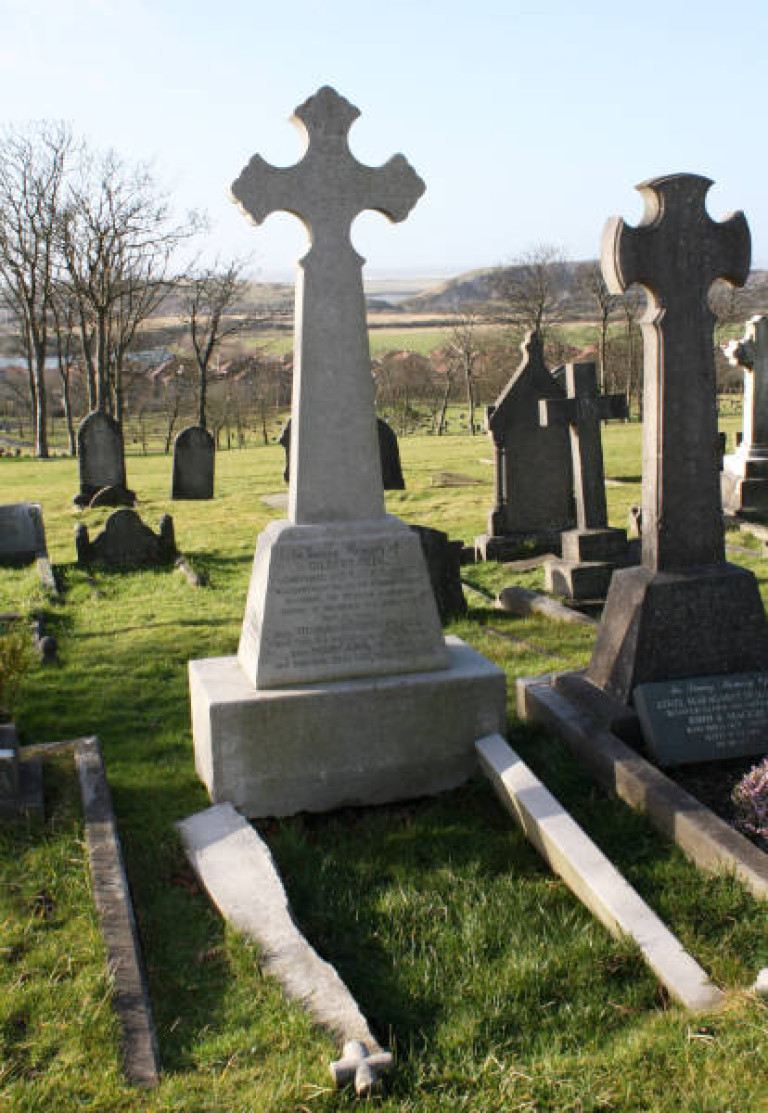
Davies is buried just north of the South Chapel. Newby is buried close to the North Chapel, on the corner closest to its north-west point.
In the late C19th Dalton was full of miners, and many more worked overseas in South Africa, Rhodesia (now Zimbabwe), Australia, Canada and the USA. Health & Safety legislation was rudimentary or non-existent, and injury and death were not uncommon. Robert Davies (or Davis as the local paper spelt his name) was one example. The detailed account of the accident and of the funeral, is typical of the time, and some of the language now appears archaic.
The Barrow Times Monday 27 April 1874 reported:
The Barrow Times, Monday 27 April 1874FIRE IN A MINE AT ASKAM. TWO MEN KILLED.
On Saturday morning last two miners, who were bravely pioneering in order to find out the source of a fire which had broken out at the Ronhead (sic) mines, the property of Messrs. Kennedy Brothers, succumbed to the fumes, and were brought out dead. It appears that on Friday a fire had broken out in some workings, but it could not be exactly ascertained where, and when the evening set came out some of the men were suffering considerably from the effects of the stifling vapour, Humphrey Williams, of Askam, and William Newby, of Dalton, being very ill. The mines which were affected were three pits belonging (sic) Messrs. Kennedy, and these mines having drift ways through into three pits belonging to the Furness Iron and Steel Company Limited, Askam, the rest were also smoked out. The locale of the fatal accident is a cluster of pits, close together, opposite the Askam Ironworks, and near to that portion of Askam known as Chapman Lot.
It seems that the morning set go to work about half-past three a.m. and leave their labours for the day about half-past eleven a.m. In the Ronhead pits the men were obliged to come out, and by about half-past seven a.m. the smoke had arrived in the Greenscoe pits, the property of the Furness Iron and Steel Company Limited, and the men, after lunching at that time, were not allowed to descend again. Some of the men of the latter mines in the galleries they were working could not perceive anything unusual, while in other workings the fumes had got so strong the men could scarcely work. The men say that the heat is so great underground that they can feel the timbers quite hot to the touch in some parts. It was supposed that the fire had started by spontaneous combustion among very old timber in some of the older and disused workings, while others venture to affirm that where the fire is, being one of the wettest parts of the mine, could not have taken hold unless a candle or something of the kind had been left there lighted. Others again assume that it is not really known where the fire was at the commencement. As the pits could not be worked many of the men went home, and a guard was stationed at each pit mouth to prevent any going down to work.
At the Ronhead mines some of the men volunteered to descend, endeavour to find out where the fire lay, and attempt to extinguish it. Some miners, named Dissington, James Foye, Robert Huddleston, John Miller, William Blendle, and others, made attempts but had to return, not being able to accomplish their purpose. James Newby, aged 34, a married man, residing at Rawlinson-street, Dalton, the pump foreman, descended one of the shafts and traversed the workings, and came to the bottom of the shaft of another mine. It was expected that he would come up by the shaft he went down by, but whether the volume of gas was too great to stand against, which made him come out by the other shaft, is not known. However, Newby did not live to tell whether he had discovered where the outbreak of the fire was, as he was dead before he could be brought to the surface. A miner named Robert Davis, aged 34, a single man, lodging at Sandy-row, Steel-street, Askam, and formerly of the neighbourhood of Wrexham, went down to see after Newby. There are lower mains that are reached with step-ladders, about 12 feet in height, leading to the shaft foot, and the fatality that occurred in the case of Newby happened at one of those points. It is believed that Newby was climbing one of these ladders, and Davis another, when Newby became so influenced by the gas that he became unconscious and fell backwards, and received a severe cut on the back of the head. Davis went up for a rope, and no doubt the gas must have been strong on him when in the air at the pit- mouth, as when he got down again he was not only unable to fix the rope to Newby but was overpowered himself.
Dr. Anderson had been sent for, and was at the mine-top when the two men were brought up, when it was found both were dead. This was shortly after nine o’clock in the morning. The dead bodies were then sent home, where rumour had been before them, and the greatest consternation was created in the neighbourhood. The intelligence made a complete turn-out in Steel-street, and busy groups of persons from all parts of Askam stood conversing on the affair as the body of Davis was conveyed up the street about eleven o’clock in the forenoon. The Greenscoe mines, closely adjoining the Ronhead pits, and having driftways communicating with each other, it was advisable to board off to secure the mines from being filled with baneful vapours arising from the burning timber. Wm. Sims, John Parkinson, of Duddon-road, and Wm. Higgins, of Sawmill Field, Askam, descended No. 5 Mine, belonging to the Furness Iron and Steel Company, a little past eleven in the morning, but could not make headway against the smoke which had already penetrated into this pit. They emerged from the shaft mouth in about twenty minutes. Sims and Parkinson were suffering, while Higgins was entirely unconscious.
By this time Mr. W. Crossley, of Greenscoe House, manager of the Askam Ironworks and Greenscoe Mines, had arrived at the scene. Higgins was laid upon some planks with his head raised, and Dr. Anderson, after considerable trouble, restored him. The odour of the smoke emitted from the shaft was quite overpowering. Seeing that no feasible plan could be employed to clear away the fumes which had filled all the workings, the whole of the shaft moths were boarded over and sealed with wet clay, while the water which is being pumped out will be allowed to fall back in again, so as to overcome the fire if it should approach the Greenscoe Mines. Those of the Ronhead pits which were on fire were covered in a similar manner and the water from some streams was turned down the shafts. It is computed that between two to three hundred men are employed at the pits which are now stopped, but it is said that the owners will be able to give the men work independently of the mines, which are now forced to be idle. On making enquiries about Higgins yesterday morning it was found that he had recovered. The district coroner, Mr. John Poole, has signified his intention to open the inquest at Askam this morning at half-past eight, after which the inquiry will be adjourned for the presence of Mr. Evans, the Government inspector for this district.
Barrow Times Saturday 2 May 1874 reported a detailed account of the start of the inquest, held at the Vulcan Hotel:
... The coroner, in adjourning the inquiry until Friday afternoon next at one o’clock, informed the jury that he had another inquest at Dalton, arising out of the same accident. ..... on Friday morning, when he would take the evidence of the Government Inspector of Mines. The jurymen were severally bound to appear at the inquest in the sum of 10/- (50p) each. ......
There also follows an account of the funerals:
........ The Rev. J. M. Morgan, vicar of Dalton parish, assisted by his curate, performed the solemn duties required at the tomb, both men having been in the faith of the Established Church. The coffin of Newby was plain oak, unpolished and solid, and bore upon a brass plate the simple inscription, “James Newby, aged 31, 1874.” Davis’s coffin was made of plain white wood, unpolished or stained, and bore on a black breastplate the following: - “Robert Davis, was killed at Ronhead Mines of the 25th of April. 1874, aged 35 years.” Newby is buried at the north-west of, and close to the chapel, in the private ground. Davis is interred to the west and at some distance from the chapel, in the cheaper portion. It is a pity they were not buried in the same grave, as it is customary in such cases, and as headstones by subscription are generally put up when the circumstances are similar to what attended these. It is said that Messrs. Kennedy Brothers, who have generously bound themselves to pay all the expenses of the funerals, had expressed a wish, if possible, that the men might be buried together. One melancholy circumstance attends the death of Davis, the poor fellow having meant to be married at the approaching Whitsuntide. We understand that Mrs. Newby has had a letter of kindly sympathy from Messrs. Kennedy in her sad bereavement. There were with mourners and spectators upwards of 1,000 persons assembled in the cemetery.
The inquests both returned verdicts of ‘accidentally suffocated by carbonic acid gas’, and the Inspector of Mines recommended ‘adequate means of proper ventilation before men were allowed to work in [the mines].’