Died
21 July 1941
Sources
Place
Themes
Commander Alastair Shand Cumming
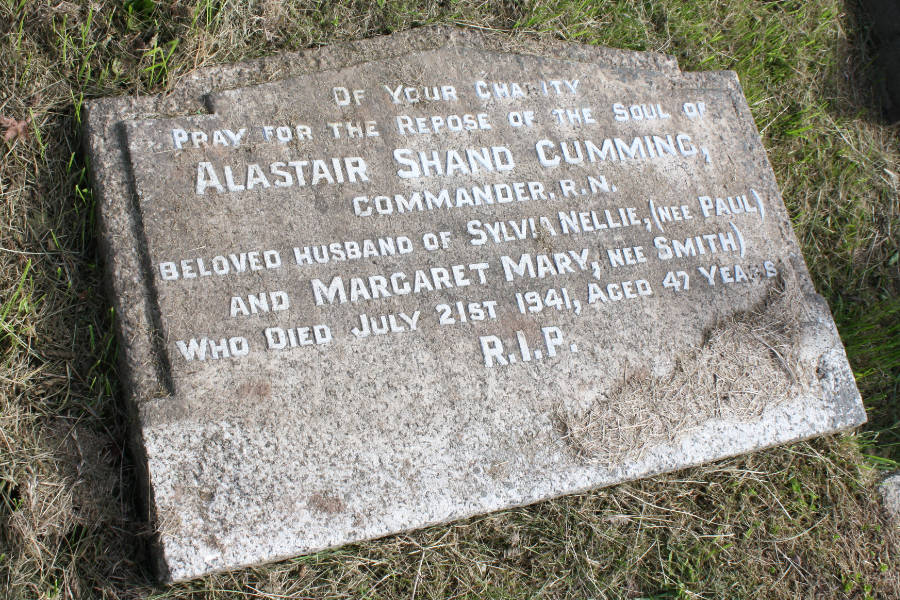
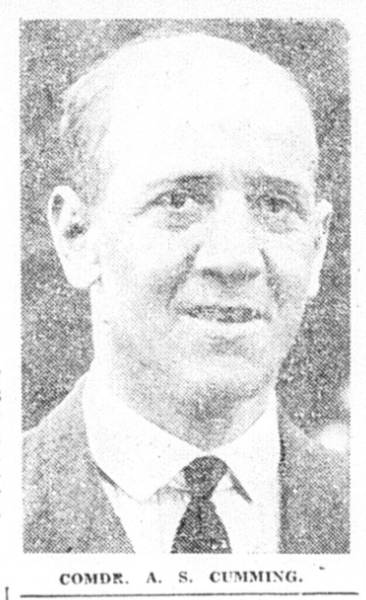
Where is the grave?
Coming up the main drive from Devonshire Road, branch left soon after a hedge on your left. The grave is a few yards along on the right.
Don Kindell, who has compiled information about dead naval personnel, sent me the following:
In Stuart Clulow’s book (Chapter 3 Page 23) about HMS Ursula he refers to both Lakin (Ursula’s Navigating Officer) and Commander Alastair Shand Cumming. The story about Lakin, motorbikes and testing the Ursula suit using a fire hose is a direct quote from Lakin himself who confirmed the story to Clulow. Phillips and Lakin both 'stood by' the Ursula build at Barrow. However Clulow goes on to say: 'Phillips was first inspired with this train of thought before the war by a retired submarine officer called Cumming. He was employed organising sea trials and acceptance trials at the Vickers shipyard. He used to wear a German leather two piece overall which he had acquired at the end of the First World War. This idea coupled with seeing Lakin in a Barbour overall used for motorcycle trips motivated Phillips to complete a design suitable for Submariners. 'Reference the 'before the war' comment - Phillips was appointed to Ursula in Build as Commanding Officer on 8 Nov 1937 and would probably have met Cumming whilst arranging acceptance and trials. Lakin joined Ursula also in Barrow in May 1938’ The important thing was that it was a combination of the two ideas, the German suit worn by Cumming and the Barbour one piece worn by Lakin that assisted in the design and production of the Ursula Suit.
Commander Cumming was an interesting character and research has uncovered the following:
Alistair Shand Cumming was born in 1896 (was 47 in 1941 when he died so either 1893 or 94?) and joined the Royal Navy as a cadet probably aged thirteen. He was promoted to Midshipman on 15 Jan 1912 and was appointed to the battleship HMS Colossus on the same date. He was promoted to Acting Sub Lieutenant on 15 May 1914. In December 1914 he was still serving in the 20,000 ton Battleship HMS Colossus (Captain the Hon. Edward S Fitzherbert, RN) to which he had been appointed on 15 Jan 1912. Promotion to Lieutenant followed on 15 May 1916. Alistair Cumming joined Submarines on 1 Mar 1917 (Nominal List) when he was appointed to HMS Dolphin ‘for Submarine Training’. He was then appointed to the Submarine Depot Ship HMS Maidstone (9th Submarine Flotilla) at Harwich ‘for Submarines’ on 1 May 1917 (Nominal List) and this was followed, on 1 July 1917 (Nominal List) by an appointment to HMS Maidstone ‘for Submarine E27 as First Lieutenant’. He returned to HMS Maidstone ‘for Submarines’ on 30 May 1918 (Nominal List) before being appointed to the Submarine Flotilla Leader HMS Fearless (12th Submarine Flotilla) at Rosyth ‘for Submarine K5 as First Lieutenant’ on (31 July 1918 Nominal List). On 28 Mar 1919 he was appointed to the Submarine Depot Ship HMS Thames (the Periscope School) at Portland ‘for Commanding Officers Course’ and on 3 July 1919 he was appointed to the Submarine Depot Ship HMS Vulcan (4th Submarine Flotilla) at Blyth ‘for Command of Submarines’. His first command appointment was to the Submarine Depot Ship HMS Maidstone (3rd Submarine Flotilla) at Portsmouth ‘for Submarine H28 in Command’ to date 18 Oct 1920. He was listed as between appointments on 18 July 1922. This was followed by an appointment to the Submarine Depot Ship HMS Lucia (2nd Submarine Flotilla) at Gibraltar ‘for Submarine L52 in Command’ to date 1st Oct 1922. Alistair Cumming was appointed to the Submarine Depot Ship HMS Vulcan (the Periscope School) at Portland ‘for Submarine H32 in Command’ on 30 Apr 1923 and he promoted to Lieutenant Commander on 15 Dec 1923. He was appointed to the Royal Naval College at Greenwich ‘for the Staff Course’ on 16 Sep 1924 and then to the Submarine Depot Ship HMS Lucia (2nd Submarine Flotilla) at Malta on 18 Jan 1926 ‘for Submarines’ and, on 15 July 1926 ‘for Submarine L53 in Command’. His last Submarine appointment was to the Submarine Depot Ship HMS Maidstone (2nd Submarine Flotilla) at Devonport ‘for Submarine L54 in Command’ on 20 Nov 1926. Alistair Cumming was transferred to the Retired List in 1927 with his seniority as Lieutenant Commander. He was promoted to Commander on the Retired List on 31 May 1934. Alistair Cumming died at the age of forty seven on 21 July 1941.
The Times of 17 May 1934A Young Woman’s Death
Father’s Evidence at Inquest
Mr. Ingleby Oddie, Coroner for the London Central district held an inquest at Paddington yesterday into the circumstances concerning the death of Mrs. Margaret Elsie Douglas Bennett, aged 36, of Cromwell Road SW, who died in St Mary’s Abbot’s Hospital on Saturday.
Mr. Francis William Bain said the dead woman was his daughter, who had lived with him at Cromwell Road, Kensington. She was the widow of Captain Douglas Bennett of the Royal Engineers. Her health has been absolutely good, but she had had a very great disappointment in a love affair.
The Coroner: Did the man wish to marry her? – There was not the slightest doubt about it at one time. Recently things happened which led him to tell her six months ago that he was going to marry someone else. The witness added that she had been in very great tribulation during the last six months and had been sleeping very badly. Altogether she had not been herself.
Tell me about the actual occurrence – I will give you exactly what happened. On Thursday last my daughter and I were going to different places about 8 p.m. I was going to see some friends in Chelsea, and she was going to the Dorchester to meet Commander Cumming.
Is he the officer we have been taking about? – Yes, I knew they would be later in getting back than I. When I got home round about 11 o’clock I pottered about a little and then went to bed. It would be approximately half past eleven. I closed my door, got into bed and went to sleep. I had been fast asleep for I cannot tell how long, perhaps an hour or more when somebody battered at my door, and I woke up. I saw Commander Cumming outside the door. He said ‘will you come into the next door’? I went into the next room, the sitting room, and Commander Cumming said to me ‘she has taken something; she has a loaded revolver in her hand’. I walked straight up to the sofa where she was seated, and put my hand round her. I said ‘Peggy what is the trouble?’ She had got the revolver, it was an automatic pistol grasped in her hand. The magazine was fully loaded as we found afterwards. She had it grasped in her hand with her finger round the trigger, and it was pressed into her clothes. I was afraid she would shoot herself. It was extraordinary difficult to get at the revolver. I managed to get my hand round the muzzle of it. She was very much agitated and did not know what she was doing. And just as I got my hand round the revolver, she said ‘Daddy, I have taken something. ‘I wanted witnesses’ suddenly she crumpled up and fell unconscious into my arms. Thank God sir, it was in my own arms that she died, because she never regained consciousness and died at 5 o’clock the next day. But actually she went away in my arms.
That is all she said? – Yes. Immediately she said ‘witnesses’ she became unconscious.
What did she mean by that? – She had been hinting to me for some time she was going to make away with herself. We were very fond of each other and I used to expostulate with her. One day I said to her ‘do you know what you are doing?’ We live by ourselves. ‘If you are suddenly found lying dead in the flat are you aware you may get me hanged?’ She was a very intelligent girl. She looked straight at me and said never a word. Notice what she did. She had contrived the situation. She had gone to the Dorchester. She knew that when she came back with Commander Cumming I should be asleep. What passed between her and Commander Cumming when I was asleep I do not know. She must
have taken a drug; I have not the faintest notion what it was. She may have stepped out of the sitting room for a minute, swallowed the drug the told Commander Cumming knowing that he would have brought me to the scene and thus make it absolutely certain that I could not have given her the drug. That is why she said she wanted the witnesses, and she was a brave girl.How did she get the pistol? – I have not the slightest idea where she got the drug or where she got the automatic.
Did you know if she had any drugs for sleeplessness? – I know she occasionally said could not sleep and would get some sleeping draught. I have occasionally a small box bearing the name of a chemist which I think must have contained a sleeping draught.
Did she see a doctor? – She never saw a doctor she was absolutely healthy. When this dreadful thing happened I immediately sent for a doctor. Immediately she had gone I had the pistol in my hand, and I wondered what she was doing with an automatic. I am going to say a very serious thing, I handed the pistol, as I held her in my arms, to Commander Cumming. I thought perhaps he might need it himself. My daughter
preferred death to dishonour. I thought he might like to follow her example.Commander’s Evidence
Commander Alistair Shand Cumming giving evidence said he was a retired officer of the navy living in Barrow-in-Furness.
The Coroner: You heard Mr. Bain’s statement about you and his daughter is that true? – It is true.
You were engaged and broke it off? – I was not engaged.
You were a friend and you were very friendly? – Yes. She was passionately in love with me.
Did she in fact ask you to marry her? – She did last May or June.
Since then you have become married to another girl? - Yes. I told her I was not going to marry her in answer to her categorical letter. I have just recently become engaged.
His engagement had been announced in The Times of Saturday, 28 Apr 1934 – Lt. Cdr AS Cumming RN (Retired) and Miss Smith (Second Marriage) - The engagement is announced between Lt Cdr Alistair Shand Cumming RN (Retired) of Arlington House, Barrow-in-Furness second son of John Arthur Cumming ICS (Retired) and Mrs Cumming of 7 Lathbury Rd. Oxford and Margaret Mary only daughter of John Peter Smith of Arndene Barrow-in-Furness.
The witness added that he remained friendly with her and saw her from time to time.
He arranged to meet her last Thursday, and they went to the Dorchester to a dinner and dance.
Was the other lady there? – No.
The witness said they returned to her father’s house and remained together in the drawing-room for some time. He kept saying he felt tired and wanted to go home. Then she asked him if they would like some tea. They usually had tea and never drunk any alcohol after dinner.
The Coroner: You were both quite sober? – Quite sober.
The witness continuing said they went into the kitchen, made some tea and returned to the drawing room. She was loth for him to leave the flat. After 10 minutes or quarter of an hour he said ‘Well now I must be going. She got up quite quickly and said ‘Wait a minute stay where you are’. He got up and was standing by the mantelpiece when she walked out of the room. She was away for about three or four minutes. Then she came back looking very cool and collected. She had a pistol in her hand pointing at her breast. She said ‘It is loaded and I have taken something that will finish me’. He had a tremendous shock, because she had been quite calm and cheerful all evening. He said ‘Peggy let me call your father’. He dared not move himself in case she shot herself, and he thought her father was the only man who could get the pistol away from her. He knocked on Mr. Bain’s door and said ‘Mr. Bain will you come into the next room?’ He went back into the drawing-room and found that she had walked back to the sofa and sat down, still with the pistol in her hand. He went and stood by the mantelpiece straight in
front of her, about 6ft away so she would not get startled with any movement he made.The Coroner – When she said she had taken something that would finish her, did you know what she was referring to? – No.
Did you find out? - No
The Coroner summing up said that this was undoubtedly a love tragedy and a very painful case of a young woman, a widow, who had been very much in love with a gentleman who was fond of her but did not wish to get married to her, and who became engaged to another lady. The deceased became aware of the fact, and she had become very very worried, sleepless and in a state of nervous depression no doubt for a considerable time. She and her friend had spent the evening at the Dorchester, after which they went to her father’s house where the dramatic scene occurred. Her father behaved very tactfully in gaining possession of the revolver. She had died from hypostatic pneumonia consequentially on the taking of medical, a drug which could be gained by medical prescription. He as satisfied that Mrs. Bennett was not in full possession of her faculties at the time and he recorded a verdict that she died from hypostatic pneumonia, following narcotic poison self administered while of unsound mind.
North West Evening Mail – Monday 21 July 1941Tragic Death of Shipyard Official, Found Shot in Summer House
The death has occurred under tragic circumstances at his home Arlington House, Abbey Road Barrow, early this morning of Commander Alastair Cumming an ex-naval commander and chief of ARP for Vickers Armstrong Ltd., Barrow. He was 47 years of age.
At about 06.45 today his wife Mrs. Margaret Mary Cumming discovered a letter on her dressing table. Going out of the house to the summer house in the garden she found her husband lying face downwards on a seat with a revolver held in his hands which were folded over his face.
An inquest will be held tomorrow.
Commander Cumming was a native of Aberdeen and served in the Navy until after the last war, when he left to join the firm of Vickers Armstrong Ltd. at Barrow as a submarine expert. Since the outbreak of the present war he has been in charge of ARP services at the firm’s work in which he took a very keen interest.
Commander Cummings was a former member of Barrow Town Council and the flag is flying at half-mast over the Town Hall. The deceased gentleman was twice married, his second wife being the daughter of the late Mr. Smith, JP, mayor of the borough in 1901-02 and again in 1911-12, to whom he was wed a few years ago. He had three children by his first wife and two by his second.
Alistair Cumming was married, firstly to Sylvia Nellie Cumming (nee Paul) and secondly to Margaret Mary Cumming (nee Smith). He is buried in Thorncliffe Cemetery, Barrow-in-Furness.
Research undertaken by Barrie Downer and Peter Schofield.
Barrow News Saturday 26 July 1941Tragic Death of Shipyard Official, Found Shot in Summer House: Inquest Story
After repeating the preliminaries above, the report went on to say
WIFE’S TRAGIC STORY
“HUSBAND WAS WORN OUT”
The tragic circumstances surrounding his death were investigated by the Deputy Coroner of Furness, Mr. John Poole, at the Police Buildings, on Tuesday afternoon.
Major W. G. Pearson represented Mrs. Cumming and Mr. S. Morgan appeared on behalf of Vickers-Armstrongs Ltd.
The deceased gentleman was a member of Barrow Town Council for three years 1931-34. He came to Barrow as a submarine expert, a few years after the last war, and conducted the trials of many submarines. He was one of the pioneers of A.R.P. work in Barrow, and when war broke out he was placed in charge of Vickers-Armstrong’s extensive A.R.P. services, in which he took
an enthusiastic interest, and worked very hard to render those services as efficient as possible. He had worked right up to the week-end prior to his death, the news of which came as a great shock to shipyard employees and the townspeople generally.He was married twice, his second marriage, to Miss Margaret Mary Smith, daughter of the late Mr. J. P. Smith, J.P. a former Mayor, taking place some years ago. He had two children of the second marriage, the eldest a girl being five years of age, while the second child, a son, was born a few months ago. The late Cmdr. Cumming had also three children of his first marriage.
Mrs. Cumming is a well-known Barrow lady, having been for some years one of the leaders of the Girl Guide movement, and she is now Centre Organiser for the Women’s Voluntary Service in Barrow.
WIDOW’S EVIDENCE
Mrs. Margaret Mary Cumming said at 10.20pm on Sunday her husband went to bed, stating that he was very tired.
The Coroner: had he previously complained of being tired?
Winess: Yes, for the last several months he has been worn out.
FOUND THE LETTER
Proceeding, she stated that she went to bed half to three-quarters of an hour later. About 6.30 on Monday morning she heard the alarm clock, and thinking her husband was in bed spoke to him, but did not receive any reply, and she apparently fell asleep again. About a quarter of an hour afterwards she awoke and found her husband was not in bed, and then she found the letter in the envelope (produced) addressed to herself. She read it and went downstairs and searched the house and garage.
The Coroner: I think you eventually went into the summer-house.
Witness: Not at that time. I went into the summer-house about a quarter of an hour later. I went back to the house and got dressed, and I had to get my son ready for breakfast.
“It was only when I missed my husband’s dressing gown that I realised he could not have gone very far away, so I went out again”, added Mrs. Cumming.
She then found him in the summer-house on a wood seat face downwards. She saw blood near his head, and a revolver in his hands which were folded under his face. She immediately telephoned for the police.
The Coroner: You told me your husband had been worn out for seven months, was that due to his work?
-Yes, chiefly. In addition to his ordinary work at Vickers he carried out A.R.P. work, and since the air raids there was a good deal else he had to do.
Sergeant John Jones said at about 7.30 a.m. on Monday he received a telephone message at Hawcoat Police Station which caused him to go to Arlington House. He there saw deceased lying face downwards on a wooden seat in the summer house in the garden.
Deceased was wearing a dressing gown and a steel helmet. He had no stockings or boots on. His right hand was folded under his face, clasping a Webley service revolver. His right thumb was through the trigger guard and his left hand was clasping the barrel. His face was covered in blood and there was bullet wound in the centre of his forehead. The skin on his face was scorched.
There were five live cartridges in the magazine and one used cartridge in the breach of the revolver. The barrel showed signs of fouling which was consistent with the revolver having been fired. Dr. Carson, who arrived at 8.15 a.m., pronounced life extinct.
LETTER TO A FRIEND
He (witness) recovered a letter which was addressed to a friend of deceased, Commander Parkinson.
Dr. F.S. Carson, the police surgeon, examined deceased and found he was dead. Death was due to a wound probably caused by the revolver (produced). Death had taken place about two hours previously.
The Coroner said he had two letters that the deceased has written, one to his wife and the other to his friend. “I do not propose to read these letters, but in them the deceased stresses the very great anxiety his work had given him, and that he was suffering a great deal with his nerves and had difficulty in sleeping.
THE VERDICT
“I am quite certain this had caused him for a time to become temporarily unbalanced, and I find that he shot himself whilst the balance of his mind was temporarily disturbed.”
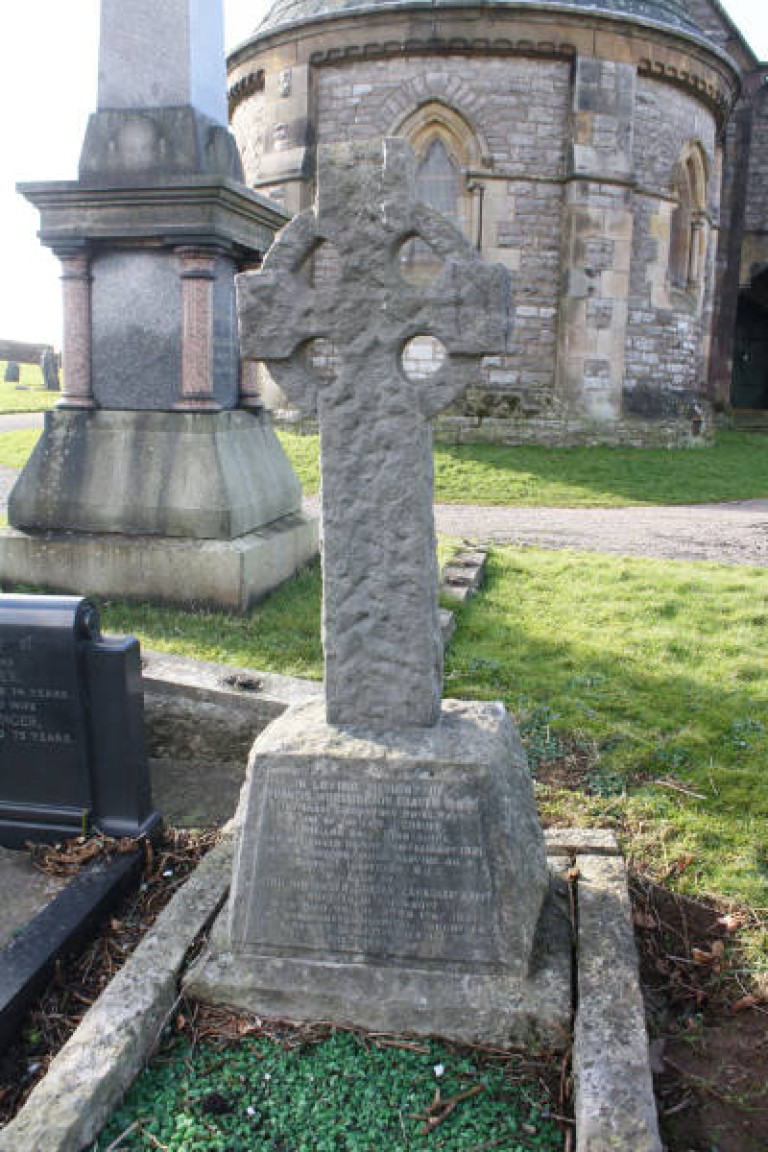
In March 2016 I discovered the gravestone commemorating both his wives, in the Catholic section of the cemetery.
Are they separated because of the manner of his death, or because he wasn’t a Catholic?
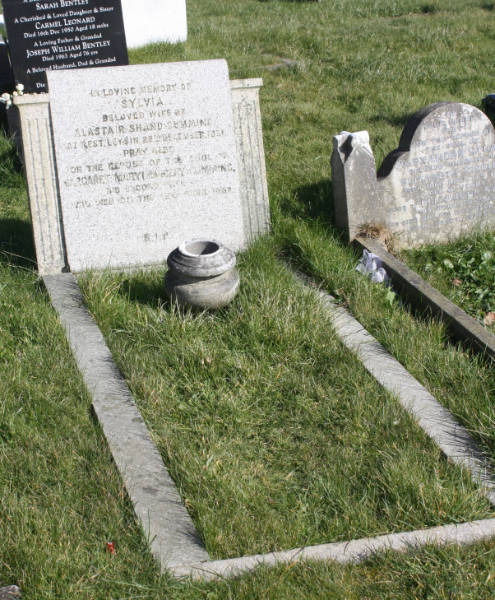
IN LOVING MEMORY OF
SYLVIA
BELOVED WIFE OF
ALASTAIR SHAND CUMMING
AT REST LEYSIN 28TH DECEMBER 1931
PRAY ALSO FOR THE REPOSE OF THE SOUL OF MARGARET MARY (MARGERY) CUMMING HIS SECOND WIFE
WHO DIED ON 19TH APRIL 1952