Died
7th April 1940
Sources
Place
Walks
Barrow 3 point 17
Themes
Sergeant Observer Andrew McNicol
Died in an air accident at Whitley Bay

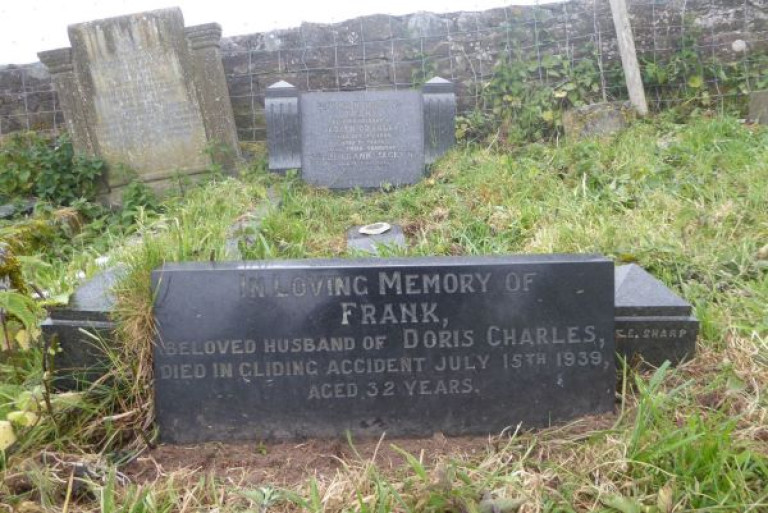
The name is spelt McNicol on the grave, and on the Barrow Grammar School memorial in the Town Hall, but McNichol throughout the news articles.
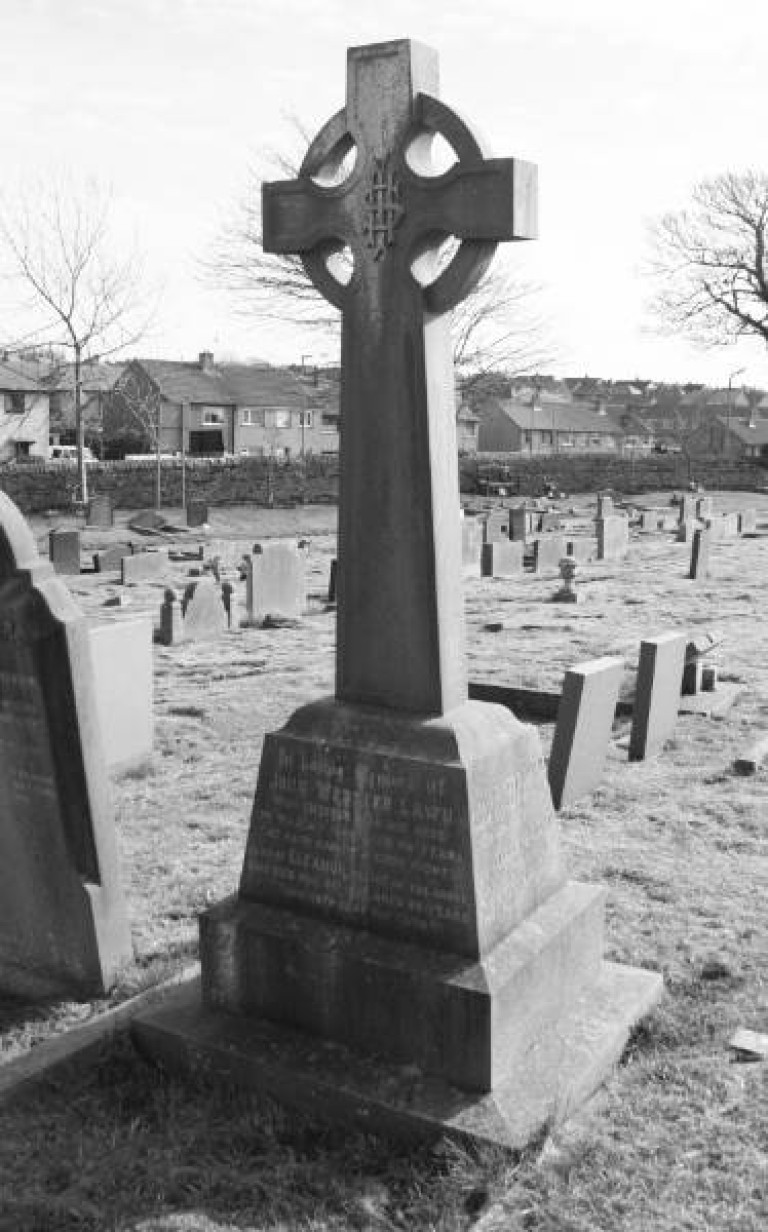
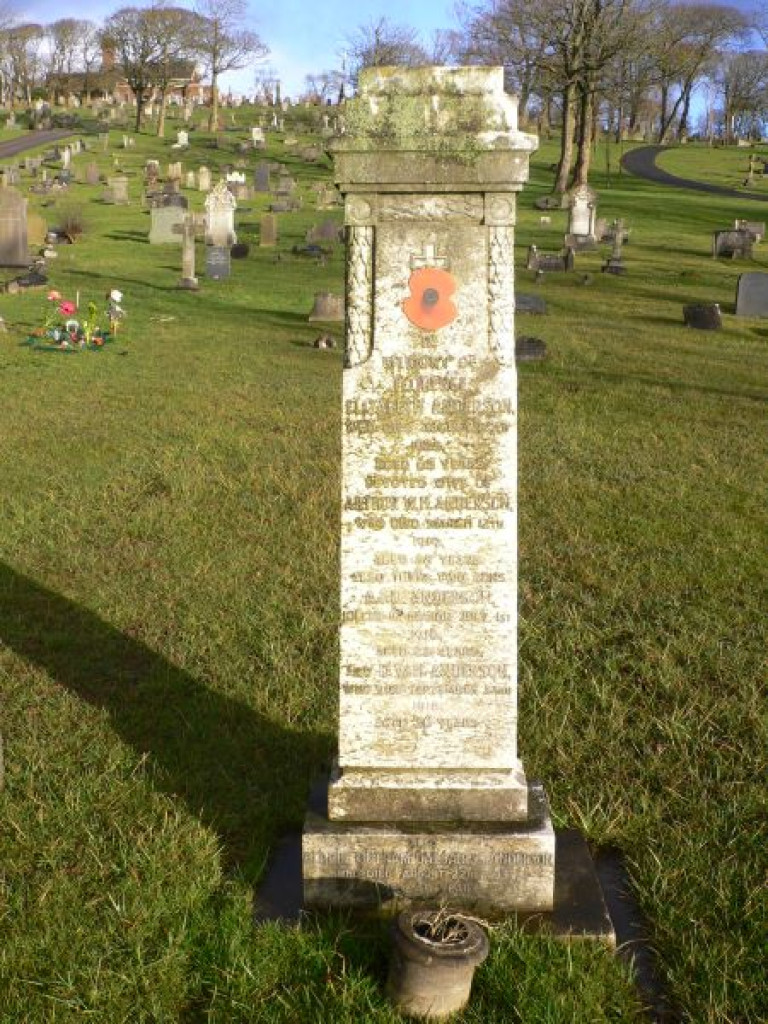
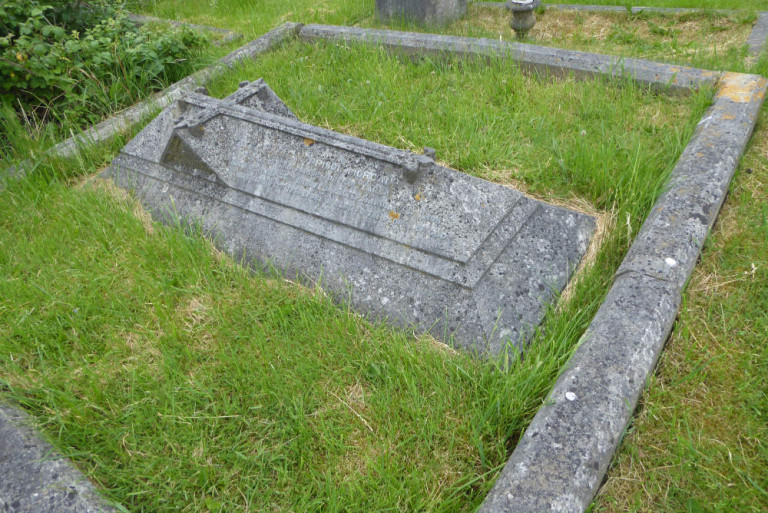
Where is the grave?
In the lowest part of the cemetery, near the ‘green burial area’, and directly below the crematorium.
The Barrow News 13 April 1940 recorded:
The Barrow News, 13 April 1940BARROW R.A.F. MAN KILLED
TRAGIC END OF YOUNG SERGEANT
FORMER PUPIL OF BARROW GRAMMAR SCHOOL
Another Barrow member of the Royal Air Force has met his death in the service of his country.
He is 26-years-old Sergeant Air-Observer Andrew McNichol, eldest son of Mr. and the late Mrs. Hugh McNichol, of 9, Norfolk-street, Barrow.
Sergt. McNichol was killed during an operational flight on Sunday.
A pupil of the Barrow Grammar School, he joined the R.A.F. as an aircraft apprentice, at Halton, in 1929. He was a member of the No. 215 Bomber Squadron when they won the Minet Trophy, for night and day bombing, in 1937.
Sergt. McNichol had a narrow escape when the ‘plane in which he was flying, crashed into a ploughed field at Ronaldsay Airport, Isle of Man.
For some time he was a member of Driffield R.U. team and acted as instructor for many sport, including boxing.
Many Barrovians will remember him as a leading member of St. Paul’s Church Choir, where he took a main part in the “Messiah” at the age of 12. He also played in the Barrow Grammar School production of “H.M.S. Pinafore.”
Sergt. McNichol was the grandson of the late Andy Nichol, a well-known local dancer and charity entertainer.
The funeral took place at Barrow Cemetery on Thursday, the choral service at St. Paul’s Church, and the service at the graveside being conducted by the Rev. A.S. Picton, vicar of St. Luke’s.
The mourners were – Mr. Hugh McNichol, father; Mr. Hugh McNichol, junr. and Master Alwyn McNichol, brothers; Miss Vera McNichol, sister; Mr. and Mrs. Andrew McNichol, Mr. and Mrs. A. Day, Mr. and Mrs. R. Holmes, Mr. and Mrs. Archie McNichol, Mr. and Mrs. J. McNichol, Mr. and Mrs. J. Atkinson, Mrs. D. McNichol, Mr. N. McKay, Mrs. A. Robinson, Mrs. E. Hetherington and Mrs. Jarvis, uncles and aunts; Mr. and Mrs. T. Holmes, Mr. and Mrs. Sutherland, Mr. F. Hetherington, Miss M. McNichol, Messrs. Andrew, Thomas and Ray McNichol, Gladys, Alfred and Betty Day, Richard and Hilda Holmes, cousins; Mr. W. Williams, Mr. and Mrs. Clegg, Mr. G. Guselli, Mr. and Mrs. Kavanah, Mr. T. Lloyd, Mr. W. Shepherd, Mr. Brocklebank, Mr. J. Blackburn and Miss Norah Blackburn (Carnforth).
Flight-Lieut. Pitcairn-Hill (He was to die on 18 September 1940) represented Sergt. McNichol’s commanding officers and Sgt. Air Observer Beattie, his comrades-at-arms.
The bearers were members of the Border Regiment and Trumpeter Fenton sounded the “Last Post.”
There were numerous floral tributes including wreaths from the commissioned officers, from Flight-Lieut. Pitcairn-Hill, from fellow N.C.O.s and from the 83rd Squadron (all ranks).
Funeral arrangements were carried out by A. W. Edney and Son, Dalkeith-street, Barrow.
The 83 Squadron website has the following:
Maureen WheelhouseLAID TO REST 68 years on
Denis William Sharpe lost his life on 7 April 1940 as did the rest of the crew of the Hampden L4054.
The plane was believed to have been lost in the sea but in fact it crashed on land (near to St Mary's Lighthouse in Whitley Bay. In 2007 the plane was located by Russ Gray, a member of the North East section of the Air Crash Investigation and Archaeology Group.
The Pilot, Navigator and Observer baled out over the sea but Denis remained with the aircraft which crashed just over the top of the cliffs with all its bombs on board. The plane had been damaged whilst on a mission over Sylt in Germany and was unable to jettison its bombs.
Denis's final resting place has now been ascertained, and a Memorial Service to all four members of the crew was held on 12 Apr 2008 at St Mary's Lighthouse, with a plaque in dedication to the airmen is to be housed permanently in the Lighthouse.
Denis was based at Scampton. He joined the RAF in 1937 and trained to be a wireless operator. He volunteered as a gunner when war was imminent. He was born in Leicester on 26 Sept 1916 and was killed on 7 April 1940. He was 21.
The three other crew members were:
Pilot - Wilfred Roberts from Australia; Navigator - Keith Brooke-Taylor from New Zealand; Observer - Andrew McNichol from BarrowThis information was provided by Maureen Wheelhouse who was Denis's niece. [Source]
PETER TAYLORTHEY perished in a Lighthouse fireball as their Royal Air Force twin-engined bomber crashed on Tyneside But now more than 60 years later, four crewmen can finally be laid to rest after an incredible piece of timeline detective work by plane enthusiasts.
Luck was out for the four-man crew of the Handley Page Hampden bomber after returning from a raid in Germany in 1940.
Believed to be still carrying her bomb load, the plane circled St Mary's Lighthouse, Whitley Bay, for about one-and-a-half hours, signalling SOS repeatedly before crashing and exploding. Three of the crew baled out but were drowned in the North Sea. The wireless operator, Denis Sharpe, stayed in the plane, probably because he was dead or injured, and was lost in the explosion which rocked the area in the middle of the night.
His last resting place was found in a search led by Russ Gray, a member of the North East section of the Air-Crash Investigation and Archaeology Group. By tracking down elderly witnesses to the incident and researching RAF records, he pinpointed a field about half a mile away from the lighthouse. Other members of the group were called in
from around the country to take part in a field-walking exercise using metal detectors. The result was the discovery of numerous small fragments of perspex and other tiny remnants of the plane which confirmed the site of the crash.Relatives of wireless operator Denis Sharpe, who came from Leicester, including his mother Barbara, who is in her 90s, and niece Maureen Wheelhouse, have visited the field. They will return to the lighthouse for a memorial service next month which will be attended by civic dignitaries and RAF personnel. A plaque remembering all four airmen is to be placed in the lighthouse.
The others were the Australian pilot Will Roberts, the navigator Keith Brooke-Taylor, from New Zealand, and observer Andrew McNichol, from Barrow.
Mr Gray, of Seaton Delaval, said: "It was quite exciting to find these little bits of the plane. There was a few of us there with metal detectors.
"Maureen wants to put some sort of closure on it and she wanted to have a memorial service at the lighthouse.
"It will be held on the nearest day, tides permitting, to the date of the crash which was on April 7.
"The family had been trying to discover for 60 years what happened to him and this is the first time they have found it out." RAF records show the Hampden L4054 of 83 Squadron, left RAF Scampton on the night of April 6, 1940, at 7.15 for a security patrol and offensive operations against the enemy in the district of the Sylt coast in north Germany.
The aircraft was fired on in that area and nothing was heard again from her until she appeared in the vicinity of St Mary's Lighthouse at 2.45am the next day where she circled for about one-and-a-half hours, signalling SOS repeatedly on a lamp. The SOS was challenged by the then lighthouse keeper, Harold Owen Hall, who, after receiving the correct reply, contacted the appropriate authorities.
No other Morse signal was picked up from the aircraft except the SOS.
Standard procedure to aid lost aircraft was followed.
Searchlight beams over a wide area were trained towards Acklington, the nearest RAF base equipped to land the stricken aircraft. The base lit the flare path at 3am and instructions on how to find Acklington were transmitted to the bomber by Morse lamp, the signal reading "St. Mary's Lighthouse, follow the beam for Acklington".
Each separate word was acknowledged by a dash on the aircraft signalling lamp, but the pilot made no attempt to follow them. The plane continued to circle until one engine appeared to fail and shortly after 4am three crew left the aircraft by parachute before she crashed and exploded.
The RAF concluded that the fact that the pilot disregarded the instructions to fly to Acklington suggested the aircraft was damaged in such a way as to render a landing hazardous. The plane did not jettison the bomb load over the sea, indicating that the bomb doors or bomb release gear was damaged.
RAF chiefs surmised that the hydraulic system of L4054 was so badly damaged that the aircraft could not lower the undercarriage or open the bomb doors and it would have been too dangerous to attempt a belly landing at Acklington carrying a cargo of bombs. It was wiser to remain in a known area but the pilot, navigator and observer, baled out over the sea too far out to be rescued. Their flying boots, which they must have kicked off as they jumped, were found later. Their bodies were recovered from the sea.
[Source]