Thomas Harris
Gasometer explosion at Askam
25 March 2007
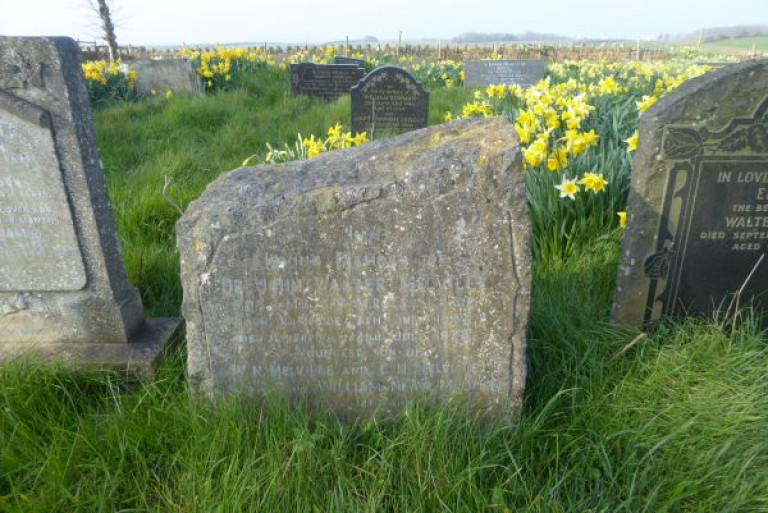
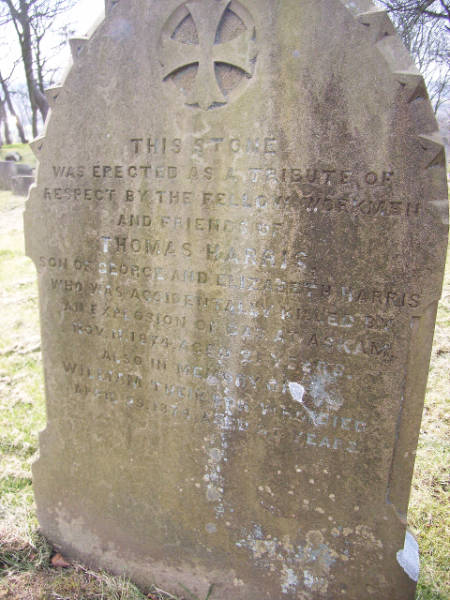
THIS STONE
WAS ERECTED AS A TRIBUTE OF RESPECT BY THE FELLOW WORKMEN AND FRIENDS OF
THOMAS HARRIS
SON OF GEORGE AND ELIZABETH HARRIS WHO WAS ACCIDENTALLY KILLED BY AN EXPLOSION OF GAS AT ASKAM NOVEMBER 11TH 1874 AGED 22 YEARS ALSO IN MEMORY OF
WILLIAM THEIR SON WHO DIED APRIL 29TH 1874 AGED 27 YEARS
Where is the grave?
Walking up the main path until the last section before the crematorium, it is half-way along that section, facing the main path, about 4 rows back.
The Barrow Herald Saturday November 14th 1874 reported:
Barrow Herald, Saturday November 14th 1874GASOMETER EXPLOSION AT ASKAM
TWO MEN KILLED AND ONE INJURED
The usually quiet little town of Askam, commonly known as Ireleth, was thrown into a state of consternation and alarm on Wednesday last, by a rumour, which unfortunately turned out to be too true, that the new gasometer lately erected at the junction of the main line of the Furness railway and the branch line leading to the works of the Iron and Steel Company at Askam, had burst with fatal effects. It appears that about eight months ago the construction of the new gasometer was commenced, it being intended to supply the Askam Iron Works with gas from the Corporation Works in Barrow. The work was completed some time ago, and since then the gasometer has been tested with air, we believe, on several occasions, and with such an amount of success that it was considered requisite that it should be tested with gas. Accordingly, on Wednesday last, the process of filling it with gas was commenced, under the superintendence of Mr. Scott, from the Gas and Water Works, who was assisted by T. Harris, one of the workmen from the same place; John Pennington, of 10, Sharp-street, Askam, a gasfitter in the Askam Ironworks, and Henry Walker, aged 18, residing at Sharp-street, Askam. These men were all engaged upon the top of the gasometer, and Scott had returned, after telegraphing to Mr. Lewis at Barrow for a greater pressure of gas, and Pennington had been instructed to do nothing until the gasometer had been filled as indicated. A light was applied to the tap at the top of the gasometer by Pennington, when a terrific explosion was heard, shattering the top of the gasometer, sending the heavy balance weights to the ground, and blowing the men engaged upon the work into the air. The three men were afterwards picked up, when it was found that Harris was dead, and ... but Scott still lies in a precarious state.
The Barrow Times, Friday November 13thPennington leaves a wife with three children, one being an infant. Pennington was quite a young man, and had been employed in the Ironworks a considerable time, having the whole of the arrangements regarding the gas apparatus under his care. He was a favourite among the workmen, being of a very cheerful disposition, and he will be much missed.
The Barrow Herald November 14th 1874 wrote that:
Barrow Herald, November 14th 1874The inquest was opened yesterday in the Askam Hotel, before Mr. John Poole, coroner, and a jury, when the evidence reported below was given.
Mr. C. F. Preston, town clerk, was present on behalf of the Corporation of Barrow, as was also Mr. John Lewis, manager of the Gas and Water Works.
Mr. Preston intimated to the Coroner that the Corporation of Barrow were quite willing to render all the assistance in their power to clear up the cause of the accident.
The first witness examined was George Harris, who said he was a painter, and resided at Ince. The deceased, Thomas Harris, was his brother, was 22 years of age, and a labourer by trade.
Harriet Pennington deposed that the deceased, John Pennington, was her husband, and was 29 years of age. He was brought home on Wednesday last suffering from injuries received by the explosion of the gasometer at Ireleth. He lingered until about 4 o’clock on Thursday morning, when he died. He was a gasfitter by trade.
Henry Walker deposed that he resided in Sharp-street, Askam, and was employed by the Furness Iron and Steel Company. He knew the deceased man, John Pennington, but did not know Harris. First saw Harris Wednesday last, the day of the accident. Witness and Pennington had been working at Mr. Crossley’s (Greenscoe House) all the morning, and in the afternoon about three o’clock they come (sic) down to the gasometer for the purpose of seeing Mr. Scott, who was working at the gasometer. When witness and Pennington arrived at the gasometer they went on to the top of it, and shortly after they had done so Mr. Scott arrived. At that time there were Harris, Pennington and the witness on top of the gasometer. They took a piece of piping in order to place it into the tap at the top of the gasometer, through which they had been pumping air before. The pipe did not exactly fit the tap, and Harris was sent down to get some clay to pack it with. Somebody on the gasometer struck a match, as witness heard it strike, but he could not see who had struck it. The match was applied to the pipe by John Pennington to see if it would light, but it would not, as there was too much air in the gasometer. Mr. Scott saw Pennington apply the light.
Mr. Scott went to the Ireleth station to telegraph to Barrow for some more gas to be put on. While he was away one of the men lit the gas coming out of the pipe, having fixed it round with clay in the meantime. At this time witness was at the bottom of the tank below the gasometer, and Pennington and Harris were on top of the gasometer by themselves. The light at the pipe was only burning very little at the time. When Mr. Scott came back he saw the light burning. Pennington went witness down to the gas house to examine the meter, and see if there was any more gas coming on, but there was no more coming and after doing so was coming down the ladder from the top of the gasometer when he heard Mr. Scott say they would all be blown up. Witness did not know why Mr. Scott said so, as the light was just then burning very little. Just as witness got down the ladder the gasometer blew up. Previous to the explosion it made a little bit of a noise, and then went off. It made no noise before Mr. Scott said they would all be blown up. As soon as all was over he looked round, and saw Scott lying at the hedge side next the road. Went to him, and asked him if he was much hurt, but he made no reply. Witness then went round to see if he could see Pennington and Harris. He found them on the Furness Railway line. Harris was not then dead, as he was breathing. Pennington’s eye was cut at the time he saw him, but Harris appeared to be the worst. He spoke to Mr. Pennington, but he obtained no answer. He was sent away for a cab, but they were removed before he got back. He had never seen the gasometer bust before in this way. Pennington had not been accustomed to work at this kind of work.
By Mr. Preston: Mr. Pennington worked at the Askam works.
John Sinclair said he resided at Askam, and was a porter. He heard the explosion last Wednesday between three and four o’clock. He went in the direction of the gasometer, and found it had exploded. Saw the bodies of the deceased men, Harrington (sic) and Pennington lying on the railway. The bodies were not burnt, but only severely cut and injured apparently from falling on the line. The deceased had been blown about twenty yards. Harris was dead when he got to the spot, and Pennington was removed to his home in an insensible state.
The Coroner said under the circumstances it was necessary they should have Mr. Scott to give evidence, as it was evident that the witness Walker knew nothing about the case further than what he had stated; and it appeared to him (the coroner) that Mr. Scott was the only person who could give them such information as would lead them to come to a proper conclusion as to how this accident arose. Besides, it was desirable on Mr. Scott’s own part that he should be allowed an opportunity to make any explanations that he might think fit to make.
The Coroner adjourned the inquest for 3 weeks, until December 4th, and then until December 18th, to allow Mr Scott to recover. On the 18th Mr Scott and Mr Lewis got the time wrong, so it was again adjourned until December 22nd. The following day it was reported:
December 23rd 1874.... The only witness was Mr. Wm. Scott, outdoor foreman at the Barrow Gas Works, who was seriously injured in the explosion. ... came to Askam for the purpose of getting the gasholder which had been put in to supply the Askam Iron Works into proper working order. Thomas Harris had been previously sent by the 10.45 a.m. train to turn on the gas, to open the valve to fill the gasholder. Witness left Barrow by the 12.45 train, and arrived at the site of the Askam gasholder about 1.25 p.m. On his arrival he found that the gasholder had risen about 15 inches, showing about fifteen inches of gas within. Witness opened the test cock that was placed on the top, so that the air could be blown off. As nearly as could be told, this remained open until 2.30 p.m.
The Coroner inquired if Pennington had anything to do with the gasholder. – Witness replied that he only wanted Pennington that the key could be got to unlock the door of the meter house. Pennington was not employed by the Barrow Corporation. Of course, his being employed by the Askam Iron Works Company, and there being a scarcity of gas, he seemed anxious to have the gas supplied, and he supposed this must have been the case from the deceased staying at the gasholder. ...
The Coroner inquired whether Scott knew if Pennington had any special knowledge of gas arrangements. – Witness could not tell; Pennington was nearly a stranger to him. He had merely seen Pennington two or three times with reference to the insufficient supply of gas and other matters in relation to the same.
The coroner again put the question so that there should be no doubt. – Witness repeated that he was unaware that Pennington had any special knowledge of gas.
The Coroner asked if before Scott left a match was struck. – Witness responded in the affirmative and said that he himself struck the match. He had a test pipe in, in which there was a slight crack at the bottom and he sent Harris for clay to stop it up. Witness lighted the match to test, but of course there was insufficient gas to light. Witness gave instructions to Harris to try the siphon and see if there was any water in it also to leave the outlet cock and not apply any more lights as witness saw the holder was going down. Witness left Harris close to the siphon. He could not see where Pennington was: he did not take particular notice. Pennington and witness had both gone down the slope together , and he could not tell where he went to after. Instructions were given to Harris to let the blow off remain as it was, and not to apply any light. Witness could not say if Pennington heard this. However, Pennington had nothing to do with the matter, and witness did not give him any instructions whatever. The match was struck, and applied to the pipe by witness himself, before he went away to telegraph to Mr Lewis at Barrow for a greater pressure of gas. Pennington did not strike any match in witness’s presence and no match was applied while witness was there but his own. Witness was away about half an hour before he returned. He then went on to the holder and on putting his hand over the test-pipe, which stood nearly four feet high, to his surprise found heat. Witness immediately turned to Harris and said ‘You have not lighted the gas, Harris, have you?’ Harris made no reply, but Pennington said, ‘Yes.’...
The Coroner, in the course of his remarks ... very carefully reviewed the whole of the evidence, representing the circumstances in the clearest light to the jury. .. Scott left the cock shut off to one fourth the size, and instructed Harris not to apply any light in his absence.. It was neither part of Harris’s or Pennington’s duty to strike or apply a match in the way it had been done. These instructions were not observed, for shortly after Pennington struck the match and applied it, lighting the pipe, and sent the lad to the meter house and back, the light burning all the time ....... and doubtless this was the real cause of the accident. Thus, while Scott was away, the gas was improperly lighted and allowed to burn by Pennington, who admitted that he had lit it, whilst Harris made no reply. Being no part of Pennington’s duty to interfere, he would be merely trying to assist, and to light the gas in Scott’s absence would therefore merely amount to an error of judgement, as Pennington had no special knowledge of gas arrangements, nor would he expect any danger. He probably did not exercise that care and caution that would have been exercised if Scott had been there. The holder sinking from the escape of gas and walking on the plates all pointed to the circumstances from which the explosion occurred. No one appeared to be to blame excepting Pennington, and doubtless Harris to some extent, for not seeing that Scott’s orders were not carried out. Harris might not have noticed, or perhaps would not care to find fault, and neither of the men apprehended any danger, or they would not have stopped on the top in the way they did. It was a great pity parties should interfere in this way with things they did not understand, but one could not at all times prevent them doing so. He thought the jury would now have sufficient knowledge as to how the accident arose. It did, however, appear to him that the method of testing gas used in this instance seemed dangerous. He did not know whether it was the usual method, and it might not be dangerous, but it appeared to him that some more care in testing might be used than by fixing a pipe and applying a light. Mr. Scott had told them it was not dangerous, but to his (the coroner’s) mind it did not seem to be so safe a means of testing as might be employed. Probably this accident would make parties, at any rate in that district, and for some time to come, more careful in the way of testing gas in the future.
– The jury returned a verdict “that Thomas Harris and John Pennington were killed by the accidental explosion of the gasholder at Askam, on the 11th day of November, 1874.”
There are a number of interesting features about Thomas Harris’ death:
- The fact that an expensive headstone was erected by his workmates.
- That lighting the gas was regarded as a safe test by Mr Scott
- That the Coroner singles out the dead for blame: no mention of the Company’s responsibility, or Mr Scott’s supervision. There is no doubt that unsafe working practices would be condemned today.