Died
19th January 1912
Place
Mr. A-dong Zhang (3541)
A Chinese Sailor’s Grave in Barrow Cemetery
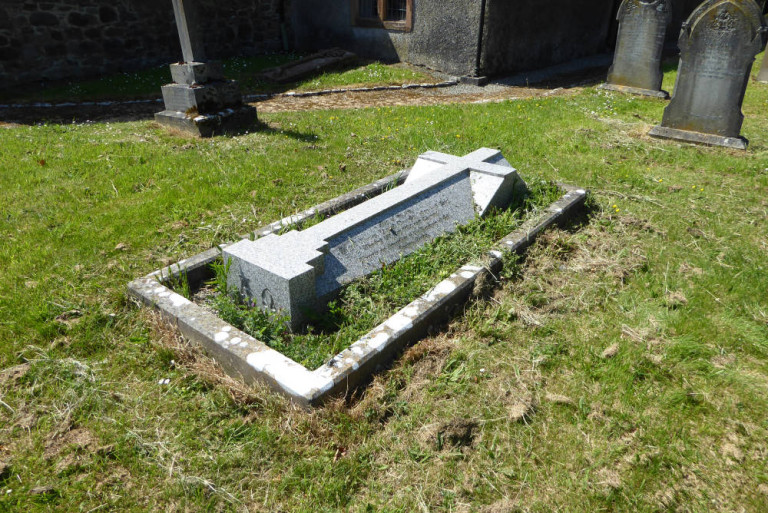
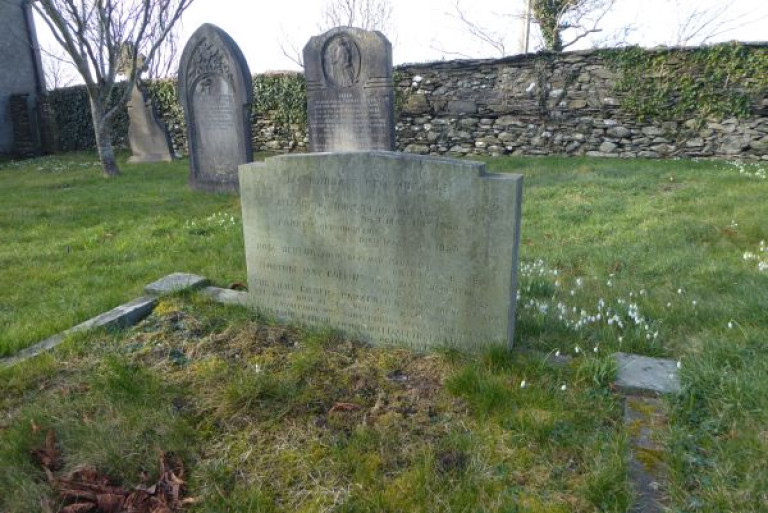
The grave stands low down in the cemetery below the crematorium. The only lettering I understood was 1912. Why was this foreign national buried in Barrow?
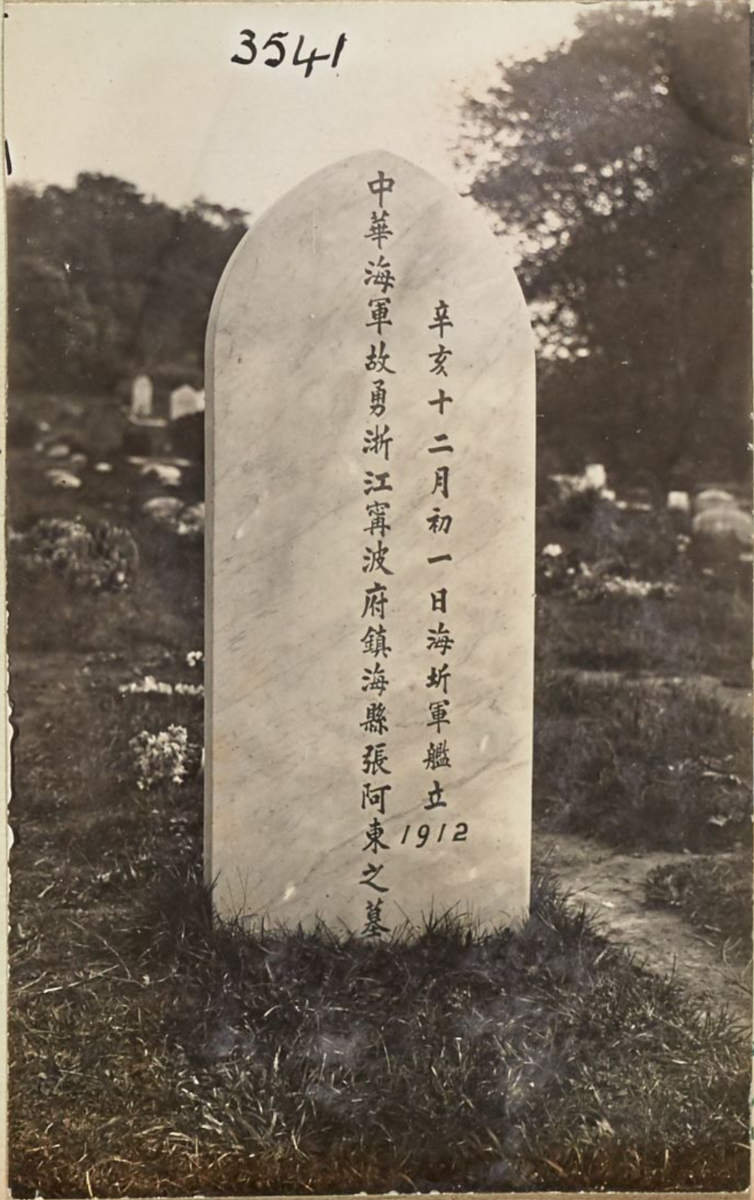
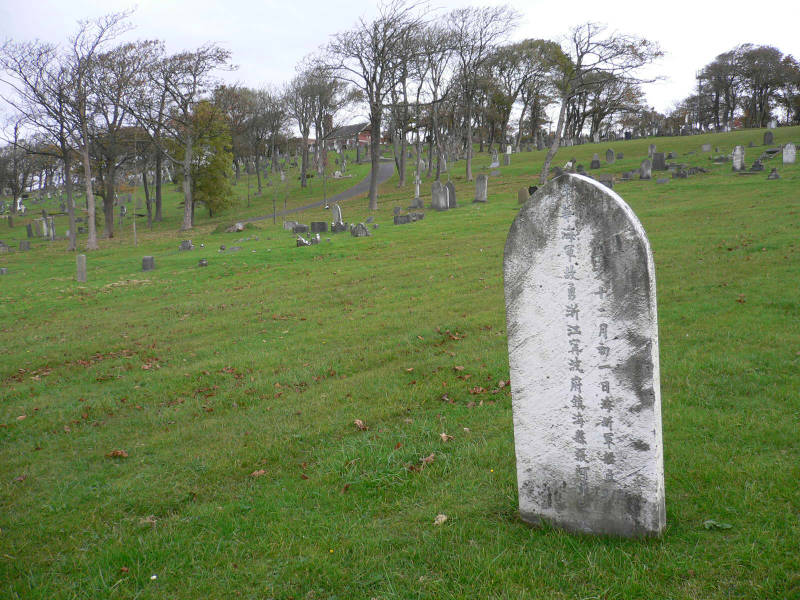
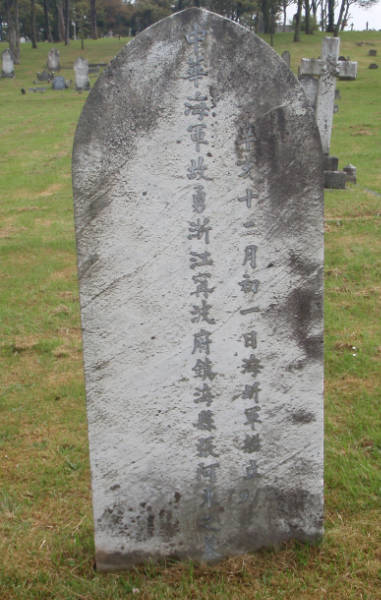
Initially I was not certain whether it had Chinese or Japanese script. Ships for both Chinese (The Ying Swei launched December 1911 [Source 1 2]) and Japanese (The Kongō launched May 1912 [Source]) navies were being built by Messrs Vickers Ltd. in Barrow Shipyard in 1911/12. The embassies of each country responded to my request for assistance, confirming that it was the grave of a Chinese sailor. However, Mr Zhao Lei, First Secretary and Consul at the Chinese Embassy (2012), helpfully said that the grave was of a sailor on the Chinese ship Hai Chi [Source]. The Hai Chi had arrived in Portsmouth on 24 April 1911 to celebrate the Coronation of the new king (King George V); went to the US in July, returning to the UK in September. Its crew were assisting in the training of the crew of the Ying Swei.
Mr Zhao said that it was the grave of Mr. A-dong Zhang (张阿东), born in Zhen-hai County (镇海县), Zhejiang Province(浙江省) China. This is a coastal town near the city of Ningbo. The name in the following account is anglicised in a different way: conventions have changed in the last hundred years.
The Barrow News of 27 Jan 1912 reported:
The Barrow News, 27 January 1912CHINESE FUNERAL – On Saturday (Jan 20th), the body of a Chinese stoker, named Chang Ho Tong, of the cruiser Hai Chi, was interred at the Barrow Cemetery with full burial rites of the Church of England. The deceased, who was 57 years of age, expired on the 19th inst., and the same day the body was removed to the mortuary, from where the funeral cortege left shortly after 2.30. On the top of the coffin, which was enveloped in the Chinese ensign, were a couple of wreaths, and the open hearse in which it was placed was immediately followed by a cordan (sic) of about 20 members of the crew, and the rear was brought up by two mourning coaches containing the following officers from the Hai Chi:- Engineering Lieut. Commander Chang, Lieut Wong, Lieut. Engineers Liu and Lin, Flag Lieut. Tchin and Sub-Lieut Hau. An interested concourse of people assembled in the vicinity of the mortuary, and likewise at the graveside, where the committal ceremony was witnessed by a number of spectators. The burial service was taken by the Rev J.W. Adams, of St James’s Church, and Messrs Henry Swarbrick and Sons carried out the funeral arrangements. [Italics inserted]
It is not known whether Mr A-dong was an Anglican, but Christian missionaries were very active in China until the 1920s. In spite of the Anglican references above, he was buried in the non-Conformist section of the cemetery.
The Barrow Herald, 2 December 1911NEW CHINESE CRUISER – The Chinese cruiser, under construction at the Naval Construction Works, Barrow, leaves today for the Clyde, where she will undergo her steaming and gun trials. Part of her crew was brought from China on board the cruiser Hai Chi, which is at present birthed in Ramsden Dock, Barrow, and will remain there until the new vessel is ready to proceed to her Eastern home.
On 9 December the Herald reported that ‘In every respect the results were completely satisfactory.’
The delivery of the Ying Swei was delayed because of the 1911 Revolution, also known as the Xinhai Revolution or Hsinhai Revolution, ended China's last imperial dynasty, the Qing dynasty, and led to the establishment of the Republic of China. Having been ordered by the Imperial government, it was delivered to the Republican government.
The Barrow News 24 February 1912 reported:
MESSRS. FAIRBAIRN & CO., Rawlinson-street, have been instructed to make and erect in Barrow Cemetery a memorial to the member of the crew of a Chinese cruiser Hai Chi, who died a short time ago. The memorial is of fine Sicilian white marble, and can now be seen in their showroom. The engraving is in Chinese characters.
No-one is certain why Edward Sankey took photographs of graves in the period 1910-1920 or later. Were they advertising the skills of his friend William Hull, or later Hull and Fairbairn? Were they to be made into postcards that the bereaved family could send to members who were not able to attend the funeral?
The historic photograph is from the Sankey Family Photographic Collection, courtesy of Cumbria Archives.