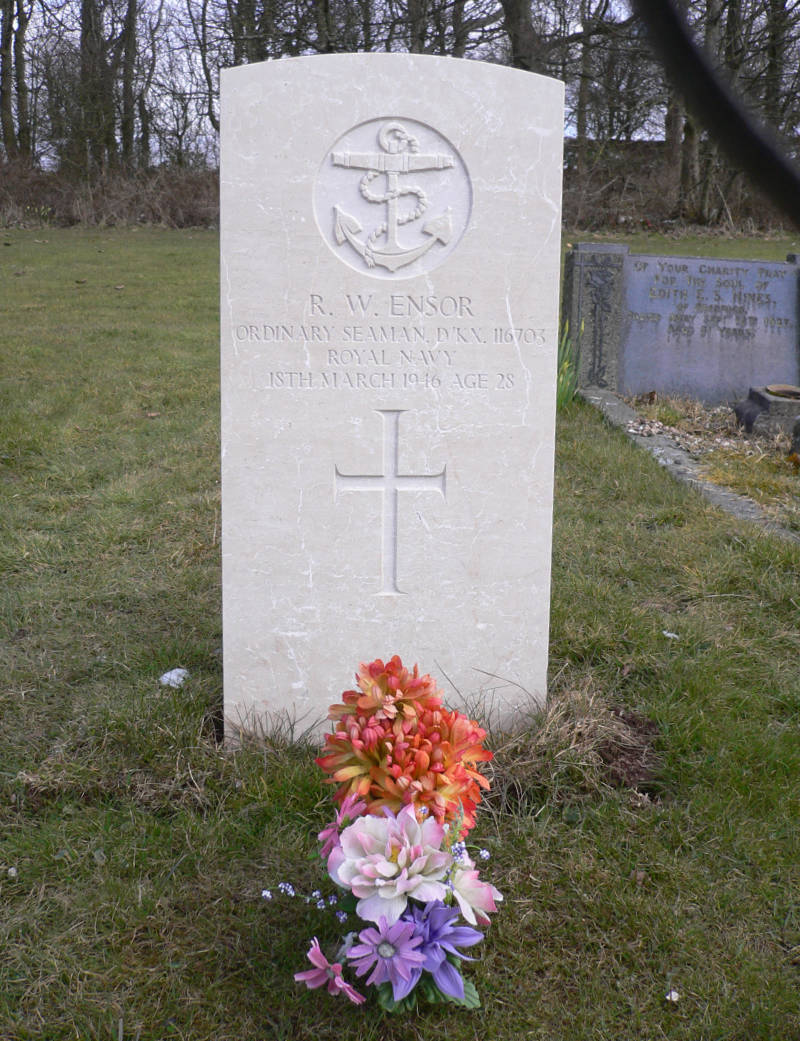
Ordinary Seaman R. W. Ensor
Looking at articles from the war-time newspapers, it is likely that O/S Ensor was a prisoner of the Japanese.

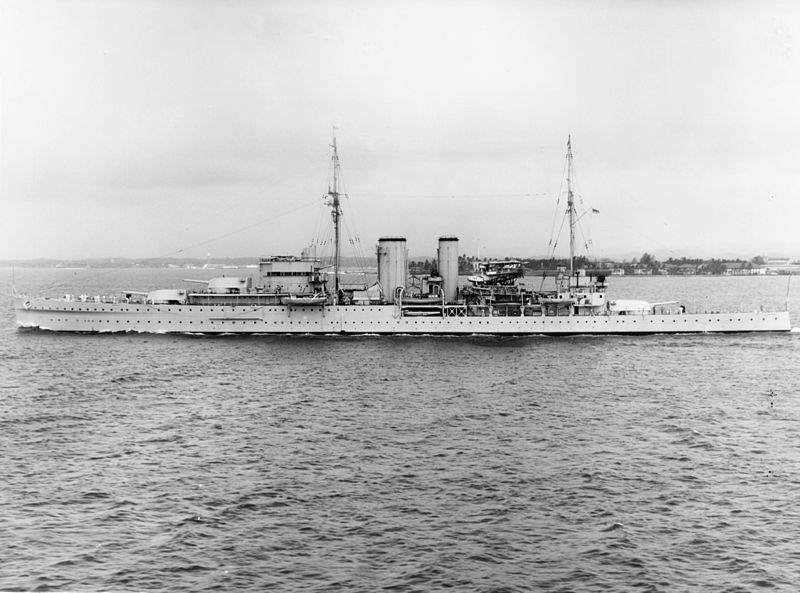
Exeter underway off the coast of Coco Solo, Panama, 1939
By U.S. Navy - Official U.S. Navy photo NH 60814 from the U.S. Navy Naval History and Heritage Command, Public Domain. [Source]
The Barrow News 28 March 1942 reported:
The Barrow News, 28 March 1942BARROW STOKER ON H.M.S. EXETER
Mr. and Mrs. R.W. Ensor, of 22, Blake-street, Barrow, have received notification from the Admiralty that their only surviving son, Stoker Robert William Ensor, who was serving on H.M.S. Exeter, has been reported missing, following the loss of his ship in the Java sea battle.
Stoker Ensor, who is 24 years of age, was employed at the Barrow Steel Works before joining the Navy over two years ago. He was an excellent swimmer, and was formerly a member of St. Mary’s swimming team. He was last home about 18 months ago, but his parents received a letter from him only a fortnight before he was reported missing.
He obviously survived the sinking, and it is quite likely that there is a mention of him being returned to Britain at the end of the war, but I haven’t found it (yet). Nor is there any mention, apart from a death notice in the announcements column, of his death and funeral. Of course, his early death may have nothing to do with any war- time experiences, but you do wonder .....
HMS Exeter was one of three British cruisers that fought the German pocket battleship Admiral Graf Spee later that year in the Battle of the River Plate. She was extensively damaged during the battle and was under repair for over a year.
After her repairs were completed, the ship spent most of 1941 on convoy escort duties before she was transferred to the Far East after the start of the Pacific War in December. Exeter was generally tasked with escorting convoys to and from Singapore during the Malayan Campaign and continued on those duties in early February 1942 as the Japanese prepared to invade the Dutch East Indies. Later that month, she was assigned to the Striking Force of the joint American-British-Dutch-Australian Command and took on a more active role in the defence of the Dutch islands. The culmination of this was her participation in the Battle of the Java Sea later in the month as the Allies attempted to intercept Japanese invasion convoys. Exeter was crippled early in the battle and did not play much of a role as she was forced to withdraw. Two days later, she attempted to escape inbound Japanese forces, but was intercepted and sunk by Japanese ships on 1st March in the Second Battle of the Java Sea.
Most of her crew survived the sinking and were rescued by the Japanese. About a quarter of them died during captivity. Her wreck was discovered in early 2007 and declared a war grave, but by 2016 the remains had been destroyed by illegal salvagers.
[Source]