Died
25th January 1911
Born
He was born on 13th September 1879 in Salisbury, Wiltshire
Sources
Place
Walks
Barrow 4 point 16
Themes
Sholto Hamilton Gordon
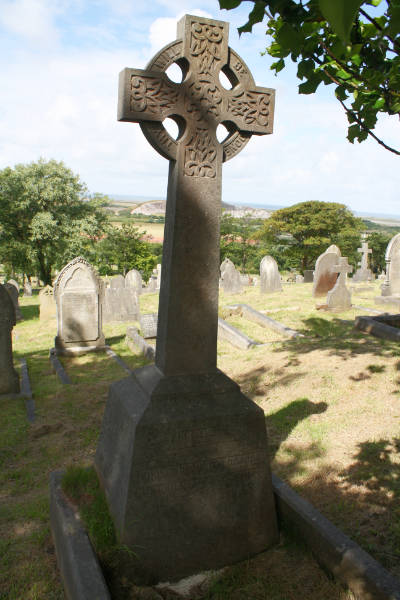
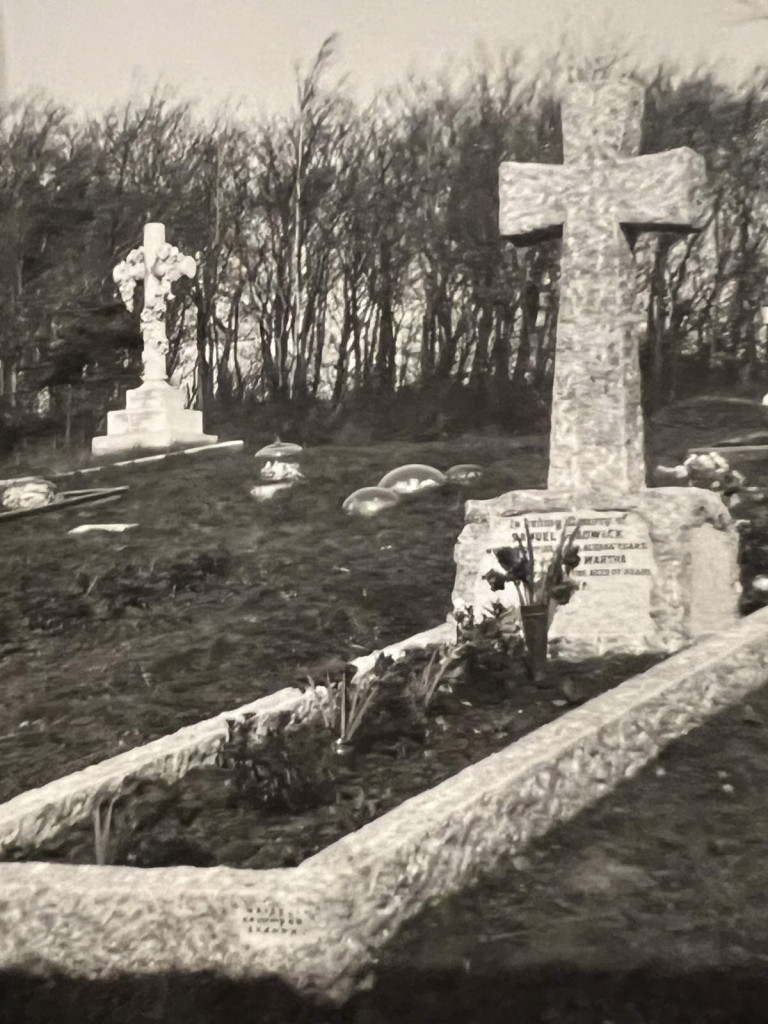
On the left-hand side it reads, Newton Quarry Co., Dalton in Furness.
Where is the grave?
From the Crematorium, looking towards the cemetery entrance, walk down the right-hand path for a few yards. The grave is on the right, under some bushes, and next to the Taylor grave (father & son who died in WW1).The Barrow News, Saturday 28th January 1911Terrible Accident at Barrow
SHIPYARD OFFICIAL KILLED WORKMEN INJURED
On Wednesday afternoon a terrible accident occurred at the Barrow Shipyard, resulting in the death of Mr. S. H. Gordon, a valued official, and more or less serious injuries to several of the workmen. The deceased gentleman occupied a responsible position in the engineering department of the Shipyard, and it appears that during the course of the trial of a submarine engine in the shop an airpipe burst and a fragment of the pipe struck Mr. Gordon on the left breast and penetrated the body, causing death in a few minutes. A few of the workmen engaged in the vicinity were also injured, and were removed to the North Lonsdale Hospital. The deceased was a young man of great promise, and much sympathy will be extended to his bereaved mother, with whom he resided at No. 1, Croslands Park. Mr. Gordon enjoyed the confidence and respect of the directors of the firm, and was also held in the highest esteem by his colleagues in the works, amongst whom his death will be greatly deplored. The deceased gentleman was especially attached to the research department in connection with oil-engines, and his knowledge and experience were of great value to the firm, with which he has been connected for several years.
The police report issued at 5.30 stated: A fatal accident occurred at about 2.40 to Sholto H. Gordon, aged 30, assistant manager in the marine department. He was standing alongside the foreman, Mr. G. Aston, who had a minute and a half previously started a heavy oil-engine running in the oil-engine house in the field marine department, when a steel air reservoir part exploded, and a portion of it struck him on the breast. He was picked up by Mr. G. Aston as he was trying to recover himself on the floor. It was found that he was bleeding, and he was removed to the gatehouse infirmary. Dr. Carmichael was sent for, but Mr. Gordon died before the doctor arrived. Three or four other men were slightly injured, but they were able to proceed home.
We understand that the late Mr. Gordon resided at 59, Harrison-street up to four months ago, when his mother came to Barrow.
Mr. Sholto Hamilton-Gordon was in his 32nd year. He was well-known in social circles in Barrow, and had made himself very popular, although he had resided here only a short time, and his untimely death is a subject of deep regret. He was a clever engineer, and those able to judge predicted that he had a great future before him. Mr. Hamilton-Gordon was allied to the family of the Earl of Aberdeen. His grand-father was the Rev. Douglas Hamilton- Gordon, the third son of the fourth Earl of Aberdeen, Canon of Salisbury, and Honorary Chaplain to the late Queen Victoria.
THREE WORKMEN INJURED
As a result of the explosion three workmen, who were engaged in the vicinity, sustained injury, which, happily, was of a very slight character, and others had a very narrow escape. Lionel Mead, apprentice fitter, of 3, Empress-drive, Vickerstown, had his back wounded; Jno. Hawkins, labourer, who resides at 41, Goldsmith-street, had the misfortune to get a piece of metal or some of the fragments in his eye; and Timothy Leather, labourer, also sustained injuries to his back, but was able to walk home. Two of the men were taken to the Hospital, but their injuries were not of such a serious character as to necessitate their detention, and they were subsequently able to proceed to their homes.
The Barrow News, Saturday 28th January 1911INQUEST AND VERDICT
THE FIRM’S REGRET AND SYMPATHY OIL LEAKAGE CAUSES DISASTER
The deplorable accident which occurred at the Barrow Shipyard on Wednesday, causing the death of Mr. Sholto Hamilton Gordon, and injuring three others, was the subject of an inquiry by Mr. Coroner F. W. Poole and a jury at the North Lonsdale Hospital yesterday. Mr. H. F. Seymour, H.M. Inspector of Factories, was present, and Mr. R. B. D. Bradshaw, solicitor, represented the firm. Mr. J. R. Little was the foreman of the jury. After the jury had viewed the body and their places. (sic)
The Coroner said that this was an accident which had taken place in the yard of Messrs. Vickers in connection with certain oil engines in a shed attached to the Field Carriage Department, and he proposed to call before them Mr. Clear, who would explain a plan and photographs that had been prepared for that inquiry, and that would enable the jury to have some idea of the later evidence to follow, and which would be given by witnesses who were present at the accident. Then he would call Mr. Weeks to give his version of the cause of the accident.
Mr. R. B. D. Bradshaw said that perhaps it would be desirable for him to say that he appeared on behalf of Messrs. Vickers, Sons, and Maxim, and the directors requested him to say that they regretted very much the death of that young man, who was a young man of considerable promise, and who had a future before him. They also deeply sympathised with the relatives of the deceased in the calamity that had befallen them.
Mr. Wm. Bradley, head timekeeper, said he knew the deceased. He was assistant manager in the Marine Department. He was 31 years of age.
Mr. Julian Clear, engineer, employed by Messrs. Vickers, Sons, and Maxim, Ltd. said the deceased at the time of the accident was in a shed attached to the Field Carriage Department, conducting certain experiments in connection with the oil engine. The photograph (produced) was one of part of the place. Deceased, he said, was standing about two feet from the pipe, and would receive the full force of the explosion. The air in the pipe was used for part of the engine, and for assisting in the working of the engine. The object of the pipe was to store up a quantity of compressed air. The force of the explosion blew off the water jacket near the pipe.
In reply to a juror, Mr. Clear said the pipe was examined on the 16th of December last to a pressure of 1,800lbs to the square inch.
Fragments of the pipe which exploded were shown to the jury.
Mr. Clear said that he was not in the shed at the time of the accident.
By Mr. Bradshaw: The deceased took great interest in the work. The pipes were all subjected to a severe test to ensure that they were safe enough.
The Coroner said he had the piece of metal brought to the inquest to show how serious the explosion had been. It was not part of the actual pipe, but the casing.
The Foreman: This was smashed in consequence of the inner tube bursting.
A Juror: Don’t you think it would be better if the jury visited the scene of the accident, instead of having these plans and photographs?
The Coroner: I do not know, gentlemen. I think after you have heard the evidence and the explanation of Mr. Weeks, you will be satisfied that it will not be necessary for you to visit the scene of the accident.
Mr. Clear, in answer to the coroner, said the tank shown on the plan was a separator.
The Coroner remarked that he understood it was a foreign body that got into the pipe that caused the explosion.
In answer to a juror, the witness said the tank referred to was for the purpose of separating oil.
The Foreman: How often is this tested?
Mr. Clear: I won’t be certain as to the date, but this particular piece was a new pipe sometime in October. All such pieces were stamped and a record kept of the tests. In most cases the date was stamped on part of the article tested. This particular piece was tested during its life of four months. As far as human skill, foresight, and up- to-date methods were concerned, the experimental tests were exercised.
In answer to the Inspector, witness said the pipe was a solid drawn one.
The Inspector: It being a solid drawn pipe that was a fair indication of its quality? – Yes.
So far as the bending of the pipe was concerned, are you satisfied that the bending done to the pipe was done to ensure that no damage resulted?
Witness: I am quite satisfied of that. We have had experience of that before with pipes. We test internally by examination.
George Aston, foreman fitter, living at 7, Bowness-road, stated that he was in charge of the heavy oil engines, which were erected in the Field Carriage Department. These had been running at a big speed for hours, and had duly passed the official tests. At the time of the accident - 2.45 p.m. on Wednesday – they were being run to carry out an experiment. They had been running in the forenoon at a pressure of between 1,100 and 1,200lbs. in this reservoir, which afterwards exploded, and the pressure in the reservoir in the afternoon was 950lbs. The deceased was not taking any part in the actual testings at the time, but had come over to ascertain the result of the experiment. He had been over for about ten minutes, and the engine was started and the explosion took place a minute and a half afterwards. When it occurred deceased was standing close beside him (witness) – almost shoulder to shoulder. He was nearer the pipe, and when it burst they both scrambled off the platform, about two feet away. He went to the deceased when he fell on the floor, but he didn’t speak, and he was trying to recover himself. He was bleeding, apparently from the abdomen, but later on they found that the blood was proceeding from a wound on the chest. The ambulance men were sent for, and he was taken to the gatehouse infirmary. He (witness) did not go with him, but he thought he died before he left the shop.
The particular reservoir had been previously tested on the 17th of October, 1910, with a pressure of about 2,000lbs., and the bend in the pipe at that time was absolutely new, and had also been tested. A further test of between 1,800 and 2,000lbs. was put on December 2nd.
In answer to the Foreman of the Jury, witness said the pipe had been in use probably at intervals for about four or five weeks. The last time this particular pipe, which caused the deceased’s death, was tested was December 2nd last, and it had been running at intervals ever since until the day of the explosion.
The Foreman: Don’t you think it is necessary to test the pipe every week or perhaps once a month?
Witness: No sir. A pipe of that description would not need testing more than every six months.
John Hedges, assistant foreman, of Aberdeen-street, said that he was assisting the last witness in charge of the heavy oil engine, for testing purposes. The engine had been running about an hour, and the pressure of the air was about 700lbs. Before the accident the engine was started at No. 4 cylinder. The reservoir pipe exploded. He did not see anyone struck. The explosion was a very loud one. The engine was stopped, and he passed around and saw the deceased lying on the platform.
Arthur Bannister, fitter, residing at 25, Fife-street, said he was present at all the testings. He was present when the engines were running in the forenoon. It was his duty to look after the air cistern, and he kept the pressure to instructions. They had got to 950lbs. when the explosion took place. Witness went to the assistance of Mr. Gordon, and helped to carry him to the platform.
By the Inspector: The pressure was steadily rising.
Mr. H. R. Weeks, head chemist at Messrs. Vickers, said he examined the plate thoroughly. He examined the whole of the pipe, and he was satisfied that the disaster was not caused by the air pressure at all, but by an explosion inside the air cistern. The combustible present was due to the leakage of lubricating oil from the cylinder. It was oil that had leaked through, in spite of all the precautions that were taken. Some oil certainly leaked through, and that was where the combustible element had come in. That had come in to contact with the air, and formed a perfect explosive mixture, which had caused such a violent explosion. He made an examination of the tube, and the whole of the fracture was of quite a blue colour, showing that it had been oxidised. The blue colour indicated that the temperature had been very considerable, and quite sufficient to ignite the gases.
A Juror: It could not possibly be anything else could it?
Witness replied that there could be nothing but air in the tube. The only other thing that could be there – and which they had taken sufficient care to keep out – was the lubricating oil, which had got through the cylinder of the tank.
Mr. Seymour: You have to do with the testing materials?
Witness: Yes.
Mr. Seymour: You examined this pipe?
Witness: Yes.
Mr. Seymour: The pipe would not have been there unless it had passed the Admiralty tests.
Mr. Seymour: That means that it was of good thorough mild steel?
Witness: Certainly.
Mr. Seymour: It was of ample size and strength to stand even the ordinary working pressure of 1,100lbs to the square inch?
Witness: More than that. It would take between 5,000lbs. and 6,000lbs. to burst it.
Mr. Seymour: With regard to this theory of yours as to the foreign mixture, it is not unknown in motor- cylinders?Witness: That is so.
Mr. Weeks further stated that carbon had been present undoubtedly, and that would be derived from the oil.
In reply to further questions, Mr. Weeks said the testing of oil had been a very difficult problem, and that every mean that could be taken had been taken. It was a violent explosion.
The Inspector: Have you any figures to show what would do this?
Mr. Weeks: The chances are that the explosion was due to a much higher pressure than 5,000lbs pressure. The explosion took place with a chemical mixture and it must have been higher.
In reply to Mr. Bradshaw, Mr. Weeks said he had government experience, and everything possible had been done to avoid accidents.
The Foreman: Everything possible so far as you can tell has been done?
Mr. Weeks: Yes.
The Foreman: All precautions have been taken?
Mr. Weeks added that they thought they had overcome the difficulty, but apparently they had not.
The Coroner: Up to the present all necessary precautions have been taken?
Mr. Weeks: Yes, every precaution has been taken.
THE SUMMING UP
The Coroner, in summing up, said that this was a particularly sad case. Deceased was a young man in the prime of life, with a very promising future before him, and it was exceedingly sad that he should have been cut off in the way he had been. Dealing with the accident, they (the jury) were practically dependent upon the evidence of Mr. Weeks as to the cause of the accident. They had heard that this pipe had been tested from time to time, some times at 2,000lbs. In the morning it was worked at a pressure of 1,100lbs, and at the time the explosion took place the pressure was 950lbs. It was very essential that they should know that this pipe had been tested to a heavier pressure than it was worked in the ordinary way. The evidence of Mr. Weeks was that this pressure had nothing to do with the cause of the accident. Directly after the explosion Mr. Weeks had the opportunity of examining the place and the pipes. He got the cause of the accident: that it was caused by the lubricating oil becoming vaporised and causing an explosion. He thought it was an extraordinary thing they were sitting there inquiring in to one death, seeing the large number of people who were working about at the time. The factory inspector was perfectly satisfied that the work was carried on in the proper manner. So far as the accident was concerned, deceased was killed by this explosion, and the explosion caused a portion of the material to fly and strike the deceased in such a way as to cause death. Every possible care had been taken to insure safety in the works. It was one of those unfortunate accidents which happened from time to time despite every care taken.
The Foreman said the jury were satisfied with the evidence placed before them, and a verdict of ‘Accidental death’ was returned.
THE FUNERAL
The funeral of the late Mr. S. H. Gordon will take place this afternoon at 2.45p.m. from the North Lonsdale Hospital.