Died
12 August 1917
Born
1892
Sources
Place
Walks
Themes
John Bennett
Gunner

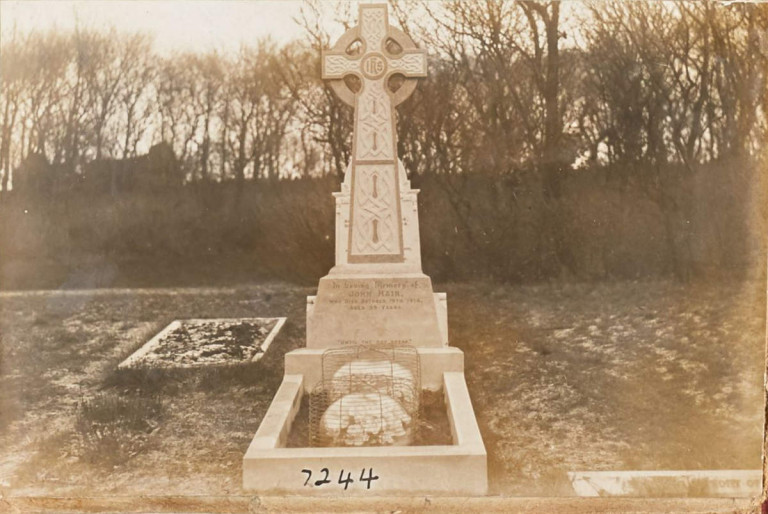
IN LOVING MEMORY OF
JOHN
BELOVED HUSBAND OF
ISABELLA BENNETT
DIED APRIL 28TH 1911
AGED 57 YEARS
ALSO OF THE ABOVE
ISABELLA BENNETT
DIED DEC 6TH, 1932
AGED 72 YEARS
GONE, BUT NOT FORGOTTEN
ALSO OF GUNNER JOHN BENNETT, BELOVED SON
OF THE ABOVE, KILLED IN ACTION IN FRANCE, AUG 12TH 1917
AGED 25 YEARS
CWGC: Regiment/Service: 216th Siege Bty. Royal Garrison Artillery
Cemetery: NOEUX-LES-MINES COMMUNAL CEMETERY Grave Reference: II. H. 19. Additional Information: Son of John and Isabella Bennett, of 10, Newby Terrace, Barrow-in-Furness.
John’s date of death is consistent with the Battle of Passchendaele, the Third Battle of Ypres. The middle name James only appears on the CWGC website.
From Ancestry we can find that the family lived at 46 Cheltenham Street in the 1911 Census. The Census took place on 2 April 1911, so father John was still alive. John Snr (57) was born in Hanley, Staffordshire, and worked as a brick & tile worker in a brickyard. Mother Isabella (55) (sic – this doesn’t match the age at death) was born in Redditch, Worcestershire. They had produced 8 children, 6 of whom were still alive. Four remained at home: William (24), single, tiler for a builder, born Oldhill, Staffs; John (19), gardner (sic) domestic, born Barrow; Walter (16), apprentice iron moulder, shipbuilding yard, born Barrow; May(11), at school, born Barrow.
Ten years previously, in the 1901 Census, the family lived at 6 Highfield Road, Barrow. Isabella was 42. Another son lived at home, Joseph Bennett (13). William (15) was an Errand Boy (Tea).
On John Bennett’s Attestation Paper, signed on 11 December 1915, he is described as a “Master Carter” or “Master Caster”. His papers give the information that he was mobilized on 10th July 1916 (presumably after training), and posted to 216 Sge Btty on 15 August. He died in the 2nd Field Ambulance on 12 August 1917. In March 1918 John Bennett’s effects were returned from R.G.A. Dover to Mrs Isabella Bennett via Mr. George A. Bigg, solicitor, of Bank Chambers, 92 Duke Street. The list reads: photos, cards, wallet, Religious books, wrist watch & strap, badge, two buttons, ring, disc, purse, match box cover, fountain pen.
A further record gives the address of all his direct relatives and their addresses, dated 13 May 1920:
Isabella Bennett, mother, 10 Newby Terrace BiF; brothers Alfred Bennett (45), 54 Harrogate St, BiF; William Bennett (39) 37 Highfield Rd, BiF; Joseph Bennett (37) 2 Gosport St, BiF; Walter Bennett (26) 33 Highfield Rd; and sister May Bennett (21), 10 Newby Terrace, BiF.
The role of the Siege Battery
Siege Batteries RGA were equipped with heavy howitzers, sending large calibre high explosive shells in high trajectory, plunging fire.The usual armaments were 6 inch, 8 inch and 9.2 inch howitzers, although some had huge railway- or road-mounted 12 inch howitzers. As British artillery tactics developed, the Siege Batteries were most often employed in destroying or neutralising the enemy artillery, as well as putting destructive fire down on strongpoints, dumps, store, roads and railways behind enemy lines.