Died
27th October 1914
Sources
Cumbria BMD
Ancestry
Barrow News
Barrow Herald and Furness Advertiser
Barrow Archives
Place
Walks
James Blezard
Fire Superintendent

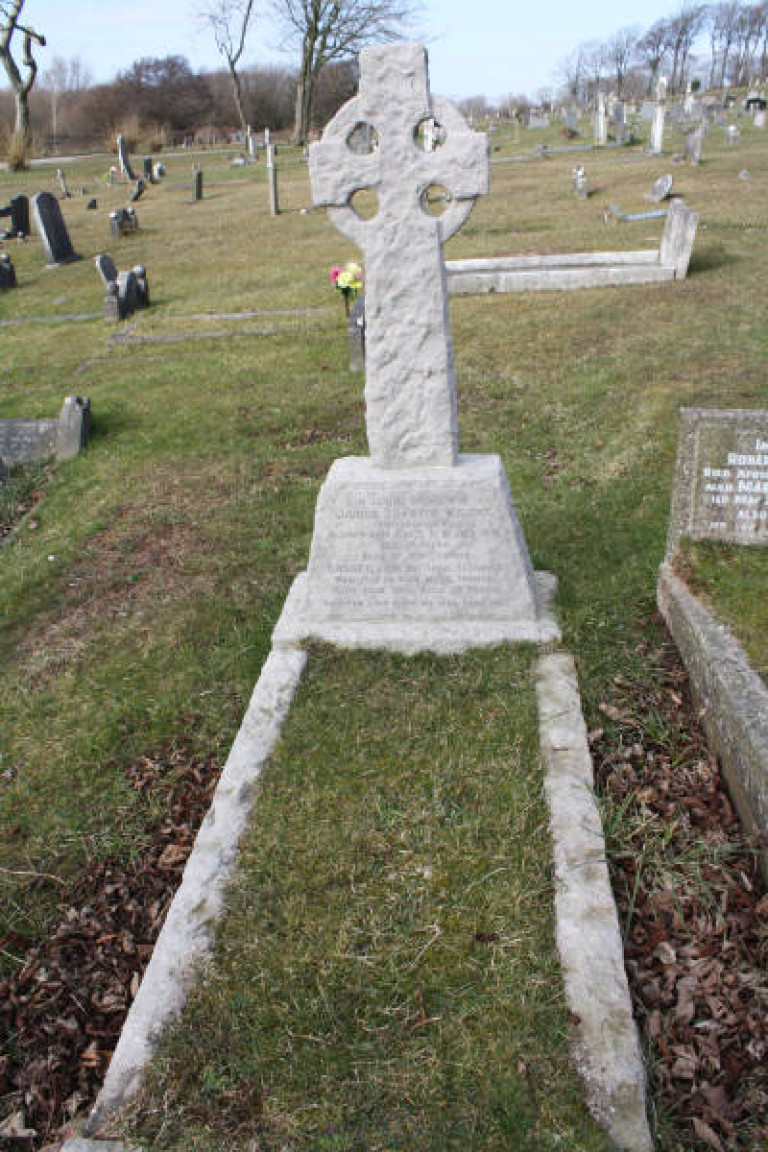
THIS STONE WAS ERECTED
BY PAST AND PRESENT MEMBERS OF
B.C. FIRE BRIGADE,
TO THE MEMORY OF
SUPT JAMES HOWSON BLEZARD
WHO DIED OCTOBER 27TH 1914,
AGED 53 YEARS

Photo from Barrow News 31 October 1914.
Barrow News 31 October 1914BARROW’S FIRE CHIEF
DEATH OF SUPERINTENDENT J. BLEZARD
We deeply regret to record the death of Mr. James Blezard, superintendent of the Barrow Fire Brigade, which occurred on Tuesday morning, after a lingering illness, at the age of 53 years. Mr. Blezard has had a long and honourable connection with the fire brigade service., having joined the local brigade as a call boy, and he attained one of the highest honours in the profession last July, when he was elected President of the Association of Professional Fire Brigade Officers on the occasion of the visit of that body to Barrow. Mr. Blezard was always willing to assist in any good work, and was actively interested for many years on promoting the hospital and other demonstrations. He was an excellent officer, and greatly esteemed and respected by his men, and a wide circle of friends in Barrow and other parts of the country. He leaves a widow and daughter for whom much sympathy will be felt in their sad bereavement.
Superintendent Blezard was a native of Barrow. He began his connection with the brigade as a “call-boy” on the 15th May 1876, and continued a volunteer member (sic) until his appointment as a permanent official. He was a most able and zealous officer, and in every way proved himself eminently qualified for his important position. For 33 years Mr. Blezard was connected with the fire service in one way or another, and this year he attained the honour of becoming President of the Association of Professional Fire Brigade Officers, which body held their annual conference at Barrow in July last. This position is one of the highest that a chief officer can achieve, and Mr. Blezard’s unanimous election was evidence of the respect and admiration he had won for himself amongst his fellow officers throughout the country. Mr. Blezard held several valuable tokens of public esteem, and also that of his fellow officers. On November 17th, 1911, he was presented with a handsome silver medal, with clasps, in recognition of his long service with the Corporation Fire Brigade, this honour being conferred on him by the association of which he became president. In 1903 also he was the recipient of a handsome gold watch and chain, together with a purse of sovereigns, these gifts being presented to him by members of the Corporation Fire Brigade and friends to mark his completion of 27 years of service, and as a mark of esteem. Mr. Blezard’s demise will be generally regretted. As a mark of respect flags were hoisted half-mast over the Town Hall, Masonic Club and Fire Station.
Ancestry tells us:
1871 Census
In the 1871 Census living at 14 Newland Street, Barrow-in-Furness, were John Blezard (44) Bill Poster, born Clapham, Yorkshire; Marie Annie Blezard (41) Wife, born Clapham, Yorkshire; and their children Sarah Jane Blezard (14) Scholar, born Gressingham, Lancs; John Edwin Blezard (11) Scholar, born Barrow-in-Furness; James Howson Blezard (9) Scholar, born Barrow; William Blezard (7) Scholar, born Barrow; Edward Blezard (4) Scholar, born Barrow; and Marie Annie Blezard (1) born Barrow.
1881 Census
In the 1881 Census they have moved to 19 Newland Street, Barrow. The household members are the same, except Sarah Jane Blezard has moved on. The children’s occupations are: John Edwin Blezard (21) House Carpenter; James Howson Blezard (19) Labourer (General); William Blezard (17) Blockbreaker; Edward Blezard (14) Scholar, as is Marie Anne (11).
1891 Census
By the 1891 Census James Blezard is married and living at 10 St Vincent Street, Barrow. James Blezard (29) is a Block and Spar Machinist, born Barrow; Wife Mary Blezard (30) is born in Lancaster; and Lodger Harry Edward Brooks (24) School Teacher, born Wells, Somersetshire.
1901 Census
In the 1901 Census James and family have moved back to Newland Street. At 33 Newland Street, Barrow, are James H. Blezard (transcribed Blizard) (39) Supt. Fire Brigade, born Barrow; Mary Blezard (40) born Lancaster; and Maria Blezard (8) no occupation recorded, born Barrow.
The Register of the United Grand Lodge of England Freemasons, Hindpool Lodge, has James Howson Blezard of 23 Newland Street, Supt. Fire Brigade, being initiated on November 19 1901. William Blezard, Foreman Contractor, of 18 Warwick Street, was initiated on June 6 1903. This is probably James’ brother.
1911 Census
They are still at 33 Newland Street in the 1911 Census. James Howson Blezard (49) Supt. Fire Brigade, Barrow Corporation, born Barrow, shares the house with Mary Blezard (50) married for 28 years with one child, born Lancaster; Marie Blezard (18) Single, Engine Tracer, born Barrow, and Elizabeth Jackson (22) Single, Neice (sic) Domestic Worker, born Barrow, make up the household.
The National Probate Calendar (Index of Wills and Administrations) 1914 has:
BLEZARD James Howson of The Fire Station Abbey-road Barrow-in-Furness Lancashire died 27 October 1914 Probate London 30 November to Mary Blezard widow. Effects £386 5s.
James Blezard had some interesting experiences in his life. The Barrow Herald and Furness Advertiser 5 March 1887 reported:
DESTRUCTIVE FIRE ON WALNEY ISLAND
SEA VIEW HOTEL COMPLETELY BURNT DOWN
GREAT DAMAGE TO PROPERTYThe first fire of any magnitude on the Isle of Walney took place at an early hour on Sunday morning at the Sea View Hotel, situate on Tummerhill, at the entrance to Biggar Bank, and resulted in the total destruction of the hotel and outbuildings, consisting of a stable, Dutch Barn, &c. The occupier, Mr. Edward Parkinson, also occupies the Victoria Hotel, Church-street, Barrow, where he resides, and although the Sea View Hotel has continued in daily occupation, it appears that for a considerable time the premises have not been used as a dwelling-house. Mr. Parkinson crossed over to Barrow on Saturday night about 8 o’clock, and the hotel was locked up as usual for the night. No one sleeping on the premises. The disaster which has occurred, although entailing considerable damage to the property, has therefore been fortunately unattended by loss of life. The policeman on duty states that he saw the place apparently all right at 11.30, when he passed. The fire was first discovered a little after two o’clock in the morning by Mrs. Willoughby, who occupies one of the four cottages at Tummerhill, and which are situate close to the hotel. She gave the alarm to her neighbours who, as may be imagined, turned out without much delay. Although their personal safety had so far secured the occupants of these cottages had considerable reason to feel apprehensive for the safety of their property in consequence of the dangerous proximity of their homes to the hotel, of which by this time the fire had taken a firm hold. A good breeze from the South-East was blowing at the time. One of the cottages is occupied by Mr. James Blezard, who for the past ten years and until very recently was a member of the Barrow Fire Brigade. On going up to the hotel Blezard saw a light through the side window and also noticed that the stable and Dutch barn adjoining were burning. All three were on fire when he first saw them about ten minutes past two. Thereupon Blezard went off as fast as he possibly could for the Fire Brigade. On reaching the ferry, however, he found he could not get any further, and after an exciting run was obliged to come to a dead halt. The steam ferry according to usual practice, was lying on the Barrow side, and Blezard whistled and shouted across the channel, and at the same time aroused the captain of the steam ferry on the Walney side (Peter Bartholomew). The latter told him that it was no use whistling in that way as the man on the ferry would not come for him (Blezard) or anyone else. The man on the steam ferry heard the shouting and sang out that he would not come. There was no boat to be had on the Walney side, and Blezard kept shouting “Ferry ahoy!” &c., with great persistence, which attracted a number of persons to the Barrow side of the ferry, amongst whom were two butchers who state that they heard the cries at Anson Street, Hindpool. During this deplorable waste of time, Blezard woke up Mr. W. R. Ormandy, and got his whistle to attract further attention. Whilst Blezard was away, the other cottagers, Willoughby, Jackson and Walmsley, aided by P.C. Cole (16) set about saving what they could from destruction. A waggonette was drawn out to a place of safety, and some chairs and a table were rescued, but beyond this and the liberation of some fowls from the stable, the work of salvage, as far as the buildings were concerned, could not be pursued further owing to the amazing rapidity with which the flames spread. The next thing to be done was to save the stack of hay near the Dutch barn, and for this purpose they lined the side of the stack with wet boards, which proved very effectual. These operations continued until the arrival of the Fire Brigade.
About a quarter to three on Sunday morning several constables on duty in the town noticed a vivid glare in the sky in the direction of Walney Island. The new tower of the Municipal Building was ascended, and from this height the fire could be seen very plainly, although whilst ascertaining beyond doubt that the conflagration was taking place in the locality of Tummerhill, the precise building on fire could not be definitely discerned. Two constables were despatched to the Walney Ferry, and first of all they boarded the steam ferry and told the man in charge that there was a fire on Walney, and that the fire brigade would be coming directly. They broke into a boat house, took a small boat, and rowed over to the Walney side. There they found Blezard, who had been waiting on the Walney side for an hour and twenty minutes, using his most strenuous efforts to obtain assistance. Blezard then took the policemen’s boat and crossed the ferry to Barrow. About 3.30 a.m. the police informed the Superintendent of the fire brigade that there was a fire, but that they could not say where, or what. Soon after James Blezard arrived from Walney at the Fire Brigade station, bringing definite information of the whereabouts and nature of the fire, Supt. Gabbatt then summoned his men, 23 of whom responded to the call, and with all despatch the manual engine was turned out, and the brigade proceeded in hot haste to the ferry, where, however, their further progress was impeded. A little before four o’clock, when the police and others came down, the ferryman brought the steam ferry to within a few yards of the side, and Supt. Gabbatt went down to him. The man in charge of the steam ferry refused to convey either the firemen, policemen, or fire engine across the channel. His orders were, he said, not to move the steam ferry until 5.30 in the morning, and he stated that he could not do it for anybody except Captain Barnett, the harbour-master. When Supt. Gabbatt found that the man on board the steam ferry would not convey them across, he told his men to get some small boats and convey themselves over, taking four lines of hose and stand-pipe, there being, as was known, a hydrant in the immediate vicinity of the burning building. This they did, and on arrival at the fire it was found that the stabling, coach-house, and that the roof of the hotel and flooring were completely burnt out. The members of the brigade played upon the fire with two jets. Near to the hotel stood two stacks of hay, one of which was on fire, and all that the brigade could do was to save one of the stacks of hay and a small building at the end of the hotel used as a kitchen. They were successful in saving both the stack and the kitchen. They had to remove a portion of the burning stack and spread it out in an adjoining field, and so extinguish the fire, and prevent it doing further mischief.Some time between four and five o’clock, Captain Latham, of the steam ferry, took upon himself to convey the fire-engine across the channel, but, as was seen on being run across the island to the scene of the fire, this was much too late to be of any service.
The hotel and stabling are in complete ruins, nothing but the bare walls of the hotel being left standing. The hotel was owned by the Kendal Banking Co., and leased by the occupier, Mr. Edward Parkinson. The stock and buildings are insured in the Lancashire and Manchester Fire Offices.
The fire kept smouldering during the whole of Sunday, and many thousands of persons visited the scene in the course of the day. An unusual number of waggonettes and carriages were kept busily employed during the day conveying passengers to and fro between the steam ferry and the scene of the fire.
There is no doubt that if the fire brigade and fire engine could have come at first they would have saved the best part of the hotel. We would throw out the suggestion, in order to avoid a recurrence of any similar catastrophe on the island, that a hose-reel supplied with hose and stand pipe be stationed on Walney. It is believed that this inexpensive form of branch fire station would be of great service, as there are good hydrants on the island, and a sufficient number of inhabitants available to be formed into an efficient Walney Fire Brigade. Perhaps it would also be as well in future if a boat were kept on the Walney side, in readiness to convey urgent messages across, as the steam ferry, when lying off, is always lying on the Barrow side.

Photo courtesy of Barrow Archives BDP 41.
On site of 115 Ocean Road.
The following version of the affair is given from another source:
No detention of the fire engine was caused by the steam ferry. At the time the engine reached the gates the steam ferry was at the beach on the Barrow side, with steam up. The officer in charge of the fire engine on going to the steam ferry found there was no captain. He accordingly roused Captain Latham, who at once proceeded to convey them across. The horses were taken out and led on board the ferry, and the men eased the engine down the slope and placed it likewise on board. The time when the steam ferry landed the engine on the Walney side was 4.15 a.m. It appears that neither the Superintendent of the Fire Brigade (Mr. Gabbatt) nor the police, had once thought of rousing the captain of the ferry out, but had satisfied themselves by merely going to the fireman on board the ferry. The fireman’s instructions are never to take people across without the captain, as he cannot be expected to attend the engines and the navigation of the ferry. One of the ferry captains lives on the Barrow side adjoining the gates, the other in a similar position on the Walney side.